

Can paying for a luxury car rental with a corporate card be as smooth as the drive itself? It can when company approval, cardholder responsibilities, and payment arrangements are clear before the booking is finalized. A premium vehicle can suit an executive trip or client occasion, but an unexpected authorization or missing receipt can create extra work for finance.
Treat the booking as a documented process, not just a card transaction. A completed payment, a temporary authorization, and a possible deposit can affect the card differently. Understand which applies, then keep the agreement and payment records for reconciliation.
Whether you’re considering a Porsche 911 GT3 RS, a Rolls-Royce Cullinan Black Badge, or another luxury rental from Delta Rentals Dubai, prepare the company and card details in advance. This guide explains how to align approval, renter information, payment expectations, and expense records.
Key Takeaways
- Paying for a luxury car rental with a corporate card starts with company approval and clear roles for the cardholder and authorized renter.
- Understand the difference between a completed charge, a temporary authorization, and a possible deposit by reviewing the rental agreement.
- Compare corporate and personal card use to see how each affects expense records and possible reimbursement.
- Prepare renter and cardholder details before arranging the booking, then keep the rental documents together for reconciliation.
- Align business requirements and rental details before an executive trip or occasion.
Can You Pay for a Luxury Car Rental with a Corporate Card?
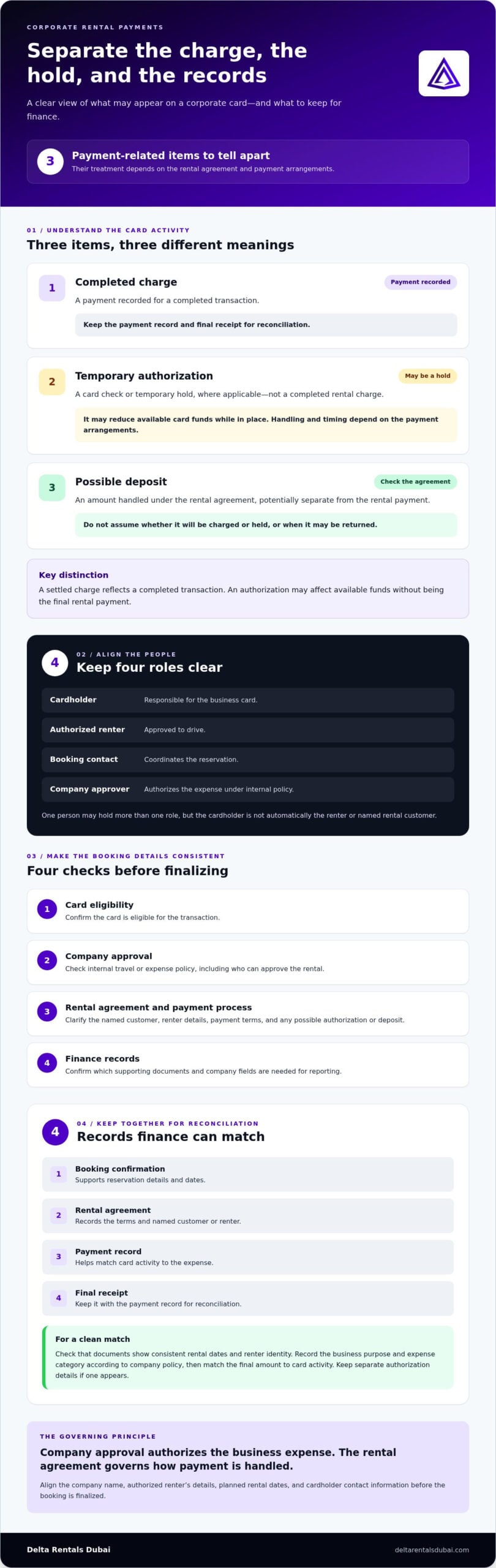
Yes, paying for a luxury car rental with a corporate card may be possible, depending on the rental agreement and payment arrangements. A corporate-card payment is a company-authorized expense charged to an eligible business card. Company approval alone does not determine how the rental payment is handled.
Keep four questions separate: Is the card eligible for the transaction? Has the company approved the rental? What payment process does the rental agreement require? What records does finance need? Each question has a different answer and owner. A car rental involves an agreement with the rental provider, so make sure the named customer and payment details are clear before finalizing the booking.
The people involved may have different roles. The cardholder is responsible for the business card; the authorized renter is approved to drive; the booking contact coordinates the reservation; and the company approver authorizes the expense under internal policy. One person may hold more than one role, but don’t assume the cardholder is automatically the renter or named rental customer.
What does paying with a company card usually involve?
Start with your company’s travel or expense policy. It determines whether the rental qualifies as business spending, who can approve it, and which supporting documents are needed. The rental agreement separately governs the payment process and customer details. Align the cardholder, renter, booking contact, and approver early, especially if one person is arranging the rental and another will drive.
Which details should you clarify before booking?
Prepare the company name, authorized renter’s details, planned rental dates, and cardholder’s contact information. Establish how the business should appear in the rental documentation and which records finance needs. For an executive trip or client occasion, a Porsche 911 GT3 RS or Rolls-Royce Cullinan Black Badge can make a polished impression. Clear booking details help keep the arrangements organized.
- Confirm internal approval and who is authorized to drive.
- Align the named rental customer, cardholder, and company details.
- Understand the payment process and retain the rental records required for reporting.
Company approval authorizes the business expense; the rental agreement governs how payment is handled.
How Corporate-Card Payments, Authorizations, and Rental Records Work
Before paying for a luxury car rental with a corporate card, distinguish a completed charge from an amount that may be temporarily held. These entries can appear differently in the card account and affect available funds in different ways. The rental agreement and payment arrangements determine what applies and how a transaction is handled.
| Item | What it means | What to keep in mind |
|---|---|---|
| Completed charge | A payment recorded for a completed transaction. | Retain the payment record and final receipt for reconciliation. |
| Temporary authorization | A payment-card check or hold, where applicable, rather than a completed charge. | It may reduce available card funds while in place. Handling and timing depend on the payment arrangements. |
| Possible deposit | An amount handled under the rental agreement, potentially separate from the rental payment. | Check the agreement for how it is treated. Don’t assume whether it will be charged or held, or when it may be returned. |
Payment versus authorization: what is the difference?
A settled charge reflects a completed transaction. An authorization is a card check or temporary hold, where used; it can affect available funds without being a completed rental charge. A deposit is another possibility governed by the rental agreement. Review the payment terms and factor any authorization into the card’s available balance. Don’t mistake a temporary hold for the final amount paid.
What rental records help finance teams reconcile the expense?
Keep the booking confirmation, rental agreement, relevant payment record, and final receipt together. Check that the documents show consistent rental dates and renter identity. Record the business purpose and expense category according to company policy, then match the final amount to the card activity. If an authorization appears separately, retain its transaction details so finance can distinguish it from the completed payment.
- Booking confirmation: supports the reservation details and dates.
- Rental agreement: records the terms and named customer or renter.
- Payment record and final receipt: help match the transaction to the expense.
Confirm required company fields, invoice format, and tax treatment with your finance team rather than assuming one document format meets every need. The IRS guide to business-use portion of the expenses covers U.S. federal tax guidance, not UAE tax rules, so use it only if relevant to your reporting context. Keep the records required by your company and organize the rental details in a booking conversation with Delta Rentals Dubai.
Personal Card vs. Corporate Card for a Luxury Rental
The right payment route depends on company policy, the booking terms, and who is responsible for settling the expense. A corporate card can put the rental payment directly into company expense records. An employee might use a personal card for a business trip if the organization allows it, but may need to claim reimbursement separately. Neither option determines company approval or the deposit arrangement.
| Consideration | Corporate card | Personal card |
|---|---|---|
| Payer | The company cardholder pays using a business payment card. | The employee pays from a personal account. |
| Approval route | Follow the company’s approval process and card-use policy. | Confirm the company permits personal payment and reimbursement. |
| Expense ownership | The charge is recorded on the company card, while its business purpose still needs documenting. | The expense may qualify as business spending, but the employee initially pays it. |
| Recordkeeping | Match the card transaction with the booking and rental records. | Keep rental documents and proof of payment for the reimbursement claim. |
| Reimbursement | Usually no employee reimbursement claim for the card payment itself, subject to company processes. | A claim may be needed if company policy allows repayment. |
When can a corporate card make the process simpler?
If the company approves the trip and the booking aligns with its policy, paying for a luxury car rental with a corporate card can connect the rental charge directly to business travel records. This may avoid reconciling an employee’s personal payment against a separate reimbursement claim. You still need to document the business purpose and retain the rental records.
In short: a company-card transaction matched to the approved trip and rental documents gives finance a centralized record, but it does not guarantee savings or automatic approval.
When might a personal card create extra administration?
A personal card separates the initial payment from the company account. If reimbursement is permitted, the employee may need to submit the booking details, proof of payment, rental receipt, and business purpose under the organization’s process. A rental can be a company expense even when an employee pays personally, but the payment method does not establish that the expense is approved or reimbursable.
Before choosing either route, follow your organization’s approval and reimbursement procedures. Make sure the company, cardholder, renter, and named rental customer details align with those procedures and the rental agreement. Payment handling follows the rental terms.
How to Arrange a Luxury Rental with a Corporate Card
Work through the process in order: secure internal approval, prepare renter and cardholder information, coordinate booking and payment details, then reconcile the expense after the rental. This creates a clear record from business purpose to final payment without assuming a particular deposit arrangement.
What should you prepare before requesting the booking?
Gather the business purpose, intended rental period, preferred vehicle, authorized renter’s details, and cardholder contact information before starting the booking conversation. Check that the expense fits company policy and that the cardholder is authorized to use the business card. Identify the records finance needs and the expense code to use.
- Get company approval. Record who approved the rental, its business purpose, and any internal spending or expense-code requirements.
- Align the people and details. Prepare the cardholder and authorized renter information. Identify who will arrange the booking and who will drive.
- Coordinate the booking. Share the planned dates, vehicle preference, and business details. Clarify how the rental customer and company should appear in the documentation.
- Review the rental and payment terms. Before finalizing, understand the agreement, payment process, and whether any authorization or deposit applies. Keep the confirmed terms with your booking records.
- Organize handover documents. Keep the booking confirmation and rental agreement with company travel records. Note payment or authorization information and ensure the renter has the documents required by the rental terms.
- Reconcile after the rental. Match the final receipt and payment record to the approved trip, dates, renter, business purpose, and expense code. Keep relevant records together for finance.
What should you organize at payment and handover?
Make the handover a document check, not a scramble. The renter should have the documents required under the rental terms, while the booking contact keeps the agreement and confirmation. Record whether the transaction shows a completed payment or an authorization, if one is used. Don’t label a temporary hold as a final charge; compare the record with the agreement and later card activity.
Pre-rental checklist
- Company approval, business purpose, and expense code
- Cardholder contact and authorized renter details
- Named drivers reflected in the booking details as applicable
- Booking confirmation, rental agreement, and payment information
- Finance requirements for the final receipt and reconciliation
Clear preparation makes paying for a luxury car rental with a corporate card easier to document, while the rental terms govern the booking and payment process. For an executive journey or business occasion, review your luxury rental details with Delta Rentals Dubai.
Arrange a Delta Rentals Dubai Booking with Clear Corporate-Card Details
A premium vehicle can add a polished touch to business travel, executive meetings, and client occasions. Delta Rentals Dubai’s fleet includes high-performance options such as the Porsche 911 GT3 RS and McLaren Artura, alongside the ultra-luxury Rolls-Royce Cullinan Black Badge. Choose based on the occasion, the impression you want to make, and the experience that suits the trip.
Match the vehicle experience to the business occasion
A high-performance car may suit a business visit where the drive is part of the experience. For executive transport or a more spacious luxury SUV, consider the Cullinan Black Badge. Compare vehicle experiences in this luxury car rental guide, then match your preference to the trip’s purpose and practical needs.
Make the booking conversation efficient
Before discussing paying for a luxury car rental with a corporate card, gather the details that help shape the booking:
- Intended rental dates and preferred vehicle
- Authorized renter’s details and the cardholder’s contact information
- Business purpose and company requirements for rental records
- Corporate-card requirements to address in the payment discussion
Share these details together so the renter information, business requirements, and rental arrangements are clear. The rental agreement sets out the applicable terms. State that you plan to use a company card and establish how payment and documentation will be handled before finalizing the arrangement. Company approval does not determine the payment or deposit terms.
Preparing these details helps coordinate a premium rental around an executive schedule while keeping company records in view. For a direct conversation about your intended vehicle and corporate-card arrangements, discuss your luxury rental booking with Delta Rentals Dubai.
Make Your Next Executive Rental Easier to Coordinate
A smooth corporate-card rental starts before the booking: secure company approval, prepare the cardholder and authorized renter details, and understand the rental agreement’s payment terms. Distinguish completed charges from temporary authorizations, then retain the confirmation, agreement, payment record, and receipt for expense reconciliation.
Paying for a luxury car rental with a corporate card is easier to document when the business purpose, booking details, and records are aligned. Delta Rentals Dubai specializes in luxury and high-performance vehicle rentals, including the Porsche 911 GT3 RS and Rolls-Royce Cullinan Black Badge for business travel and executive occasions.
Share your intended dates, preferred vehicle, renter details, and corporate-card requirements to begin coordinating your rental. Discuss your luxury rental booking with Delta Rentals Dubai.
Frequently Asked Questions
Can I pay for a luxury car rental with a corporate card?
Yes, paying for a luxury car rental with a corporate card may be possible, depending on the rental provider’s payment arrangements and the rental agreement. Company approval is separate: internal authorization does not determine how the provider handles payment. Communicate the corporate-card requirement during the booking conversation and keep the agreed terms and payment records for expense processing.
Does the corporate cardholder need to be the person driving the rental car?
Not necessarily. The cardholder, booking contact, and authorized renter can have different roles, but the rental agreement sets the requirements for a particular booking. Align company approval with the named renter and proposed payment arrangement. Don’t assume the cardholder must drive or that another person can provide or present the card. Clear roles help avoid confusion during booking and handover.
Is a security deposit the same as a charge on a corporate card?
No. A completed payment is a charge recorded for a transaction, while a card authorization may be a temporary hold rather than a settled charge. A deposit may be handled separately, depending on the rental terms. The agreement determines whether an authorization or deposit applies, how it is processed, and when a hold is released. Keep the transaction details with the rental documents for finance.
What documents should I keep when paying for a rental with a company card?
Keep the booking confirmation, rental agreement, payment record, and final receipt. Finance may also need the business purpose, rental dates, authorized renter’s details, and expense category to reconcile the transaction. Follow your company’s documentation process, since internal requirements vary. Confirm required invoice fields and tax information with your finance team before submitting the expense.
Can I use a corporate card if someone else made the booking?
The provider’s payment process and rental terms govern how the arrangement works. The booking contact, cardholder, and authorized renter may be different people, so communicate each person’s role before payment and align the arrangement with company approval. Keep the final confirmation and payment record together to help match the transaction to the rental.
How do I record a luxury car rental as a business expense?
Follow your company’s expense policy, document the business purpose and rental dates, and retain the booking confirmation, agreement, payment record, and receipt. Include the authorized renter and expense category if your finance process requires them. A corporate-card payment alone does not determine whether a rental qualifies as a business expense or tax deduction, so don’t treat it as automatic approval.
What should I check before booking a luxury rental on a corporate card?
Confirm company approval, prepare the authorized renter’s details, and review the rental agreement and payment arrangements. Clarify how any card authorization or deposit is described and identify the documentation finance needs. Keep copies of the confirmed terms and transaction records. Preparing these details helps reduce surprises and supports reconciliation.