

A booking guest list isn’t automatically a compliant passenger manifest. For a UAE private day charter, the luxury yacht passenger manifest legal requirements for private day charters depend on details such as the vessel’s flag, charter status and operating waters. A generic checklist may not cover the requirements for a specific voyage.
To prepare, first distinguish the passenger record from the booking list, then confirm which details and documents are needed for the charter. A manifest serves a different purpose from a reservation, and identity details need careful handling.
This UAE-focused guide explains what to verify for the vessel and route, which passenger records may be relevant, and how to distinguish legal obligations from practical precautions. It also considers the UAE maritime framework, including Federal Decree-Law No. 43 of 2023. The law’s application and related procedures must be checked against the charter’s circumstances and current authority requirements. Use the checklist to organize passenger information and prepare for departure.
Key Takeaways
- Start with the vessel’s flag, charter status and operating waters to identify which rules and authority requirements need verification.
- Keep the booking guest list distinct from any passenger record required for the charter. They may serve different purposes.
- Use the field guide below to sort passenger details into legally required, operationally useful and unverified information before collecting them.
- The luxury yacht passenger manifest legal requirements for private day charters aren’t one universal checklist. Verify what applies to the specific UAE charter.
- Prepare passenger details carefully, review the final record for accuracy and handle identity and contact information responsibly.
What a yacht passenger manifest means for a private day charter
A yacht passenger manifest is a record identifying the people aboard a vessel. For a private day charter, it can clarify who is travelling and provide a passenger record when required under the rules for that vessel and voyage. It isn’t automatically the same as a booking list, and a general template can’t replace checking the rules that apply.
The term has a broader transport meaning: a passenger manifest records passengers carried on a journey. The required form, details, submission method and responsible party can vary. Before relying on a template in the UAE, confirm the requirements for the vessel, its flag, the charter arrangement and the waters it will operate in.
Passenger manifest versus guest list: what is the difference?
A booking guest list can help organize reservations, names and group arrangements. A passenger manifest, where required, is a formal record of the people aboard and may require details beyond those collected to manage a booking. A name on a reservation alone may not meet identification or reporting requirements.
Forms aren’t universal. Identify who is responsible for the voyage, then establish which passenger record applies. Confirm what it must contain and whether it needs to be submitted or retained. Don’t collect extra personal details simply because they appear on another charter’s form.
Why private day-charter status matters
“Private” describes the arrangement from the customer’s perspective, but it doesn’t by itself determine how maritime rules classify the vessel’s activity. A privately booked trip may still involve a commercial operator. Applicable duties can depend on the charter’s legal status, the vessel and the route, so treat classification as something to verify, not an exemption to assume.
For a UAE charter, check the applicable maritime framework, including whether Federal Decree-Law No. 43 of 2023 applies to the specific legal point. Identify the maritime authority responsible for the vessel or operation as well. Requirements may differ according to flag and operating waters. Establish the luxury yacht passenger manifest legal requirements for private day charters for the actual voyage rather than inferring them from a general online form.
Before collecting details, establish who prepares or submits the record, which fields are required and how passenger information should be handled. This gives guests clear instructions while leaving rule verification with the responsible operator.
Which UAE rules and authorities should be checked before departure?
Start with the operation, not a generic form. In the UAE, the relevant authority and requirements can depend on the vessel’s flag and registration, its licensing and charter status, and the waters it will enter. Identify the authority responsible for the specific operation, then check its current guidance before treating a particular manifest field, submission method or deadline as legally required.
Legal starting point: Federal Decree-Law No. 43 of 2023 is part of the UAE maritime legal framework. Verify its relevance to a specific manifest obligation, along with any applicable implementing rules, against current official sources. Citing the law alone doesn’t establish a particular passenger-record duty.
How flag, registration, and charter status shape the checklist
A vessel’s flag and registration can affect which rules govern its operation and what information authorities may require. The charter arrangement matters too. A private-use booking and a licensed commercial passenger operation may be treated differently, but the word “private” alone doesn’t establish an exemption. Confirm the vessel’s status and the activity it is authorized to conduct.
Establish which emirate-level maritime authority has remit over the operation, and check its current name and responsibilities. Federal maritime oversight also involves the UAE Ministry of Energy and Infrastructure. The authority to consult depends on the vessel and operating waters, so don’t assume one agency’s guidance applies to every voyage.
Which legal sources deserve primary-source verification?
Use current official legislation and implementing rules to support legal claims. Then check the responsible maritime authority’s latest guidance, forms and instructions for passenger records. Confirm whether a record must be submitted or retained, who is responsible, and what retention rules apply. Another operator’s form can’t establish these details for your charter.
Separate confirmed facts from open questions. Treat the federal law as a source to review, but verify how it applies to the charter’s manifest duties. Do the same for each claimed passenger field, submission channel, timing or retention period. A note such as “verify against current authority guidance for this vessel and route” is more responsible than presenting an unconfirmed interpretation as a universal rule.
Make regulatory checks part of the wider charter-planning conversation. You can discuss your charter plans while keeping legal verification with the responsible operator and authority.
What passenger details belong on a private yacht charter manifest?
There’s no safe universal field list for every UAE charter. Required passenger details depend on the rules for the vessel, its charter status and the operating waters. Treat names and identity-document details as examples to verify against current official requirements, not as a definitive legal checklist. Passenger counts should also match the applicable authority’s requirements and the vessel’s relevant records.
Use the guide below to separate confirmed obligations from useful planning information and fields that still need verification. Don’t collect extra personal information simply because it appears on another charter form.
| Field category | Examples | How to handle it |
|---|---|---|
| Legally required, if verified | Passenger names or identity-document particulars, such as document type or number | Confirm each field against current authority rules for this vessel and voyage. These examples aren’t universally mandatory. |
| Operationally useful | Passenger count; an emergency contact or accessibility note, where relevant | Check what the operator needs for safe, coordinated preparation. Treat contacts and accessibility information as conditional, not automatic legal fields. |
| Unverified | Any additional personal detail, document field or retention requirement without a clear source | Leave it out until its legal or operational purpose is established. |
Required details versus useful operational information
Confirm which particulars the applicable authority requires and whether they must be submitted, carried or retained. Names and identification data may be relevant, but verify the exact fields and process against primary sources. Keep the passenger count consistent across the applicable passenger record and vessel documentation. If a guest’s details change, ask the responsible operator to establish whether the record also needs updating.
Operational notes can help the crew prepare, but they aren’t automatically regulatory fields. Gather an emergency contact or accessibility information only when there’s a defined reason, and explain how the information will be used.
Passenger-data privacy and secure handling
Identity and contact details need careful handling. Collect only what’s needed for a stated legal or operational purpose, limit access to people who need the information, and store records securely. Remove or delete information when it’s no longer needed, subject to any verified retention duty.
Check how UAE personal-data protection rules apply to the operator and passenger record. Don’t promise a specific retention period or consent process without verifying the governing requirement. Applying luxury yacht passenger manifest legal requirements for private day charters responsibly means preparing an accurate record while protecting passenger information.
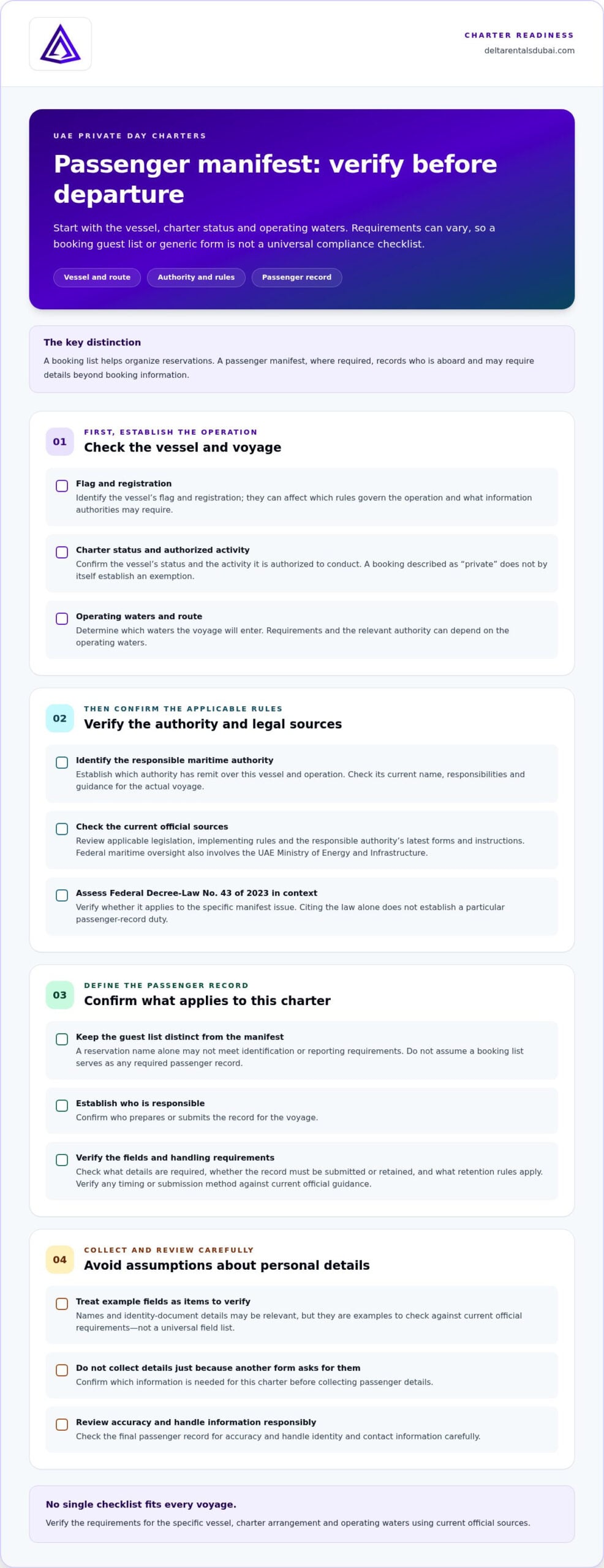
Pre-departure checklist: prepare and verify the manifest
First confirm who is responsible for preparing and submitting any required passenger record. The charter operator, vessel representative or another designated party may handle different parts of the process. Establish responsibility for this voyage before collecting information, then verify the procedure with the relevant authority.
- Confirm the voyage details. Record the vessel’s flag and registration, the charter’s status, and the waters planned for the trip. These details help identify which authority and rules apply.
- Identify the responsible authority. Confirm its current remit for this vessel and operation. Use official guidance rather than a form prepared for a different vessel or route.
- Verify the record requirements. Establish whether a passenger record is required, who must prepare or submit it, and which fields are necessary. Check submission timing, format and retention requirements against current authority guidance.
- Collect only necessary information. Request details with a defined legal or operational purpose. Treat names and identity-document particulars as examples to verify, not a universal mandatory list. Handle passenger information securely.
- Reconcile the final group. Compare the record with the people expected to board. Review names and passenger count with the responsible charter operator, and follow the verified process for correcting a mismatch.
- Complete a final review. Check for omissions, duplicate entries and inconsistencies before the record is submitted or handled as required. Confirm who will keep it and how it will be protected.
Changes, corrections, and records after boarding
Plans can change. A late addition or cancellation may affect the passenger record, so don’t assume a verbal update is enough. Follow the responsible operator’s verified procedure and confirm whether the authority requires a revised submission or another action. Steps and timing can vary, so don’t assume a universal deadline or correction format.
Document changes clearly for operational accuracy while checking what the governing process requires. Before archiving the final record, verify reporting, storage, access and retention rules. Keep only information needed for the stated purpose, subject to any applicable legal retention duty.
Careful preparation supports a smoother charter experience, but a checklist can’t replace confirmation for the specific voyage. Apply the luxury yacht passenger manifest legal requirements for private day charters responsibly, then discuss planning a private yacht charter.
Plan a private yacht charter with manifest readiness in mind
A well-prepared charter starts with clear coordination. Guests can provide accurate information through the operator’s designated process, while the responsible operator verifies which passenger record applies and how it must be handled. This keeps preparation practical without asking passengers to interpret maritime rules on their own.
What guests can prepare before sharing their details
Wait for the operator’s instructions on which details are needed and how to provide them. Enter requested information carefully, using the relevant identity document as a reference when asked. If you spot an error or your plans change, tell the responsible charter contact promptly so they can follow the applicable correction process.
Share only information requested for a clear legal or operational purpose. Avoid sending identity documents or other sensitive information through unsecured channels, and use the designated method provided for the booking. If you’re unsure why a detail is needed, seek clarification from the responsible charter contact before sharing anything additional.
A smooth next step for charter planning
Before departure, the responsible operator should bring four checks together:
- Vessel: Confirm the vessel’s flag, registration and relevant operating status.
- Jurisdiction: Identify the authority and current rules that apply to the charter and operating waters.
- Passenger record: Verify whether a record is required, who prepares or submits it, and which details, format and timing apply.
- Privacy: Confirm how passenger information is accessed, stored and retained under applicable requirements.
Guests can support the process by sharing requested details accurately and flagging changes early. The operator remains responsible for verifying requirements for the specific voyage. This is the practical way to approach the luxury yacht passenger manifest legal requirements for private day charters: prepare thoughtfully, protect personal information and don’t treat a general checklist as a substitute for current, case-specific verification.
Delta Rentals Dubai offers luxury yacht rental experiences in the UAE, where attentive planning brings the guest experience and voyage preparation together. To discuss a private yacht charter, get in touch about your plans.
Make your charter preparations feel effortless
A confident departure starts with the right checks, not a one-size-fits-all form. The luxury yacht passenger manifest legal requirements for private day charters depend on the vessel, charter arrangement and operating waters, so verify the rules for the specific voyage. Keep the passenger record distinct from the booking list, and share only accurate information needed for a defined purpose.
Before departure, confirm who is responsible for the passenger record, which authority’s requirements apply, and how details should be submitted, protected and retained. Guests can help by providing requested information accurately and promptly reporting changes. Clear coordination makes preparation smoother while keeping practical steps distinct from legal obligations.
Delta Rentals Dubai offers luxury yacht rental experiences in the UAE, alongside premium vehicles and curated luxury experiences. To plan your charter, discuss your luxury yacht charter plans with Delta Rentals Dubai. Prepare thoughtfully, verify what applies and look forward to your time on the water.
Frequently Asked Questions
Is a passenger manifest legally required for every private yacht day charter in the UAE?
There isn’t a universal yes-or-no answer for every charter. Requirements may depend on the vessel’s flag and registration, the charter’s status and the waters it operates in. A prudent passenger record isn’t automatically the same as a legally required submission. Confirm the current rule with the authority responsible for that operation, including whether a record must be submitted, retained or both.
What information must be included on a yacht passenger manifest?
Required fields depend on the rules governing the specific vessel and operation. Names, identity-document details and passenger counts may be relevant, but don’t treat them as universally mandatory without current official guidance. Emergency contacts may be useful operationally, but aren’t automatically legal fields. The responsible operator should verify the format and submission process, while collecting only accurate information needed for a defined legal or operational purpose.
Do private yacht charters have different manifest rules from commercial charters?
They may be treated differently, but calling a booking “private” doesn’t establish an exemption. The vessel’s registration, flag, licensing, actual charter status and operating waters can all affect which rules apply. Identify how the operation is classified, then verify current requirements with the responsible UAE maritime authority. Don’t rely on a generic checklist or assume another charter’s process applies to your voyage.
Who is responsible for preparing and submitting the passenger manifest?
Responsibility depends on the applicable rules and charter arrangement, so there isn’t one role that applies to every voyage. The vessel operator or another designated party may manage the record and any submission. Guests should provide requested details accurately and report corrections or changes promptly. Before departure, clarify with the responsible charter contact who manages the record and how updates or submissions are handled.
Can passenger details be collected before the day of the yacht charter?
Yes, details may be collected in advance to support planning, but early collection alone doesn’t prove that a manifest obligation has been met. Verify the required timing and submission method for the specific operation. Collect only information with a clear legal or operational purpose, using the designated process. Before departure, the final passenger record should reflect the people actually boarding, subject to the applicable authority’s requirements.
How should passenger information be protected on a yacht manifest?
Limit access to people who need the information, use secure methods to transfer and store it, and keep it only as long as a valid purpose or applicable rule requires. UAE personal-data protection requirements may apply, but their scope depends on the circumstances and responsible operator. Verify relevant obligations, including retention or consent requirements, rather than promising a fixed period or process without confirmation.
What happens if a passenger is added or replaced on the day of departure?
Tell the responsible charter operator promptly so the passenger record can be reviewed under the applicable procedure. Don’t assume a late change is automatically permitted or prohibited, or that a verbal update is sufficient. The operator should verify whether corrected details must be submitted before departure and how to document the change. Follow the confirmed process and timing for that vessel and voyage, rather than relying on a general rule.