
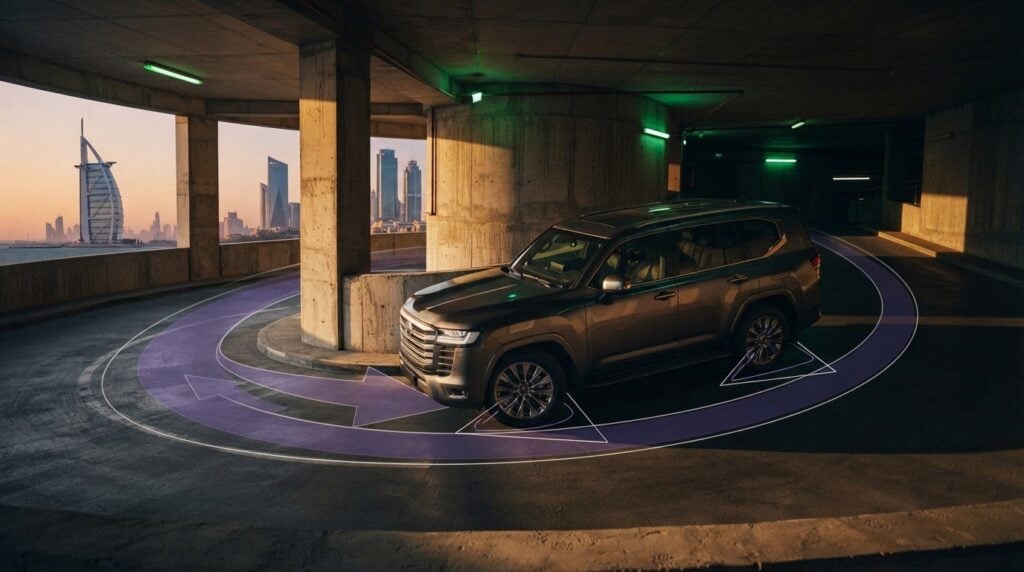
What if a longer vehicle could turn more tightly without needing extra space? That’s the appeal behind the four wheel steering turning radius benefits in multi story parking garages: at low speeds, some systems turn the rear wheels opposite to the front, helping the vehicle follow a tighter path. If narrow ramps and sharp corners make you second-guess a vehicle’s size, the technology may make manoeuvres feel more manageable.
But a smaller turning circle doesn’t make every garage easy. Vehicle width and length, wheelbase, overhangs, visibility and the garage’s ramps and aisles all affect how much room a turn needs. A published turning figure is useful, but it can’t tell you whether a particular car will clear a pillar or negotiate a tight spiral ramp comfortably.
This guide explains how rear-wheel steering works at parking speeds, where it can help and where its limits remain. You’ll also learn which vehicle and garage dimensions to consider together, so you can assess manoeuvrability more confidently and choose a vehicle that suits the spaces you expect to use.
Key Takeaways
- Learn how rear-wheel steering can help a vehicle turn through tight garage corners and approach parking bays with fewer corrections in some layouts.
- Understand the four wheel steering turning radius benefits in multi story parking garages, and why a tighter turning circle doesn’t make a vehicle narrower or shorter.
- Compare turning radius with vehicle width, length, wheelbase and steering lock to build a more realistic picture of manoeuvrability.
- Use a quick garage check before driving in: review signs and clearances, assess ramps and corners, and compare restrictions with verified vehicle dimensions.
- Choose with confidence by considering visibility aids, garage requirements and your familiarity with the vehicle, not just its steering technology.
What Does Four-Wheel Steering Change in a Multi-Storey Parking Garage?
A tight ramp, a sharp turn between levels, then a parking bay with little room to correct. In a multi-storey garage, steering affects how easily a vehicle can make these manoeuvres. Four-wheel steering gives the rear wheels a role too, but its effect depends on the system and driving conditions.
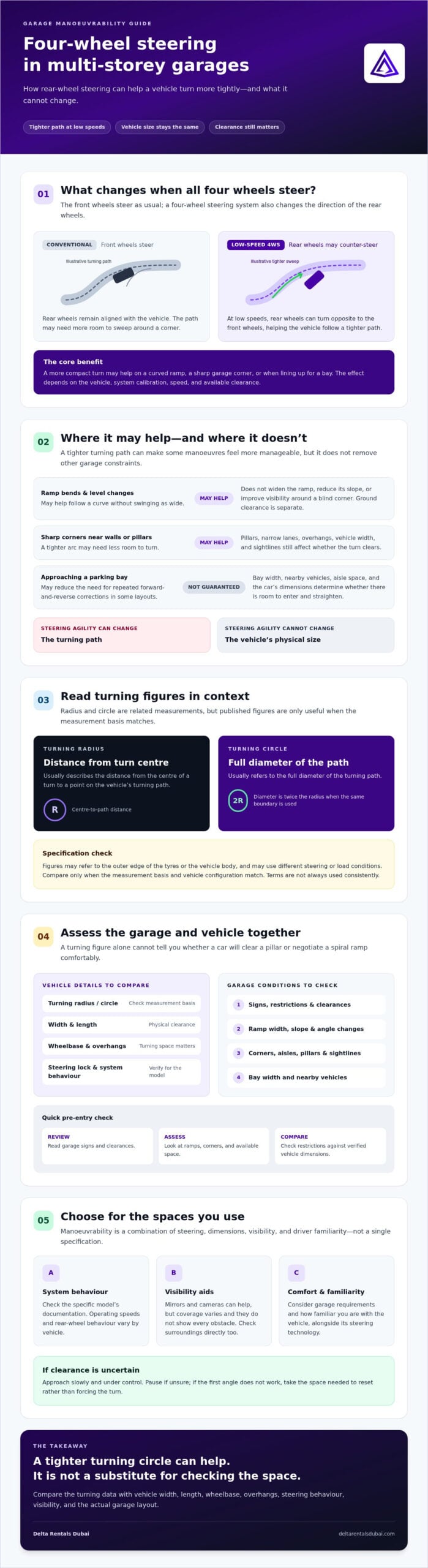
In a conventional setup, the front wheels steer while the rear wheels remain aligned with the vehicle. A four-wheel steering system can steer both axles. At low speeds, a common approach is to point the rear wheels opposite to the front wheels, helping the vehicle follow a tighter path. At higher speeds, some systems turn them in the same direction to support stability. Operating speeds and behaviour vary by vehicle, so check the specific model’s documentation rather than assuming every system works the same way.
This is the practical appeal behind the four wheel steering turning radius benefits in multi story parking garages: rear-wheel movement may reduce the space needed to turn. That can help on a curved ramp or at a garage corner, but it doesn’t guarantee an effortless manoeuvre. Pillars, narrow lanes, vehicle width, overhangs and sightlines still matter.
What is the difference between turning radius and turning circle?
Turning radius usually describes the distance from the centre of a turn to a point on the vehicle’s turning path. Turning circle usually refers to the full diameter of that path. In simple terms, the circle’s diameter is twice its radius when both measurements use the same boundary. However, specifications and sources don’t always use these terms consistently.
Figures may refer to different paths, such as the outer edge of the tyres or the vehicle body, and may be measured under different steering or load conditions. Compare figures only when the measurement basis and vehicle configuration match. Otherwise, a smaller published number may not predict how easily the vehicle clears a garage corner.
How do the rear wheels affect a tight turn?
With low-speed counter-phase steering, the rear wheels angle opposite to the front wheels. This changes the vehicle’s path so it can pivot through a tighter arc, potentially reducing the room needed to turn. Think of it as a more compact sweep, not a change to the car’s physical length.
The exact effect depends on rear-wheel angle, system calibration, speed and conditions. When evaluating a vehicle, verify how its steering system behaves at parking speeds and consider its turning data alongside the garage’s clearances. A tighter turning circle can be an advantage, but it’s only one part of manoeuvrability.
How Four-Wheel Steering Helps With Ramps, Corners, and Parking Bays
A tighter turning path can help at three common garage pinch points: a corner between levels, the approach to a parking bay, and a turn that needs more than one adjustment. By helping the vehicle change direction within a smaller arc, four-wheel steering may reduce the number of corrections needed in some layouts. The result depends on the vehicle, steering calibration, speed and available clearance.
Can rear-wheel steering help on a narrow garage ramp?
At a curved ramp or where a ramp meets a level aisle, a tighter path may help the vehicle follow the bend without swinging as wide. That can be useful when a turn is close to a wall or pillar. But steering agility doesn’t make a ramp wider, reduce its slope or improve visibility around a blind corner. Ground clearance is a separate concern, particularly where the ramp changes angle. Don’t assume a vehicle will clear a ramp based on its steering system alone.
Does four-wheel steering make parking bays easier to enter?
It may be easier to angle into a bay when the aisle offers limited room to line up. If the vehicle can turn more tightly, the driver may need fewer forward-and-reverse adjustments. Still, the bay’s width, nearby vehicles and the car’s dimensions determine whether there’s enough room to enter and straighten safely. Mirrors and cameras can help, but their coverage varies and they don’t show every obstacle.
Use a slow, controlled approach. Check your surroundings directly as well as through available cameras and mirrors, and pause if you’re unsure about clearance. If the first angle doesn’t work, take the space needed to reset rather than forcing the turn.
Four-wheel steering can improve turning agility, not shrink the vehicle. Its advantage is most useful when the system’s low-speed behaviour suits the manoeuvre and the garage leaves enough room for the car’s full body. At a tight corner, the wheels may follow a sharper arc while the body still needs clearance from the wall. A reduced turning space can mean fewer corrections, but it can’t compensate for insufficient ramp width or a bay that’s too narrow.
Before choosing a car for regular garage use, consider the actual route as well as its turning data. If you’re considering a premium rental, you can ask about vehicle suitability for your planned driving and parking needs.
Four-Wheel Steering Versus Vehicle Size: What Matters Most in a Garage?
A tighter turning circle can help a vehicle change direction, but it doesn’t alter the space its body occupies. The practical four wheel steering turning radius benefits in multi story parking garages depend on how steering agility works alongside the car’s dimensions and the garage’s clearances.
| Factor | What it affects in a garage |
|---|---|
| Four-wheel steering | Can help the vehicle turn through a tighter arc, depending on system operation and speed. |
| Width | Sets the side-to-side space needed in a bay, aisle or between pillars. Check whether the stated figure includes mirrors. |
| Length | Affects how much room the car needs to fit in a bay and move past corners. |
| Wheelbase | The distance between the axles. It influences how the vehicle follows a turn and lines up with a bay. |
| Steering lock | How far the front wheels can turn. More steering angle can affect turning ability, but it doesn’t describe the whole vehicle’s path. |
Which vehicle dimensions affect garage manoeuvrability?
Wheelbase helps describe how tightly a vehicle can follow a curve. Overall width matters when passing walls or aligning between neighbouring cars, while overall length affects bay fit and the space needed to reposition. Overhang is the body extending beyond an axle. A long front or rear overhang can approach a wall or ramp edge even when the wheels clear it. Check official vehicle specifications against posted garage limits and the route you expect to use.
When might four-wheel steering make little difference?
A narrow bay remains narrow, and a blocked view around a pillar remains a visibility challenge. Mirrors, cameras and sensors may help, but their coverage differs by vehicle. Rear-wheel steering may also behave differently depending on the model, speed or selected mode. Treat general system descriptions as an overview, not proof of a particular car’s features. Verify the exact specification and operation before relying on it.
Four-wheel steering is helpful, but it’s no substitute for checking clearance. Shorter overhangs, clear sightlines and well-placed mirrors or sensors can make a manoeuvre feel more predictable, but none changes the posted limits or the vehicle’s physical size. Assess the car as a complete package: steering data explains how it may turn, while its dimensions show what still needs room.
How to Assess a Multi-Storey Garage Before Driving In
A few checks before entering can help you decide whether the route suits your vehicle. Four-wheel steering may support tighter manoeuvres, but it doesn’t replace clearance checks or careful driving. Use this checklist before committing to a ramp or narrow aisle:
- Read the signs. Check posted height limits, directional instructions and any access restrictions.
- Assess the route. Look at ramp width and condition, corner shape, sightlines and visible obstructions.
- Check available space. Watch for narrow aisles, pillars, parked vehicles and occupied or restricted bays.
- Compare dimensions. Match the garage’s posted limits with your vehicle’s verified height, width and length, including mirrors where relevant.
What should drivers check at the entrance and on each level?
Start at the entrance, not halfway up the ramp. Confirm the height restriction against the vehicle’s official specification, then follow directional signs and watch for low or protruding obstacles. As you proceed, scan ahead for tight bends, narrow aisles and bays that are blocked or marked as restricted. A small turning circle doesn’t prove the whole vehicle will fit through a space or clear a corner.
Reassess as the garage layout changes between levels. A route that looks open from the entrance may narrow at a turn or be partly obstructed by parked vehicles.
How can drivers manoeuvre confidently in a confined space?
Keep your speed low and make deliberate, incremental steering inputs. Use mirrors and available cameras as aids, while continuing to check your surroundings directly. Pause before a blind corner or whenever you can’t judge the distance to a wall, pillar or neighbouring car. If clearance is uncertain, stop and reassess rather than forcing the turn.
These checks matter regardless of steering technology. The four wheel steering turning radius benefits in multi story parking garages may give a vehicle more flexibility through a tight bend, but they don’t guarantee that its body, mirrors or underside will clear every obstacle. Treat the system as support for control, not a substitute for cautious driving.
Considering a premium rental for a particular route? Ask about vehicle suitability for your planned parking and check the vehicle’s dimensions against the garage restrictions before you drive in.
Choosing a Premium Car With Garage Manoeuvrability in Mind
Choose for the parking route you’ll actually drive, not for one headline figure. The four wheel steering turning radius benefits in multi story parking garages can matter, but a confident choice also depends on the exact vehicle’s dimensions, visibility and equipment, plus the garage’s restrictions. Your comfort with the vehicle matters too. An unfamiliar car may demand more care, even if its steering technology supports tight turns.
Before confirming a vehicle for planned garage use, check:
- Exact model and year: Features can differ within a model range, so don’t rely on a family name or a specification from another year.
- Dimensions and turning data: Verify overall length and width, height, and turning figures. Check how those figures are measured.
- Parking aids: Confirm which mirrors, cameras and sensors are fitted, and remember they assist rather than replace direct checks.
- Steering details: If four-wheel steering is important, verify its availability and operation for the exact vehicle and relevant driving conditions.
- Garage restrictions: Compare the confirmed specifications with posted limits and the route’s ramps, corners and bays.
What vehicle information should you confirm before a drive?
Ask for details tied to the specific vehicle, not assumptions based on a badge or model family. Compare its verified measurements and turning data with the garage’s restrictions, and ask what parking aids and steering features are fitted. If a specification can’t be confirmed, don’t treat it as present. Use the information to judge suitability, not as a promise that the vehicle will fit every space.
How can a rental enquiry help clarify vehicle suitability?
Share the kind of garage you expect to use, including any known height limits, tight ramps or narrow bays. That context helps you ask focused questions about the vehicle’s exact model, year and verified specifications. Delta Rentals Dubai provides premium vehicle rentals across the UAE, but suitability should be assessed against the particular vehicle and parking environment.
Engineering is only part of the decision. Familiarity with the controls, confidence judging the vehicle’s edges and willingness to pause when unsure all contribute to a calm manoeuvre. If you’re considering a rental, contact Delta Rentals Dubai to ask about vehicle suitability for your planned driving and parking needs. Verify the details before setting out, and choose the car that feels manageable for the route.
Choose Your Next Drive With Confidence
Four-wheel steering can help a vehicle turn through a tighter path, but it doesn’t change the car’s width, length or clearance needs. The four wheel steering turning radius benefits in multi story parking garages are most useful when considered alongside verified vehicle dimensions, turning data, visibility aids and the garage’s restrictions.
Before driving in, confirm the exact model and year, compare its specifications with posted limits, and approach ramps and bays slowly. A vehicle that feels familiar and manageable can make a real difference. Steering technology supports the manoeuvre; it doesn’t replace awareness or careful judgement.
Delta Rentals Dubai offers premium vehicle rentals across the UAE and lists the Porsche 911 GT3 RS among its offerings. If you’re considering a rental, share the kind of driving and parking you have planned, then ask about the specific vehicle’s suitability. Ask about premium vehicle availability and suitability. With the right checks, you can make a more informed choice and enjoy the drive with greater confidence.
Frequently Asked Questions
Does four-wheel steering reduce a car’s turning radius?
Often, yes, particularly at low speeds when the rear wheels turn opposite to the front wheels. This counter-phase steering can help the vehicle follow a tighter arc. The amount of reduction depends on the car’s design, steering calibration and conditions, so don’t assume every system produces the same result. Check the exact vehicle’s specifications and compare turning figures only when they use the same measurement method.
Is four-wheel steering useful in multi-storey parking garages?
It can help with tight bends, ramp transitions and parking-bay approaches because the car may turn within less space. These are the practical four wheel steering turning radius benefits in multi story parking garages. The technology doesn’t change the vehicle’s width, length or ground clearance, though. Check the garage’s posted restrictions and available space, and drive cautiously even if the car has four-wheel steering.
Can four-wheel steering help a long car turn in a tight garage?
Yes, it may help a long vehicle take a tighter path, which can make some garage corners easier to negotiate. But it doesn’t shorten the car or reduce the room its body needs. Overall length, wheelbase, overhangs and width still affect corner clearance and bay alignment. Check verified dimensions and turning data for the exact vehicle, then assess them against the garage’s ramps and aisle layout.
What is the difference between four-wheel steering and rear-wheel steering?
Four-wheel steering means the front and rear wheels can both steer. The rear wheels may turn opposite to the front wheels at low speeds to support tighter turns, and some systems change their behaviour as speed increases. “Rear-wheel steering” describes steering action at the rear axle, but terminology can vary. Check the manufacturer’s description to confirm which wheels steer and how the system behaves on a particular model.
Does four-wheel steering make a car easier to park?
It can make some parking manoeuvres easier by helping the car turn into a bay with less space or fewer corrections. But parking also depends on bay width, neighbouring vehicles, visibility and the driver’s familiarity with the car. Mirrors, cameras and sensors can assist, but they don’t show every obstacle. Move slowly, keep checking your surroundings and pause if you’re unsure about clearance.
How can I check whether my car will fit in a multi-storey garage?
Compare the garage’s posted height and access restrictions with the exact vehicle’s official specifications. Check overall height, width and length, noting whether the width figure includes mirrors. Then consider ramp width, corner shape and bay space, not just the entrance. If you’re using a rental, confirm the specific model and year. A small turning circle alone doesn’t prove the vehicle will fit or clear obstacles.
Do all cars with four-wheel steering behave the same way at low speeds?
No. Rear-wheel angle, operating logic and steering response can vary by manufacturer, model, year and selected mode. Counter-phase steering, where rear wheels turn opposite to the front, is a common low-speed approach, but don’t assume it applies identically to every car. Confirm the exact vehicle’s steering specifications and owner information before relying on the feature in a confined garage.