

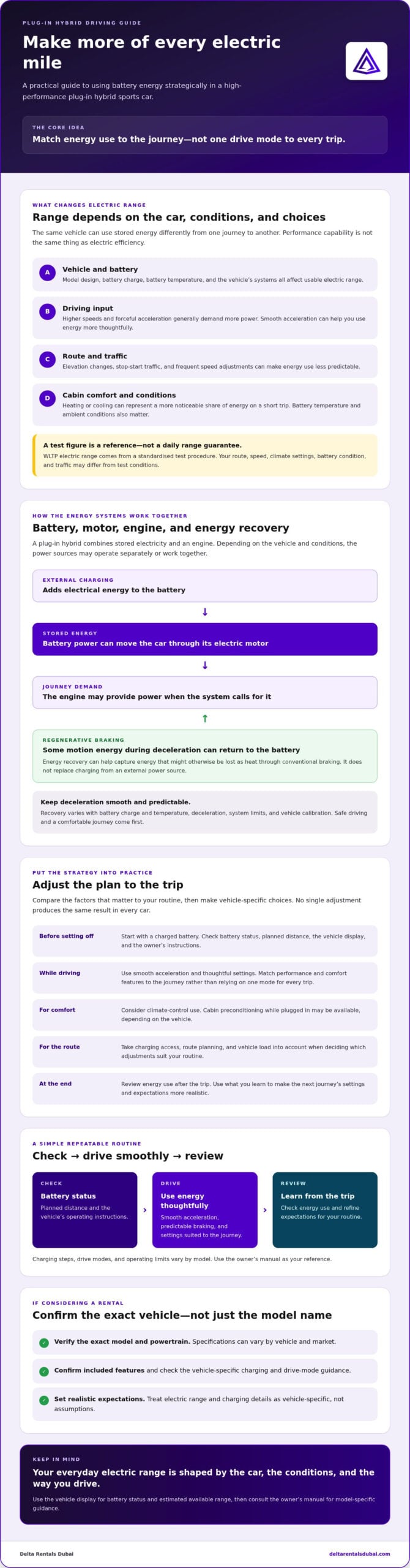
The biggest range gains in a plug-in hybrid sports car come from using its energy strategically, not giving up the drive you enjoy. If the electric range seems to drop quickly during everyday trips, you’re not alone: acceleration, cabin comfort and selected drive modes can all affect how the car uses stored energy. For drivers focused on extending daily driving range on plug in hybrid high performance sports cars, the key is to match energy use to each journey.
Start with a charged battery, then choose settings and driving habits that suit your route. Regular charging, smooth acceleration, regenerative braking and thoughtful use of performance and comfort features can help you make more of the battery without compromising safety or comfort. Charging and drive-mode instructions vary by model, so use the owner’s manual as your reference. If you’re considering a rental, confirm the exact vehicle specification and features before booking, then set realistic expectations for electric driving.
Key Takeaways
- Electric range depends on more than the battery. The model, charge level, conditions and driving choices all affect how far you can travel before the engine does more work.
- For extending daily driving range on plug in hybrid high performance sports cars, match your energy settings to the journey rather than relying on one mode for every trip.
- Compare charging access, climate control, route planning and vehicle load to decide which adjustments suit your routine.
- Build a simple pre-drive check around battery status, planned distance and the vehicle’s operating instructions, then review energy use at the end of the trip.
- Before renting, confirm the exact model, powertrain and included features. Treat electric range and charging guidance as vehicle-specific details, not assumptions.
What Affects Electric Range in a Plug-In Hybrid Sports Car?
Electric driving range is the distance a plug-in hybrid can cover while prioritising battery power before relying more heavily on its engine. That doesn’t always mean the engine stays off until the battery is depleted. Depending on the vehicle, a demand for strong acceleration or other operating conditions may prompt the engine to engage sooner. A plug-in hybrid electric vehicle combines a rechargeable battery and electric motor with an internal-combustion engine, but the way those systems work together varies by model.
Usable range depends on the car’s design, battery charge and temperature, journey conditions, and driver input. A sports car’s performance capability is not a measure of its electric efficiency. Power and acceleration describe what it can deliver; electric range describes how far it can travel on battery energy in particular conditions. Understanding that difference is central to extending daily driving range on plug in hybrid high performance sports cars.
Why a sports car’s electric range changes from trip to trip
Energy demand changes with the drive. Higher speeds and forceful acceleration generally require more power, while elevation changes, stop-start traffic and frequent speed adjustments can make consumption less predictable. Trip length matters too: on a short journey, cabin heating or cooling may account for a more noticeable share of energy use. The effect depends on the vehicle’s climate system and whether it can precondition the cabin while plugged in.
Battery temperature also plays a part. The battery management system may use energy to keep the battery within its preferred operating conditions. How it responds varies by model and ambient conditions. Heat and regular air-conditioning use are practical considerations, but there’s no single adjustment that produces the same range result in every car. Check the manual for model-specific guidance.
Which figures help set realistic range expectations?
A published WLTP electric-range figure comes from a standardised test procedure. It helps compare vehicles tested under that cycle, but it can’t predict an individual journey with certainty. Your speed, route, climate-control settings, battery condition and traffic may differ from the test conditions. Treat the figure as a reference point, not a daily range guarantee.
A test-cycle range is a comparison measure; your daily electric range is shaped by the car, the conditions and the way you drive. Check the specific vehicle’s display for battery status and estimated available range, then consult its owner’s manual for charging instructions, drive modes and operating limits. Verify the specification for the exact vehicle and market rather than assuming figures apply across a model name. That makes range expectations more useful, whether you’re assessing a car for everyday use or confirming details before a rental.
How Plug-In Hybrid Energy Management Uses the Battery, Engine, and Regenerative Braking
A plug-in hybrid’s battery and electric motor can move the car using stored electricity, while its petrol engine can provide power when the system calls for it. Depending on the design, the two power sources may operate separately or work together. The vehicle’s control system balances performance, battery charge and driving conditions. For a clear overview of how plug-in hybrids work, see the U.S. Department of Energy’s explanation.
Regenerative braking is part of that energy balance. It converts some of the vehicle’s motion into electrical energy during deceleration, returning that energy to the battery rather than creating new energy. It can help recover energy that would otherwise be lost as heat through conventional braking, but it cannot replace charging from an external power source.
What regenerative braking can and cannot do
When you lift off the accelerator or brake, the electric motor may act as a generator and send some recovered energy to the battery. How much is recovered depends on factors such as battery charge and temperature, deceleration, system limits and vehicle calibration. If the battery can’t accept more energy, or conditions limit recovery, the system may capture less.
Keep braking smooth and predictable. Don’t accelerate or brake abruptly, or delay braking, to chase energy recovery. Safe driving and a comfortable journey come first. Regenerative braking is a benefit of normal deceleration, not a reason to change safe habits.
How drive modes affect electric use
Mode names and behaviour aren’t universal. A vehicle may offer an electric-priority setting, a hybrid setting that balances the motor and engine, or a performance setting that makes stronger power available. The exact choices, and when the engine can engage, depend on the model. Don’t assume a mode works the same way across different cars.
Read the owner’s manual before selecting a mode, then check the instrument display to confirm what’s active and how the vehicle is using its power sources. A mode name doesn’t promise a fixed electric range: acceleration demand, battery state and operating conditions still matter. Understanding how your specific car behaves is a practical step in extending daily driving range on plug in hybrid high performance sports cars.
If you’re considering a rental, confirm the exact model, powertrain and operating instructions before booking. You can ask about vehicle details before booking, rather than assuming a particular hybrid system or drive mode is included.
Which Range-Extending Strategies Make Sense for a Performance PHEV?
Choose adjustments that fit your route, comfort needs and vehicle. No single habit guarantees a specific range gain, and manufacturer instructions always take priority over general efficiency advice. The U.S. Department of Energy explains how plug-in hybrids work, but your owner’s manual is the guide to your car’s charging, climate and energy settings.
| Strategy | Likely usefulness | Trade-off to consider |
|---|---|---|
| Charging | Starting with a higher battery charge gives you more stored electricity to use. | Charging access and instructions vary. Use approved equipment and follow the vehicle’s guidance. |
| Climate control | Preconditioning while connected may reduce battery use for cabin comfort once underway, if your car supports it. | Features differ by model. Keep the cabin comfortable and follow the manufacturer’s guidance for heat and battery care. |
| Smooth driving | Gentle acceleration and steady, appropriate speeds can moderate power demand. | Allow extra time where practical, but never compromise safe, suitable driving to conserve energy. |
| Route planning | Considering traffic, gradients and trip length can help you anticipate energy use and charging options. | The shortest route may not use the least energy. Follow navigation safely and review displays before setting off. |
| Vehicle load | Carrying only what you need avoids unnecessary weight. | Keep required items and passengers. Don’t remove safety equipment or compromise comfort for range. |
Charging and climate control: useful before the journey
Charge according to the vehicle’s instructions and the access available to you. Before relying on scheduled charging or cabin preconditioning, check whether the feature is supported and how it operates for that model. Preconditioning while connected may help preserve battery energy for driving, but don’t assume it works identically across vehicles. In hot weather, prioritise a comfortable cabin and follow the manufacturer’s battery and climate-control guidance.
Driving style and route choices: useful on the road
Use smooth inputs rather than sharp acceleration, and maintain a steady speed that suits traffic and road conditions. Stop-start traffic, climbs and longer journeys can change energy demand, so plan with the whole route in mind. Set navigation before moving, and check energy information when safely parked or through suitable voice controls. These practical choices can support extending daily driving range on plug in hybrid high performance sports cars without asking you to sacrifice safe driving.
Considering a rental? Confirm the exact vehicle, powertrain and operating instructions before booking. Ask about a vehicle’s specifications before booking so you can check whether its features match your plans.
How to Build a Safe Daily Routine for More Electric Driving
A consistent routine makes it easier to understand how your plug-in hybrid responds to familiar journeys. Use these steps to manage battery energy, not to chase a range target. Safe driving, traffic rules and passenger comfort always come first.
- Check the car’s instructions. Before charging or using preconditioning, consult the owner’s manual for the correct procedure and any model-specific limits. Confirm how the vehicle’s energy modes operate rather than relying on assumptions from another car.
- Review the battery and journey. Check the displayed battery status and estimated electric range. Compare that estimate with your planned distance, route, expected traffic and any available charging options along the way. Treat the display as a guide, not a promise.
- Prepare the vehicle safely. Set tyre pressures to the manufacturer’s recommendation and remove items you don’t need, without disturbing safety equipment or essential belongings. In warm conditions, use climate settings that keep occupants comfortable and follow the vehicle’s guidance.
- Drive smoothly when conditions allow. Accelerate and decelerate progressively, while keeping a speed appropriate for the road and traffic. Don’t coast, delay braking or make abrupt inputs to preserve battery energy. Keep your attention on driving, not on repeatedly checking the range display.
- Review the trip at the end. Once parked, note the distance, remaining battery estimate and relevant conditions, such as heavy traffic, a different route or substantial climate-control use. Compare similar journeys over time to spot useful patterns.
That final review turns a range estimate into experience you can use. A familiar commute on a cooler day may not compare directly with a longer trip through stop-start traffic, so look for trends across journeys with similar routes and conditions. This routine can support extending daily driving range on plug in hybrid high performance sports cars without sacrificing comfort or safe decisions.
Performance cars also serve different priorities. Delta Rentals Dubai lists the Porsche 911 GT3 RS among its rentals, but don’t assume its powertrain or operating features match a plug-in hybrid. Confirm the exact vehicle specification before relying on hybrid-specific advice. The available internal link here is the general luxury car rental page, not a dedicated guide to the Porsche model.
Considering a rental? Ask about the exact model, powertrain and vehicle instructions before booking, so your expectations fit the car you’ll be driving.
Choosing a Plug-In Hybrid Sports Car for Everyday Driving and Rental
The right performance plug-in hybrid should suit the journeys you actually make, not just a range figure in a brochure. Consider your typical daily distance, where you can charge, how much cabin comfort matters, and how often you expect to use the car’s full performance. Electric driving may suit some everyday trips, while longer journeys or enthusiastic acceleration can call for more engine support. Set expectations around the specific vehicle, not a general promise about plug-in hybrids.
Questions to ask before choosing a performance PHEV
Get clear answers before you commit. Check the exact model’s verified electric-range figure and the test procedure behind it, then treat that figure as a comparison guide rather than a guarantee for your route. Ask what charging equipment and cables are included, where charging is supported, and which vehicle-specific instructions apply. Finally, compare your planned journeys with the car’s stated electric capability, allowing for traffic, climate-control use and the possibility that conditions affect the estimate.
Also weigh comfort and performance priorities. A car that suits your commute should still feel comfortable for passengers and practical for your routine. If you expect to use strong acceleration regularly, don’t plan each trip around achieving the highest possible electric range. The aim of extending daily driving range on plug in hybrid high performance sports cars is to use battery power thoughtfully, not to suppress the qualities you chose the car for.
Make the rental experience straightforward
For a rental, confirm the exact vehicle, current availability, powertrain and included features before booking. Ask for the relevant operating instructions, including charging and drive-mode guidance, and verify that the vehicle’s specification matches the market. Model names alone aren’t enough to confirm a particular powertrain or equipment. If electric driving is a priority, make that clear in your enquiry so you can check the details that matter to your plans.
Delta Rentals Dubai lists premium vehicle rentals, but availability and specifications should be confirmed directly. Review the premium rental fleet, then verify the details of the specific car you’re considering. Choose with realistic expectations: daily distance, charging access and comfort matter as much as published range when deciding whether a performance PHEV fits your routine.
Ask about available performance cars and confirm the exact model and powertrain before booking.
Make Every Electric Journey Count
Getting more electric distance from a performance plug-in hybrid starts with a few practical choices: charge as directed, match the car’s energy settings to your journey, and drive smoothly when conditions allow. Range estimates are a guide, not a promise, so use the vehicle display and owner’s manual to set expectations for your specific model. Safety and passenger comfort always come first.
That’s the practical approach to extending daily driving range on plug in hybrid high performance sports cars: understand the vehicle, plan around your real routine, and let performance remain part of the experience. Delta Rentals Dubai lists the McLaren Artura among its rental offerings, but confirm current availability, market-specific powertrain details and operating instructions before booking.
Ready to explore your options? Ask about available performance cars and verify the exact vehicle details for your plans. With the right information, you can enjoy a confident, comfortable drive and make better use of every charge.
Frequently Asked Questions
Can driving habits extend the electric range of a plug-in hybrid sports car?
Yes. Smooth acceleration, appropriate speeds and thoughtful route choices can help reduce energy demand, but they can’t guarantee a specific range increase. Results depend on the vehicle, battery condition, temperature, traffic, terrain and cabin settings. Use the energy display to learn how familiar journeys affect consumption. Compare trips in similar conditions, and follow your owner’s manual rather than relying on universal range claims or trying to change safe driving habits.
How can I get more electric driving from a plug-in hybrid each day?
Start with a charged battery when practical, plan your route and use electric-priority settings only as the vehicle’s manual recommends. Smooth driving and removing unnecessary items may also help moderate energy use. If your model supports cabin preconditioning while connected, it may reduce the energy needed for comfort after departure. For extending daily driving range on plug in hybrid high performance sports cars, treat these as useful habits, not promises. Keep driving safe and comfortable.
Does air conditioning reduce plug-in hybrid range in hot weather?
Cabin climate control can use battery energy, but its effect depends on the vehicle, outside conditions, journey and settings. Don’t switch off cooling if that makes the cabin uncomfortable or driving unsafe. If supported, precondition the cabin while the car is connected and choose a comfortable setting for the trip. Follow the owner’s instructions in high temperatures, since battery thermal management and climate-system behaviour vary between models.
Does regenerative braking increase a plug-in hybrid’s driving range?
Regenerative braking can return some energy to the battery during deceleration, but it can’t recover all the energy used to move the car. The amount depends on speed, battery state, system limits and vehicle calibration. Anticipate traffic and decelerate smoothly when it’s safe to do so. Don’t brake harshly or use unusual driving techniques to increase recovery. Road safety and the manufacturer’s guidance come first.
Should I use electric mode or hybrid mode to save battery range?
The most suitable mode depends on your journey and the specific vehicle. Electric mode may prioritise battery power, while hybrid mode may coordinate electric and engine power, but names and behaviour differ between manufacturers. Check the owner’s manual and dashboard indicators to understand what’s active. Consider where electric driving is most useful in your day, and don’t assume a selected mode guarantees a particular distance.
Can I extend electric range by driving more slowly?
Excessive speed can increase energy demand, but there’s no single ideal speed for every car and road. Stay within posted limits and choose a safe, appropriate pace for traffic and conditions. Smooth acceleration, anticipating traffic and selecting a sensible route can help avoid unnecessary energy use. Compare similar journeys using the vehicle’s energy display to identify patterns, rather than expecting a fixed improvement from driving more slowly.
What should I check before renting a plug-in hybrid sports car?
Confirm the exact model and powertrain, current availability, charging instructions and which charging equipment is included. Ask how to select drive modes and interpret the energy display. Check whether the vehicle’s verified electric capability suits your usual journey lengths and charging access. Delta Rentals Dubai lists the McLaren Artura among its rental offerings, but confirm current availability and the specific vehicle’s market powertrain before booking.