
The tallest SUV isn’t automatically the most capable or the most comfortable executive choice. Comparing elevated road clearance features on luxury all terrain executive suvs means looking beyond the headline height to see how the whole vehicle suits the roads you plan to drive.
A ground-clearance figure is a useful starting point, but it won’t tell you how the suspension responds to uneven surfaces, whether the body clears a steep entrance, or how comfortable the ride feels on smooth roads. This guide offers a practical way to compare those priorities and match an SUV to your planned journeys across the UAE.
We’ll explain how adjustable suspension, fixed ride height, approach and departure angles, breakover geometry, and tyres affect real-world clearance. You’ll also learn what to verify for the exact model year and trim when considering options such as the Range Rover Sport V8, Mercedes G63, or Cadillac Escalade, whether you’re choosing a vehicle or making a rental enquiry.
Key Takeaways
- Look beyond the ground-clearance figure. Suspension, vehicle geometry, tyres, and load all influence how an SUV handles uneven surfaces.
- Compare approach, departure, and breakover angles alongside ride height to assess elevated road clearance features on luxury all terrain executive suvs.
- Check specifications for the exact model year and trim, especially when comparing fixed ride height with adjustable suspension.
- Match the vehicle to your planned route, passengers, luggage, and preferred balance of comfort and capability.
- For a rental enquiry, ask about the specific vehicle’s equipment and suitability for your planned route. Options include the Range Rover Sport V8, Rolls-Royce Cullinan Black Badge, and Mercedes G63, subject to confirmation of availability.
What elevated road clearance means in a luxury all-terrain executive SUV
Ground clearance is the vertical space between a vehicle’s lowest underside point and the road surface. It can help you assess whether the vehicle is more likely to clear a raised entrance or uneven patch without contact. But it’s only one part of the picture. The What elevated road clearance means reference explains ride height and its practical trade-offs. For a specific SUV, check the manufacturer’s figures for the exact model year and trim.
A single measurement can’t establish full all-terrain capability. The vehicle’s shape, suspension, tyres, and load all influence how it meets an obstacle. A low point beneath the centre, for example, may matter even if the front clears an incline. Clearance also doesn’t tell you how the SUV will ride, steer, or maintain traction on a particular surface. Treat elevated road clearance features on luxury all terrain executive suvs as characteristics to assess, not as a guarantee that every route is suitable.
Ground clearance versus adjustable ride height
Fixed clearance describes the ride height of a particular configuration. Adjustable ride height means the suspension can raise or lower the vehicle, but don’t assume a model has this feature without checking its exact trim and equipment. If fitted, a height setting may provide flexibility between everyday road use and more uneven surfaces.
Measured clearance can also vary with passenger and luggage load, tyre specification, and suspension setting. Compare figures on the same basis and check the manufacturer’s measurement conditions. If you’re enquiring about a rental, ask which model year and trim is being offered and whether its equipment matches the specification you’re evaluating.
What “all-terrain” means for executive SUV drivers
For executive travel across the UAE, judge all-terrain suitability against the journeys you plan to make. Consider whether you’ll mainly use smooth paved roads, encounter rough or uneven sections, or need added clearance for occasional changes in surface. Comfort matters too: the SUV should suit its passengers and luggage, not just clear an obstacle.
“All-terrain” doesn’t mean every route is appropriate. Surface condition, vehicle equipment, and driver experience all matter, and a high clearance figure can’t remove those limits. Identify the conditions you expect, then verify the exact vehicle specification rather than relying on a model name or broad capability claim.
How suspension and vehicle geometry create real-world clearance
Clearance figures are most useful when read alongside the vehicle’s shape, suspension, and fitted equipment. A raised suspension setting may increase the space beneath an SUV, but the front bumper, rear overhang, or central underside can still make contact first. Assess elevated road clearance features on luxury all terrain executive suvs as a complete package rather than relying on one number.
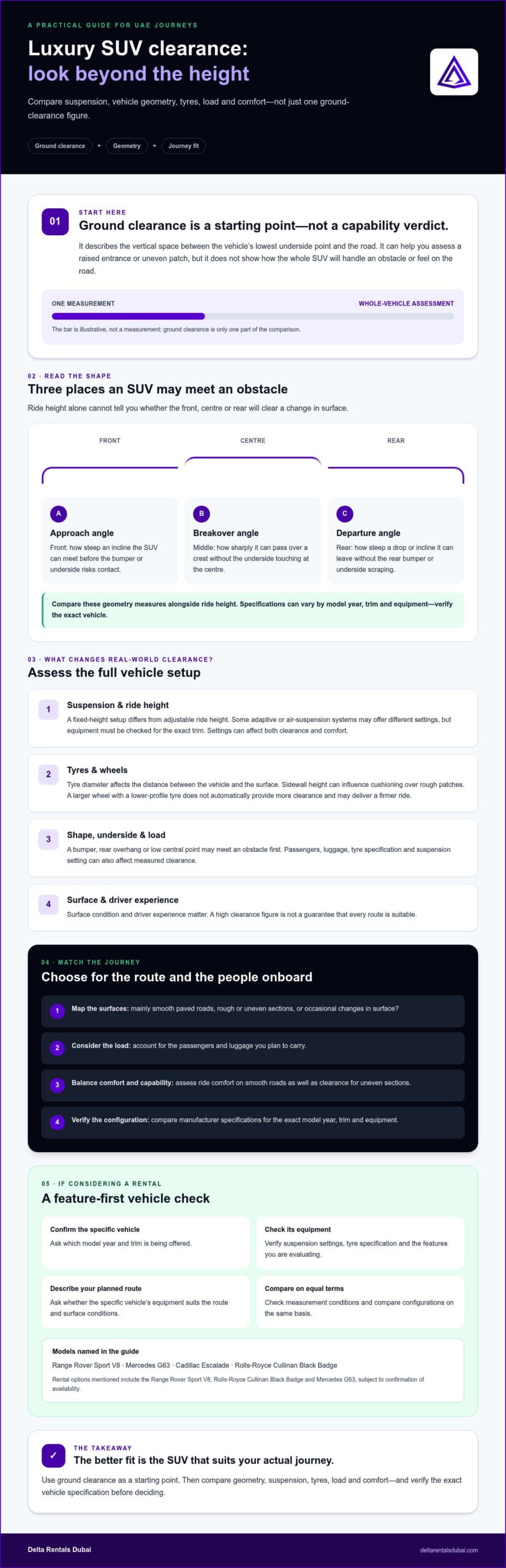
Three common geometry measures describe different potential contact points:
- Approach angle, front: How steep an incline the SUV can meet before its front bumper or underside risks contact.
- Breakover angle, middle: How sharply it can pass over a crest without the underside touching at the centre.
- Departure angle, rear: How steep a drop or incline it can leave without the rear bumper or underside scraping.
Simple diagram brief: show an SUV from the side, with a ramp approaching the front, a crest beneath the middle, and a slope behind the rear. Label the potential contact points at the front, centre, and rear. Angle specifications can differ by model year, trim, and equipment, so verify manufacturer data before making numerical comparisons.
Suspension, tyres and underbody protection
Suspension affects how the vehicle responds to bumps and how its body sits relative to the road. Some systems are fixed-height; others, including certain adaptive or air-suspension systems, may offer different settings. These are general feature categories, not equipment to assume on any particular SUV. Check the exact configuration and how its settings affect ride height and comfort.
Tyres matter, too. Their overall diameter affects the distance between the vehicle and the surface, while sidewall height can influence cushioning over rough patches. A larger wheel with a lower-profile tyre doesn’t automatically provide more clearance and may deliver a firmer ride. Confirm the tyre size and type fitted to the specific vehicle.
Underbody protection may help shield components from contact, but it doesn’t guarantee that the vehicle will clear an obstacle. Protective parts can also sit lower than surrounding components. Check what protection is fitted and identify the vehicle’s lowest point.
For a planned journey, compare the route’s surfaces with the SUV’s geometry, suspension settings, tyres, and protection. If you’re considering a rental, a vehicle suitability enquiry can help you confirm which model year, trim, and equipment to ask about.
Comparing elevated-clearance features without relying on one headline figure
A fair comparison starts with matching configurations. Check the same model year and trim, then note whether figures describe standard ride height, a raised suspension setting, or a specific tyre and wheel setup. The 2026 Range Rover, for example, is listed with 219 mm of standard ground clearance and up to 296 mm in its highest off-road setting. Those figures describe different settings, so they aren’t a like-for-like comparison with a fixed-height vehicle. Confirm the exact vehicle specification before relying on either number.
Use this checklist to compare elevated road clearance features on luxury all terrain executive suvs without turning incomplete data into a ranking:
| Feature | What to compare | What to verify |
|---|---|---|
| Ground clearance | Standard height and any manufacturer-stated raised setting | Model year, trim, measurement conditions, and suspension setting |
| Suspension adjustment | Fixed height versus selectable ride-height settings | Whether the specific vehicle has the system and which settings are available |
| Geometry | Approach, breakover, and departure angles | Exact configuration; mark figures unavailable or inconsistent rather than estimating |
| Tyres and wheels | Tyre type, size, and sidewall, plus wheel specification | Whether figures and equipment match the vehicle being considered |
| Comfort | Ride quality, cabin needs, and suitability for daily routes | Passenger load, luggage, and the vehicle’s intended use |
Make the comparison like for like
Record the source and measurement conditions alongside each specification. Don’t compare a maximum clearance figure directly with another vehicle’s standard ride height. If a manufacturer doesn’t publish a geometry or equipment detail for the exact trim, mark it “not confirmed.” Don’t fill gaps with estimates or assume that a feature shown on one version carries across the range.
Balance comfort with capability
Greater height alone doesn’t guarantee more traction, a smoother ride, or better passenger comfort. Tyres, suspension tuning, body size, and visibility all affect how an SUV feels and suits a journey. Adjustable systems, including adjustable air suspension, may offer different ride-height settings, but equipment and behaviour depend on the vehicle’s configuration.
For driving across the UAE, consider everyday road comfort alongside the uneven surfaces you expect to encounter. A luxury all-terrain SUV isn’t automatically designed for extreme off-road use, and a longer or larger body may call for more care around tight spaces and changing surfaces. Choose for your real routes, not the most impressive specification on paper.
How to choose clearance features for your journeys across the UAE
Start with the trip, not the tallest specification. The right SUV should suit your route, passengers, and luggage while delivering the balance of comfort and clearance you’ll actually use. Use this process to narrow your options.
- Map the route surfaces. Note whether your journey is mainly on paved roads or includes uneven access roads, steep entrances, or other surface changes. Describe the conditions clearly, but don’t assume any vehicle is suitable for every route.
- Set your comfort priorities. Will passengers spend most of the journey on smooth roads, or do you expect regular uneven sections? Decide whether a refined everyday ride, adjustable ride height, or occasional added clearance matters most.
- Account for people and luggage. Consider passenger space, ease of entry and exit, and the luggage you’ll carry. A vehicle that meets your clearance needs but feels cramped or can’t accommodate your bags may not suit the trip.
- Check the actual vehicle. Confirm the model year, trim, tyres, and relevant suspension equipment. Ask about permitted road types and rental conditions before booking, especially if your itinerary includes anything beyond ordinary paved roads.
Match the SUV to passengers, luggage and route
Executive and family journeys call for more than ground clearance. Cabin comfort, visibility, and practical luggage space matter throughout the trip, while extra clearance may be useful only for particular access conditions. Choose based on the most demanding part of your planned journey, while staying within the vehicle’s intended use and rental terms. No clearance feature guarantees that a route is suitable.
Ask focused questions before booking
For a rental enquiry, ask which model year and trim will be supplied, whether that vehicle has the suspension equipment you want, and what restrictions apply to road types or vehicle use. Don’t rely on a model name alone to confirm its specification. Options to ask about include the Range Rover Sport V8, Rolls-Royce Cullinan Black Badge, and Mercedes G63. Confirm both availability and equipment for the vehicle offered.
Use the same feature-first approach when considering elevated road clearance features on luxury all terrain executive suvs: compare confirmed equipment with your route, passenger needs, and comfort preferences. For broader model ideas, see the Luxury SUV Rental guide.
To discuss SUV options for your trip, ask about model-specific equipment and suitability.
Explore luxury SUV rental options with a feature-first checklist
A rental enquiry is a chance to match a specific vehicle to your journey, not just choose by badge or appearance. Delta Rentals Dubai’s confirmed SUV offerings include the Range Rover Sport V8, Rolls-Royce Cullinan Black Badge, and Mercedes G63. Their inclusion here doesn’t imply a particular ground-clearance figure, suspension system, or suitability for every road. Those details depend on the exact vehicle configuration and should be confirmed before you book.
Use the same practical approach to elevated road clearance features on luxury all terrain executive suvs: start with your route and passenger needs, then check what the vehicle actually offers. All-terrain suitability isn’t the same as permission or suitability for unrestricted off-road driving. Ask about intended use and rental conditions for your planned journey.
Assess each SUV against your requirements
The Range Rover Sport V8 is one option to enquire about, but verify its model year, trim, and equipment before comparing ride height or suspension. The Rolls-Royce Cullinan Black Badge is another confirmed offering, not a guarantee of any specific clearance feature. You can also ask about the Mercedes G63. Compare the confirmed cabin space, comfort, and equipment of the vehicle offered against your needs rather than assuming every version shares the same specification.
Before deciding, make a short list:
- Trip details: Share your intended dates and the road surfaces you expect to encounter.
- Passengers and luggage: Give the passenger count and describe how much luggage you’ll carry.
- Vehicle specification: Ask which model year and trim are being offered, and confirm relevant suspension or tyre details.
- Use and terms: Check whether your expected route and vehicle use are permitted under the rental terms.
Make an informed rental enquiry
Ask Delta Rentals Dubai to confirm current availability and the exact configuration of the SUV you’re considering. If a particular feature is essential, request confirmation for that vehicle rather than relying on general model information. This helps you assess comfort, space, and suitability without treating a ground-clearance claim as a promise that the SUV can handle every surface.
For a broader overview of the available category, see the Luxury SUV Rental guide. Then enquire about luxury SUV rental options with your dates, passenger count, luggage needs, and planned road conditions to ask about availability, vehicle details, and journey suitability.
Choose the SUV that fits your journey
The right executive SUV isn’t simply the one with the highest clearance figure. Compare suspension, geometry, tyres, and comfort together, then check the exact model year and trim. The most useful elevated road clearance features on luxury all terrain executive suvs are the ones that suit your planned roads, passengers, and luggage without compromising the ride you want day to day.
Delta Rentals Dubai offers luxury SUV rentals across the UAE, including the Range Rover Sport V8 and Rolls-Royce Cullinan Black Badge. Treat these as enquiry options and confirm current availability, vehicle details, and suitability for your journey before booking. Share your intended dates, passenger count, luggage needs, and expected road conditions to make the enquiry more useful.
Ready to compare your options? Enquire about luxury SUV options on WhatsApp and ask about the exact vehicle configuration and rental terms.
Frequently Asked Questions
What is elevated road clearance in an SUV?
Elevated road clearance refers to the space between an SUV’s underside and the surface below it. The precise measurement depends on the vehicle’s model configuration, suspension setting, tyres, and measurement conditions, so check verified specifications for the exact model year and trim. More clearance may help the vehicle pass over some uneven surfaces, but it doesn’t define capability on its own. Suspension, tyres, and vehicle geometry also affect how an SUV handles a route.
Is higher ground clearance always better in a luxury SUV?
No. Higher ground clearance isn’t automatically better for every driver or journey. Extra height may help over some uneven surfaces, but it doesn’t establish traction, passenger comfort, or suitability for a particular route. Suspension tuning, tyres, vehicle dimensions, and driver needs all matter. For executive travel, balance useful clearance with comfortable access, a composed ride, and the SUV’s intended use. Confirm the exact equipment and specifications before choosing.
How does air suspension affect road clearance?
Some air suspension systems can change a vehicle’s ride height, but availability and operation vary by model year, trim, and configuration. A higher setting may be intended for particular driving conditions, while other settings may prioritise comfort or easier access. Don’t assume a luxury SUV has adjustable air suspension simply because the model range offers it. Check manufacturer information and ask the rental provider to confirm the equipment on the specific vehicle.
Can an executive SUV with elevated clearance drive on every surface?
No. Higher clearance doesn’t make every SUV suitable for every route or surface. Tyres, traction systems, approach and departure angles, underbody protection, and driver experience can all affect suitability. Rental terms or vehicle-use restrictions may also apply. Choose according to your intended journey, confirm permitted use in advance, and follow the vehicle provider’s guidance. An “all-terrain” description shouldn’t be treated as permission or assurance for extreme off-road driving.
What is the difference between ground clearance and approach angle?
Ground clearance is the space between the vehicle’s underside and the surface below. Approach angle describes how steep an obstacle can be at the front before the vehicle risks contact; departure angle describes the corresponding risk at the rear. Breakover angle concerns the underside at the vehicle’s middle as it passes over a crest. Each measure addresses a different potential contact point, so compare them together when reliable, configuration-specific figures are available.
How do I choose a luxury SUV for varied road conditions?
Start with your passengers, luggage, planned surfaces, and comfort priorities. Then compare verified ground clearance, suspension equipment, vehicle geometry, and tyre information for the exact model and trim. These elevated road clearance features on luxury all terrain executive suvs should match your actual journey, not just a broad capability claim. If renting, ask the provider to confirm the vehicle’s availability, configuration, permitted use, and any relevant restrictions before booking.