

More throttle is rarely the answer when a powerful rear-wheel-drive car starts spinning its tyres. If you’re dealing with high horsepower rear wheel drive wheel spin on slick tarmac, a sudden surge of power can make the rear lose grip faster, particularly on damp, dusty or contaminated roads. Stay calm, ease your inputs and focus on the safest path available.
That moment can feel alarming. You may be unsure whether to ease off, steer or brake, but an abrupt correction can make the car less predictable. Grip depends on more than horsepower: tyre condition, the road surface, speed and how progressively you use the accelerator all matter. Electronic stability systems can help, but they cannot overcome the limits of available traction.
This guide explains why rear tyres break away and how to reduce risk before setting off. It also covers what to do if traction fades, when to slow down or stop safely, and why advanced car-control skills belong in a controlled environment rather than on public roads.
Key Takeaways
- When dealing with high horsepower rear wheel drive wheel spin on slick tarmac, use calm, measured inputs rather than trying to overpower a slide.
- Check tyre condition and road conditions before setting off, then adjust speed and following distance to suit the grip available.
- Acceleration, braking and steering all draw on the tyres’ limited grip. Combining sharp inputs on a slick surface can make traction harder to maintain.
- If the rear begins to lose traction, avoid sudden throttle, braking or steering corrections. Keep your attention on a safe path.
- Choose a high-performance car to match your experience and intended use, and review its guidance and rental terms before booking.
Why high-horsepower rear-wheel-drive cars spin their tyres on slick tarmac
Wheel spin happens when the driven rear tyres turn faster than the available grip can support. They then struggle to transfer engine force to the road, and the rear of the car may feel unsettled or begin to slide. This is a question of traction, not just engine size. Tyre condition, the road surface, vehicle setup, speed and driver inputs all affect how much force the tyres can handle.
For anyone dealing with high horsepower rear wheel drive wheel spin on slick tarmac, the key is understanding how those factors combine. Rear-wheel drive sends engine torque to the back tyres. If the torque demand exceeds their available grip, they can slip. A sudden press of the accelerator can exceed that limit quickly, while smooth inputs help keep the demand more manageable.
What changes when tarmac is slick?
“Slick” can describe several different conditions. Rainwater may reduce grip, while oil, sand, leaves or other debris can create an especially unpredictable patch. Polished tarmac may offer less traction than a rougher surface, and temperature and tyre condition can also affect grip. A road that looks only damp may conceal contamination, so appearance alone cannot reliably tell you how much traction is available.
Tyres are the car’s contact with the road. Worn or unsuitable tyres may struggle to provide dependable grip, and a change in surface can catch drivers out mid-journey. Watch for changes in road appearance, but do not rely on spotting every hazard. Drive at a pace that leaves room to respond if conditions change.
Why rear-wheel drive and high power demand care
In a rear-wheel-drive car, the rear tyres transmit engine force while also helping the car turn and remain stable. Grip is limited and shared: asking for more acceleration can leave less available for steering. High power can make it easier to exceed that limit quickly, but horsepower alone does not determine whether a car stays composed. Tyres, setup, the surface and the smoothness of your inputs all matter.
If the rear tyres lose grip in a corner, the car may rotate more than intended, a behaviour known as oversteer. Understanding oversteer and understeer helps explain why a car’s response changes when its tyres cannot provide the grip the driver is asking for. The practical takeaway is to avoid abrupt throttle inputs on slick tarmac, particularly while turning.
How throttle, tyres, and stability control affect rear-wheel-drive traction
Grip is a limited resource shared between accelerating, braking and steering. If the rear tyres are asked to deliver a sudden burst of power while the car is turning, they may not have enough traction for both demands. Smooth, gradual throttle and steering inputs help avoid abrupt changes in load and give the tyres a better chance of maintaining grip.
This is central to dealing with high horsepower rear wheel drive wheel spin on slick tarmac: manage the demands you place on the tyres instead of relying on electronics to rescue every loss of traction. Accelerate progressively, leave more space to brake gently and avoid combining sharp steering with a sudden change in throttle.
How tyre condition and setup influence grip
Check the tyres before setting off. Tread depth and uneven wear can affect how consistently a tyre grips, while incorrect pressure can change how it meets the road. Suitability matters too: a tyre that performs well in one set of conditions may not be right for another. Follow the vehicle’s guidance for pressure and tyre requirements rather than relying on a universal figure.
Look for visible damage, unusual wear or warning signs. If you are concerned about tyre condition, do not continue without getting advice from a professional. In a rental, ask for the vehicle’s guidance instead of assuming its tyres or setup match what you are used to.
What traction control can and cannot do
Traction control detects when a driven wheel is slipping and may reduce engine power or apply braking to help limit wheel spin. Electronic stability control can use braking and power adjustments to help the vehicle stay closer to the driver’s intended path. The exact response varies by vehicle, so consult the owner’s manual to understand the system and its settings. Kelley Blue Book explains how electronic stability control works.
Electronic assistance can help manage wheel slip, but it cannot create grip where the road and tyres provide too little. Do not disable traction or stability systems on public roads to provoke wheel spin. They are useful safety aids, not substitutes for appropriate speed, sound tyres and measured inputs.
If you are considering a high-performance rental, check that the car suits your experience and intended use. Before booking, confirm the vehicle guidance and applicable terms. You can ask about vehicle suitability and rental terms before choosing.
Wheel-spin myths: why more throttle or abrupt correction can make things worse
When the rear tyres start slipping, instinct can take over. A quick throttle jab, hard braking or sharp steering input may feel decisive, but it can add another sudden demand when the tyres already have limited grip. The appropriate response depends on the car, the surface and how the vehicle is moving. There is no universal recovery technique that makes every slide safe to correct on a public road.
- Myth: More throttle will pull the car straight. Reality: If the rear tyres are already slipping, extra power may increase wheel spin. Avoid adding power suddenly and keep your attention on a safe path.
- Myth: A sharp steering correction always stops a slide. Reality: Abrupt steering can unsettle the car further, particularly if grip changes or returns suddenly. Avoid dramatic movements.
- Myth: Stamping on the brakes is the answer to every loss of grip. Reality: Sudden braking can add instability, especially while the car is turning. Avoid panicked inputs and respond to the situation as calmly as you can.
- Myth: Switching off stability systems gives better control. Reality: Disabling safety assistance is not a public-road solution to wheel spin.
Does more throttle recover traction?
Not reliably. If the rear tyres have already exceeded the available grip, asking them for more power can deepen the slip rather than restore traction. Smooth, measured inputs are safer than chasing a fixed throttle percentage or copying a technique that may not suit your vehicle or conditions. If the car continues to feel unstable, visibility is poor or the road does not offer a safe path, do not attempt a performance-style recovery. Reduce risk and stop somewhere safe when possible.
Should drivers switch off stability systems?
No. Keep driver-assistance systems enabled on public roads, and check the owner’s manual because settings and responses vary between vehicles. Traction and stability systems can help manage wheel slip, but they cannot overcome the limits of the tyres and road. Deliberate slides, rapid counter-steering and throttle-steering are performance techniques, not general road advice. Learn them only with qualified instruction in a controlled environment.
For anyone dealing with high horsepower rear wheel drive wheel spin on slick tarmac, the useful takeaway is restraint. Do not assume one dramatic input will bring the car back under control. If traction is unpredictable or the situation is worsening, prioritise a safe stop over trying to prove you can recover it.
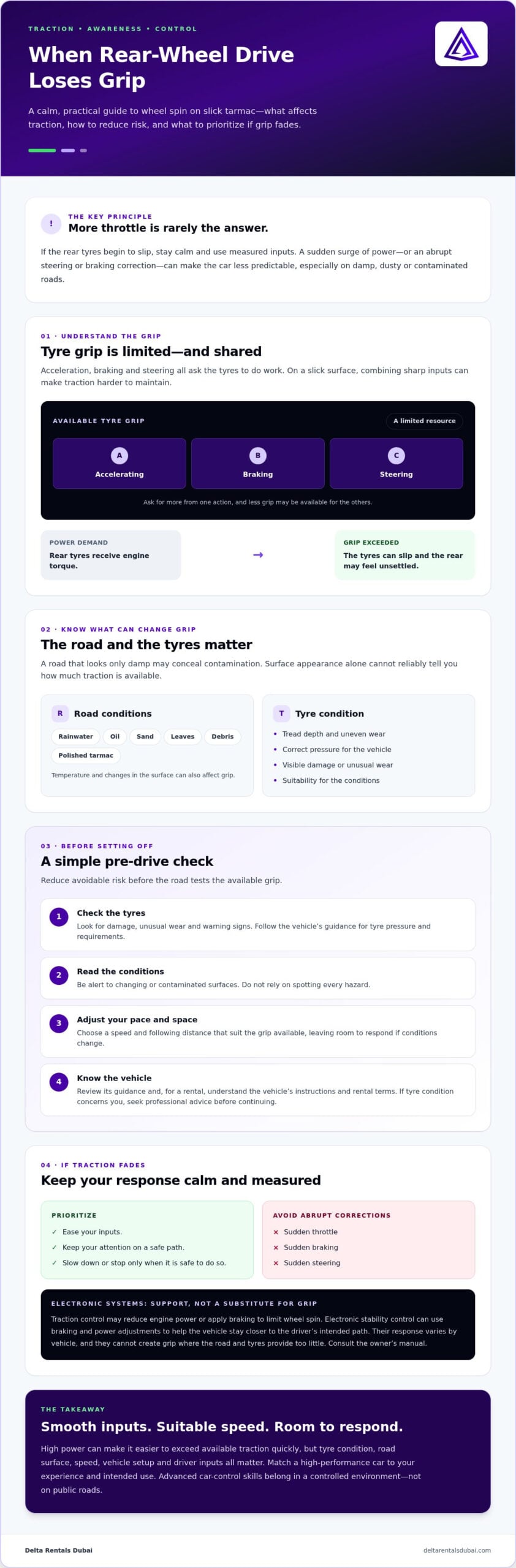
What to do before and during wheel spin on a slick road
A simple routine can reduce risk, but no sequence guarantees recovery if a car loses grip. Start before you move: assess conditions, keep your speed measured and leave room to respond. If traction begins to fade, avoid panic and prioritise a safe path over trying to save time or demonstrate control.
Reduce the chance of wheel spin before setting off
Check the tyres, visible road conditions and any relevant vehicle warnings before you set off. Do not ignore a damaged tyre or a warning you do not understand. Follow the vehicle guidance, and seek professional advice if you are unsure whether the car is safe to drive.
- Assess the surface. Watch for water, debris, polished patches and sudden changes in road appearance. Remember that some hazards are difficult to see.
- Set a cautious pace. Reduce speed to suit visibility, traffic and conditions. Do not test acceleration or traction on public roads.
- Leave extra space. Increase your following distance so you have more time to respond without harsh braking.
- Keep inputs smooth. Apply the accelerator, brakes and steering progressively. Avoid sudden changes, particularly on a low-grip surface.
If the rear tyres start to lose grip
Stay focused. If the car begins to feel unsettled, avoid a sudden throttle input, sharp steering correction or abrupt braking. Look towards a safe path and keep your inputs measured. The right response depends on the vehicle, speed, road and direction of travel, so this is not a guaranteed recovery method or a substitute for vehicle-specific guidance.
If you are inexperienced, the slide is developing or you do not feel confident continuing, do not practise a recovery in traffic. Reduce speed as safely as the situation allows, then stop in a suitable place away from moving traffic when possible. If the vehicle still feels unsafe or you are unsure what to do next, seek assistance. Advanced car-control skills belong in a controlled setting with qualified instruction.
When dealing with high horsepower rear wheel drive wheel spin on slick tarmac, prevention matters more than a last-second correction. If you are considering a high-performance rental, make sure the vehicle suits your experience and intended use, and confirm current availability and applicable terms before booking. Ask about vehicle suitability and rental terms.
Choose a high-performance car responsibly, and know when not to drive
A performance car should suit the driver, the conditions and the journey, not just its power or reputation. Be honest about your experience with rear-wheel drive, how comfortable you are managing a responsive car, and whether you can adapt calmly when the road or weather changes. Confidence matters, but it cannot replace sound judgement.
Is a powerful rear-wheel-drive car right for every driver?
Not always. A car that feels manageable on a dry, familiar route may demand more attention when grip is reduced or conditions become unpredictable. If you are unfamiliar with a vehicle’s controls, take time to understand its guidance before driving. If the surface, visibility or your own comfort level gives you pause, postponing the drive is sensible. Prestige does not make a car easier to control.
That judgement is especially useful when dealing with high horsepower rear wheel drive wheel spin on slick tarmac. The safest choice may be to avoid the drive until conditions improve or to choose a vehicle that better matches your experience and intended use. No rental choice can guarantee favourable road conditions, and a rental provider is not a substitute for driver training.
Plan a rental around the driving experience you want
Before booking, review the rental requirements and applicable terms. Ask what vehicle guidance is available, and make sure you understand the car’s controls and driver-assistance settings before setting off. Confirm current availability and terms directly rather than assuming a specific vehicle or arrangement will be available.
Delta Rentals Dubai offers a Porsche 911 GT3 RS rental. If you are researching that model, explore Delta Rentals Dubai’s rental options, then consider whether the car suits your experience, planned journey and expected conditions. Choose for a well-matched driving experience, not simply for the badge or power.
If you would like to discuss the Porsche 911 GT3 RS rental and ask about vehicle suitability or applicable rental terms, contact Delta Rentals Dubai on WhatsApp. Take the time to make an informed choice, and do not drive if the conditions or your confidence are not right.
Make your next drive a considered one
Managing wheel spin starts with respecting the grip available. Slick tarmac, tyre condition and abrupt inputs can all affect traction. Stability systems can assist, but they cannot defeat the limits of the road. If the car feels unsettled, stay measured and prioritise a safe place to stop over attempting a risky recovery.
When dealing with high horsepower rear wheel drive wheel spin on slick tarmac, preparation and sound judgement matter more than power. Check the vehicle guidance, adapt your pace to conditions and choose a car that matches your experience. If conditions feel unsuitable, postponing the drive is a sensible decision.
Delta Rentals Dubai lists the Porsche 911 GT3 RS as a rental offering. If you are considering it, ask the rental team about current availability and applicable terms before booking. Ask about the Porsche 911 GT3 RS rental and make your choice with care. A thoughtful plan is a better start to an enjoyable drive.
Frequently Asked Questions
Why do high-horsepower rear-wheel-drive cars spin their tyres on slick tarmac?
Rear-wheel-drive cars send engine power to the rear tyres, and wheel spin can occur when torque exceeds the grip those tyres have available. Slick or contaminated surfaces can reduce that grip. Sudden throttle, worn or unsuitable tyres and changing road conditions may raise the risk. The key to dealing with high horsepower rear wheel drive wheel spin on slick tarmac is to consider the whole picture: power, tyres, surface, vehicle systems and driver inputs.
Should I accelerate or ease off when the rear wheels start spinning?
Avoid adding a sudden burst of throttle. Smoothly easing your inputs may reduce the demand on the rear tyres, but no single response guarantees recovery in every vehicle or situation. Keep traction and stability systems enabled during ordinary public-road driving, and avoid abrupt steering or braking. If the car feels unstable or you cannot continue confidently, focus on stopping safely when possible rather than attempting a risky recovery.
Can traction control prevent wheel spin on slick roads?
Traction control can help manage wheel slip by reducing engine power or applying braking, depending on the vehicle. It cannot create grip that the tyres and road do not provide, so wheel spin may still occur on a slick surface. System behaviour and settings vary between cars. Keep driver-assistance systems enabled for normal public-road driving, and consult the vehicle manual to understand how its traction and stability features operate.
Are high-performance tyres enough to prevent wheel spin in the wet?
No. No tyre can guarantee grip on every wet or slippery surface. Traction also depends on tyre condition, suitability, pressure, road contamination, temperature, speed and driving inputs. Follow the vehicle’s guidance on tyre requirements and pressure, and have tyres inspected professionally if you notice damage, unusual wear or other concerns. If conditions are poor, reduce speed and leave more space instead of relying on tyre type alone.
What should I do if my car starts sliding on a slick road?
Stay calm and avoid sudden control inputs. The appropriate response depends on the vehicle, speed and direction of the slide, so a universal steering or braking formula could be misleading. Focus on avoiding further hazards, and follow the vehicle manual and any qualified instruction you have received. If the car remains unsettled or you are not confident continuing, stop somewhere safe when possible and seek assistance.
Is it safe to practise controlling wheel spin on public roads?
No. Deliberately causing wheel spin on public roads puts you and other road users at risk, and grip can change unexpectedly. Keep traction and stability systems enabled during ordinary driving, and do not use public roads to test a car’s limits. If you want to develop advanced car-control skills, seek qualified instruction in a properly controlled environment and follow its safety requirements. Practise only where the setting is designed for it.
Should I rent a high-horsepower rear-wheel-drive car if I am inexperienced?
Choose based on your experience, comfort and the conditions you expect to drive in. Read the rental requirements and vehicle guidance, and ask the rental provider about suitability and applicable terms before booking. Delta Rentals Dubai lists a Porsche 911 GT3 RS rental, but current availability and terms should be confirmed directly. A premium car does not replace experience, and you can postpone driving if conditions make you uncomfortable.