

What if the pickup plan looked complete, but one delegate, suitcase, or arrival update was missing? Coordinating multi-car pickups for a corporate delegation takes more than assigning vehicles. Different arrival times and pickup points can quickly turn a smooth schedule into missed handoffs.
It’s easy to focus first on the cars. But matching each passenger to the right vehicle, luggage capacity, pickup point, and destination is what keeps the delegation moving. A single, accurate run sheet gives organizers and providers one shared reference, with clear responsibilities when plans change.
This guide shows you how to build that plan from the ground up. You’ll learn what to include in a passenger and pickup manifest, how to compare vehicle and provider arrangements against your group’s needs, and which contingencies to confirm before travel. You’ll also see how to communicate updates and assign ownership so late arrivals or missed connections don’t derail the schedule. If you’re considering premium vehicles or chauffeuring, verify availability, passenger capacity, pickup arrangements, and itinerary support directly with the provider.
Key Takeaways
- Start with the delegation’s itinerary and passenger needs to determine the right vehicle mix, not just the headcount.
- For coordinating multi-car pickups for a corporate delegation, create one version-controlled run sheet that keeps passenger, arrival, luggage, and destination details aligned.
- Compare single-provider, multiple-supplier, and chauffeur-led arrangements by coordination effort, schedule control, and what each requires you to confirm.
- Set a response plan for delays or missed connections, with a named decision-maker, backup contact, and approved update channel.
- Before booking, get written confirmation of vehicles, pickup points, destinations, responsibilities, communication contacts, and change terms.
Start with the delegation’s itinerary, not the number of cars
Several delegates, arrival times, pickup points, and vehicles must work as one plan. Start by mapping the journeys, rather than dividing the passenger total by an assumed number of seats. A group of the same size may need a different arrangement if people arrive at different times, carry substantial luggage, request accessibility accommodations, or need to reach separate destinations.
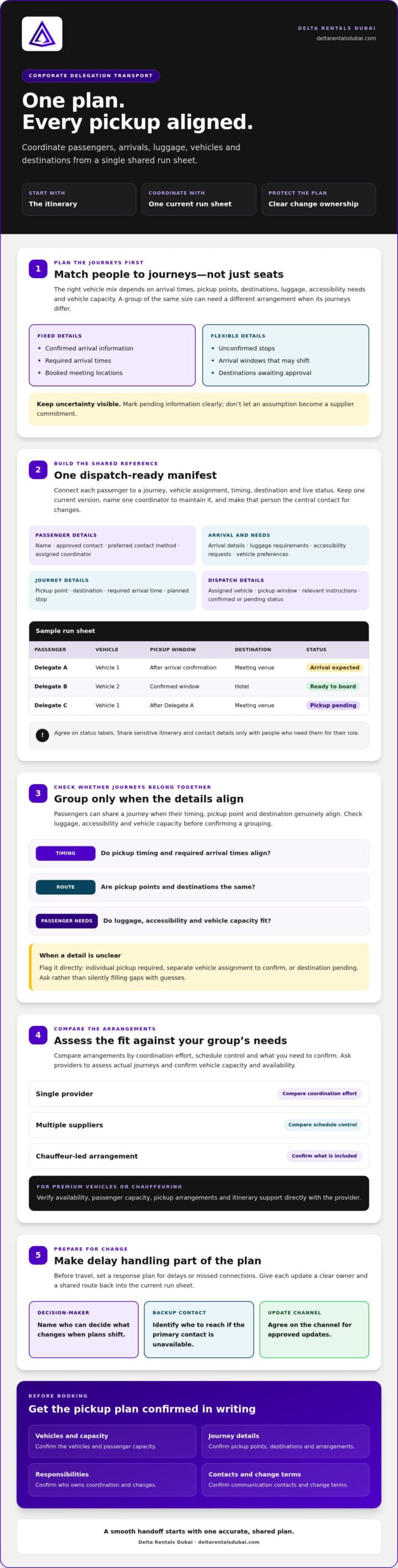
A disciplined approach to coordinating multi-car pickups for a corporate delegation starts with two categories: fixed details and flexible details. Fixed details might include confirmed arrival information, required arrival times, and booked meeting locations. Flexible details could include an unconfirmed stop, an arrival window that may shift, or a destination awaiting approval. Label uncertainty clearly. Don’t let a supplier proposal turn an assumption into a commitment. This itinerary-first approach also fits within broader corporate travel management, where transport arrangements need to support the wider business schedule.
Before requesting proposals, assemble the same core information for every supplier: passenger count by journey, pickup and destination details, timing, luggage and accessibility needs, vehicle preferences, planned stops, and any itinerary details that could change. Ask providers to assess the actual journeys and confirm vehicle capacity and availability, rather than selecting vehicles by headcount alone.
Which delegation details should you collect first?
Create one entry per passenger, then connect each person to a journey. Capture:
- Identity and contact: passenger name, preferred contact method, and assigned coordinator.
- Arrival and needs: arrival details, luggage requirements, accessibility requests, and vehicle preferences.
- Journey: pickup point, destination, required arrival time, and any planned stop.
Keep confirmed information distinct from pending details. For example, mark an arrival time as provisional if it hasn’t been confirmed, and identify who will update it. This gives suppliers a usable brief without suggesting every detail is settled.
How do you distinguish shared and separate journeys?
Group passengers only when their timing, pickup point, and destination genuinely align. Two delegates arriving close together may still need separate assignments if one has a different destination or a tighter arrival requirement. Check each proposed grouping against luggage, accessibility, and vehicle capacity before treating it as workable.
Flag exceptions directly in the itinerary: individual pickup required, separate vehicle assignment to confirm, or destination pending. Don’t fill gaps with guesses. A clear question for the supplier or travel coordinator is safer than a silent assumption that could leave a passenger waiting or send a vehicle to the wrong place.
Build a dispatch-ready manifest and schedule
A single run sheet is the control point for coordinating multi-car pickups for a corporate delegation. Once passenger details are confirmed, bring them together with vehicle assignments, timing, destinations, and live status updates. Keep one current version, name one coordinator to maintain it, and make that person the central contact for changes. This helps prevent conflicting instructions from reaching different drivers or suppliers.
What belongs in a corporate pickup manifest?
Use a consistent passenger identifier and approved contact details. For each journey, record the assigned vehicle, pickup point and window, destination, and relevant instructions, such as luggage needs or an agreed meeting point. Share sensitive itinerary and contact information only with people who need it for their role. Label entries as confirmed or pending so assumptions don’t become dispatch instructions.
A sample layout might look like this:
| Passenger | Vehicle | Pickup window | Destination | Status |
|---|---|---|---|---|
| Delegate A | Vehicle 1 | After arrival confirmation | Meeting venue | Arrival expected |
| Delegate B | Vehicle 2 | Confirmed window | Hotel | Ready to board |
| Delegate C | Vehicle 1 | After Delegate A | Meeting venue | Pickup pending |
Use real details in the working document, and agree on the status labels everyone will use. The sample is a planning aid, not a fixed vehicle recommendation.
How should you sequence pickup windows?
Build timing around the difference between an estimated arrival and confirmation that a passenger is ready. Allow a suitable buffer for the arrival process and movement to the agreed pickup point, then confirm the actual departure with the coordinator. For shared journeys, state the dependency clearly: for example, whether the vehicle waits until all assigned passengers are accounted for or the coordinator authorizes another arrangement.
- Monitor arrivals: Update each passenger’s status as information is confirmed.
- Confirm readiness: Check that the passenger has reached the agreed pickup point.
- Dispatch and verify: Share the current assignment and confirm boarding with the coordinator.
- Reconcile the group: Complete a headcount against the manifest before departure.
- Close each journey: Mark the final drop-off complete and record any outstanding change.
Give the coordinator responsibility for issuing updates and maintaining the latest version. Set an update time or trigger for changes, and make sure suppliers and relevant team members know where to find the approved run sheet.
If premium vehicle options may suit the delegation, ask about premium vehicle options and confirm availability and arrangements for the planned itinerary.
Compare transport arrangements against the delegation’s needs
The right fit depends on how closely the journeys align, which vehicles are available, and who will manage changes on the day. A single provider may reduce the number of contacts, while multiple suppliers can offer different vehicle options but require more coordination. Chauffeur-led and self-drive bookings also affect who handles navigation, timing, and passenger communication.
A suitable arrangement fits the itinerary, has confirmed capacity for each journey, and assigns clear responsibility for updates and decisions. Use that standard to compare proposals, rather than assuming one supplier or service model is always best.
| Arrangement | Coordination effort | Schedule control | Vehicle consistency | Confirm before booking |
|---|---|---|---|---|
| One provider for multiple vehicles | Potentially fewer contacts, if one person coordinates all assignments | Depends on the provider’s ability to support the itinerary | May be easier to align, subject to fleet availability | Every vehicle, pickup, destination, timing, and change process |
| Multiple suppliers | Higher, with separate confirmations and contacts to manage | Organizer must align schedules and share updates across providers | May vary between suppliers | Responsibilities, arrival windows, communication, and each supplier’s service scope |
| Chauffeur-led arrangement | Can reduce the delegation’s driving tasks, but still needs a coordinator | Confirm how itinerary updates and delays are handled | Depends on the vehicles confirmed | Chauffeur availability, passenger capacity, boundaries, and schedule support |
| Self-drive vehicles | Requires clear driver assignments and coordination among passengers | Drivers manage their own routes, subject to the agreed plan | Depends on selected and available vehicles | Vehicle assignment, driver responsibility, pickup logistics, and itinerary changes |
When might one provider simplify multi-car coordination?
One provider may make it easier to keep vehicle selection and passenger assignments in a single confirmation, but don’t assume it can meet every fleet or schedule requirement. Ask whether one contact can confirm all requested vehicles and pickup details together in writing. Verify that the specific vehicles are available on the required dates and that passenger capacity suits each assigned journey.
When should you assess chauffeured versus self-drive options?
Consider who will drive, manage navigation, and relay schedule changes. Chauffeuring may suit a delegation that wants passengers focused on the itinerary, while self-drive puts those tasks with assigned drivers. Confirm chauffeur availability, service boundaries, passenger capacity, and itinerary support directly. Premium vehicle rentals and luxury chauffeuring are available options to ask about, but confirm the scope and availability for your specific plan before booking.
Compare each proposal against the same manifest and itinerary. That gives you a practical basis for choosing an arrangement without relying on assumptions about fleet availability or service details.
Prepare for delays, changes, and missed connections
Even a well-planned schedule can shift. A flight may arrive late, a pickup point may change, or a passenger may not respond. Before travel day, agree on a simple response process so the coordinator can act quickly without sending conflicting instructions. Confirm with each supplier which changes they can accommodate, who receives updates, and how soon information must be shared to remain actionable.
Name one decision-maker for operational changes and a backup contact if that person is unavailable. Choose one approved channel for updates, such as a designated messaging thread or dispatch contact, and require acknowledgement for changes that affect a vehicle assignment or pickup time. Keep a live status column in the run sheet, with timestamps for updates and a clear record of what was confirmed.
What should the coordinator do when an arrival is delayed?
Use a consistent sequence. Check the latest verified arrival information, then notify the supplier contact assigned to that journey. Update the passenger’s status, pickup window, and any affected vehicle assignment in the run sheet. Tell impacted passengers what’s confirmed and what remains uncertain, without presenting an estimate as a firm departure time.
If a passenger is unreachable, record the attempted contact and time, then follow the agreed escalation path. The decision-maker should decide whether the vehicle waits, proceeds with other assigned passengers, or follows another supplier-approved option. Don’t leave drivers or delegates to make conflicting decisions independently.
How can you prevent confusion during handoffs?
Give each group clear meeting instructions and the coordinator’s contact details before arrival. Specify the agreed pickup point in plain language, along with what passengers should do if they can’t locate the vehicle or coordinator. When an instruction changes, send one concise update through the approved channel and request acknowledgement from both the supplier contact and affected passengers.
- Late arrival: Verify the update, notify the supplier, revise the status and pickup window, then inform affected passengers.
- Changed details: Confirm the change with the decision-maker, update the run sheet, and share the revised instruction.
- No passenger response: Log contact attempts, alert the backup contact if needed, and follow the agreed decision path.
For coordinating multi-car pickups for a corporate delegation, make the contingency plan specific: who decides, who communicates, which channel is authoritative, and what timing or itinerary changes the supplier can support. Premium vehicle rentals and luxury chauffeuring are available options to ask about, but availability and itinerary support should be confirmed for the specific booking. Ask about vehicle options for your delegation.
Confirm the supplier, vehicles, and pickup plan before booking
Before you commit, compare the supplier’s written confirmation with the final itinerary. A verbal agreement or general vehicle list may not confirm whether every requested vehicle is available on the required dates or whether the supplier can support each pickup and destination. For coordinating multi-car pickups for a corporate delegation, confirm the full arrangement journey by journey.
What should you request in writing before confirming?
Ask for written confirmation of the vehicle count and model for each assignment, service dates, pickup points, destinations, and agreed timing. Confirm who handles passenger updates, schedule changes, and day-of coordination, including the named contact and backup. Review the booking terms and any limits on waiting, itinerary changes, or service scope before treating the plan as confirmed.
- Vehicles: Confirm each model, assignment, passenger capacity, and luggage suitability.
- Itinerary: Check dates, pickup points, destinations, stops, and required arrival times.
- Responsibilities: Identify who coordinates passengers, communicates updates, and approves changes.
- Terms: Clarify which changes the supplier can accommodate and any relevant service limits.
Match vehicle suitability to the actual passengers and luggage, not appearance alone. If a larger vehicle is under consideration, verify its passenger and luggage capacity directly for the intended journey. Premium vehicle rentals and luxury chauffeuring are options to enquire about when they may suit the delegation. Confirm availability across the requested vehicles, pickup arrangements, and itinerary support for the specific booking.
How should you make a concise supplier enquiry?
Send a brief, structured request with the delegation size, itinerary, timing, vehicle preferences, and required service type, such as self-drive or chauffeur service. Ask the supplier to identify any details that remain unconfirmed, when they can verify them, and what information they need to assess capacity. This makes proposals easier to compare and helps surface gaps before you book.
Keep the request practical: “Please confirm the requested vehicles for these dates, the passenger and luggage capacity for each assignment, and whether the listed pickup points and itinerary can be supported. Please also identify the operational contact, change process, and any service limits.” Treat the arrangement as confirmed only when the written response addresses the details that matter to your group.
Discuss your delegation’s vehicle requirements.
Turn your pickup plan into a confident booking
A smooth delegation transfer starts with the itinerary, not a guess at vehicle count. Match each passenger to a confirmed journey, keep one current manifest, and assign a coordinator to manage updates. Before booking, compare the arrangements against your group’s timing, luggage, destinations, and need for schedule flexibility. Then get vehicle assignments, service dates, pickup points, responsibilities, and change terms confirmed in writing.
That’s the foundation of coordinating multi-car pickups for a corporate delegation: a plan every stakeholder can follow, with clear ownership when details shift. If premium vehicles or chauffeuring may suit your itinerary, available options include the Porsche 911 GT3 RS, Rolls-Royce Cullinan Black Badge, and Range Rover Sport V8, as well as luxury chauffeuring. Confirm availability, passenger capacity, and itinerary support directly before making arrangements.
Discuss your corporate vehicle requirements and share the details of your planned journeys. With the right information confirmed and responsibilities clear, you can move forward with greater confidence and keep the delegation’s schedule on track.
Frequently Asked Questions
How do you coordinate multiple car pickups for a corporate delegation?
Use one shared, current run sheet that links every passenger to an arrival, pickup point, vehicle, and destination. A reliable approach to coordinating multi-car pickups for a corporate delegation starts with the itinerary, then assigns one coordinator to maintain updates and contact suppliers. Set pickup windows, identify shared journeys and separate transfers, and agree on a response process for delays. Confirm vehicle assignments and responsibilities with the supplier in writing before travel.
How many cars do you need for a corporate delegation?
The right number depends on journey timing, destinations, passenger and luggage needs, accessibility requests, and the capacity of vehicles being considered. Passenger count alone isn’t enough: delegates arriving at different times or heading to separate locations may need distinct assignments. Map each journey first, then ask providers to confirm capacity and vehicle availability for the required dates. Avoid assuming passengers can share a vehicle just because they’re part of the same group.
Should a corporate delegation use one transport provider or several?
Choose based on the itinerary and each provider’s confirmed ability to meet it. One provider may simplify communication if they can confirm every requested vehicle and pickup detail together. Multiple suppliers may offer more choice, but the organizer must align separate schedules, contacts, and change updates. Compare coordination effort, schedule control, vehicle consistency, and responsibilities. Neither arrangement is automatically best; request written confirmation for each journey before deciding.
What information should a multi-car pickup manifest include?
Include each passenger’s name or agreed identifier, approved contact details, arrival information, assigned coordinator, vehicle assignment, pickup point and window, destination, and status. Record luggage needs, accessibility requests, planned stops, and special instructions that affect the journey. Mark details as confirmed or pending, and timestamp important updates. Keep sensitive itinerary and contact information accessible only to people who need it to coordinate or complete the transfer.
How should you handle a delayed delegate during a coordinated pickup?
Check the latest verified arrival information, then notify the supplier contact assigned to that journey. Update the run sheet with the passenger’s status, revised pickup window, timestamp, and any affected vehicle assignment. Tell impacted passengers what’s confirmed and what remains uncertain. Follow the agreed decision process if the delegate is unreachable, including who can authorize the vehicle to wait or proceed. Don’t let separate contacts issue conflicting instructions.
Can one rental provider arrange several premium vehicles for a corporate group?
Possibly, but confirm availability for the specific dates rather than assuming one provider can supply every requested vehicle. Ask for written confirmation of each model, passenger and luggage capacity, assignment, pickup arrangements, and any itinerary support. Premium vehicle rentals include options such as the Porsche 911 GT3 RS and Rolls-Royce Cullinan Black Badge, alongside luxury chauffeuring. Confirm directly whether a provider can support your specific multi-vehicle booking.
When should you contact a provider about multi-car corporate pickups?
Contact providers once you can share the likely dates, delegation size, itinerary, timing, destinations, and vehicle preferences. This gives them useful information to assess the request and identify what still needs confirmation. If some details are pending, label them clearly and ask when availability and service scope can be verified. Confirm all vehicles, arrangements, responsibilities, and booking terms in writing before treating the plan as final.