
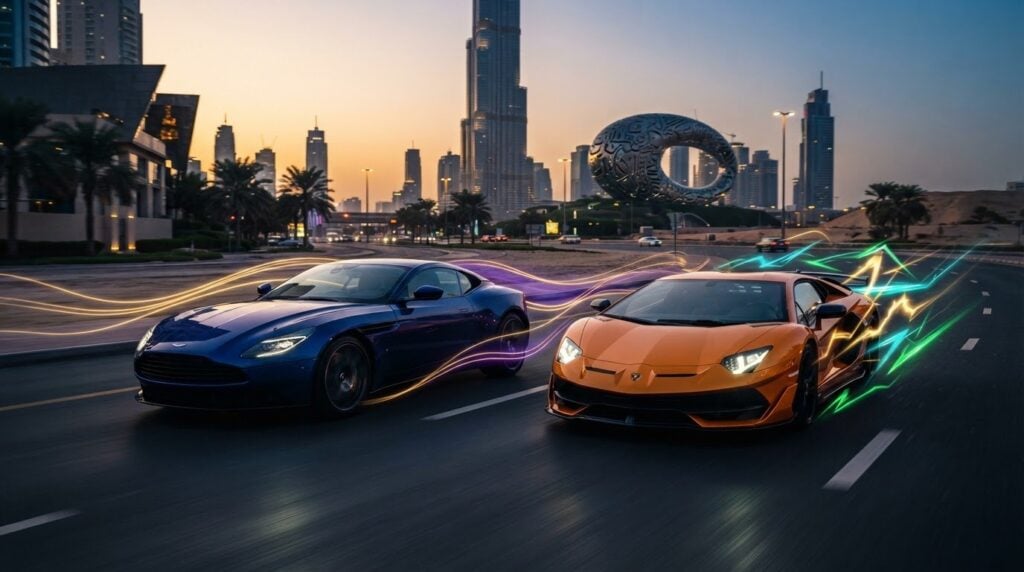
A twin-turbo V8 can feel every bit as immediate as a V12, while a V12 can deliver more than a silken, high-revving surge. Comparing 12 cylinder smoothness to twin turbo v8 power delivery is not simply a matter of deciding that more cylinders mean smoother running or that turbocharging means a dramatic punch. Cylinder count sets a baseline; engine design, tuning, transmission, and hybrid assistance shape what reaches the driver.
It’s easy to associate V12s with effortless refinement and twin-turbo V8s with forceful acceleration. Those impressions have a mechanical basis, but they don’t tell the whole story. In newer hybrid performance cars, electric motors can add torque immediately and help cover the time turbochargers need to build boost, narrowing the traditional gap in response.
This guide explains what you’re likely to feel behind the wheel, from idle smoothness and throttle response to sound and acceleration. You’ll see why engines with the same layout can behave differently, how hybrid systems change the comparison, and which character may suit your driving preferences. Use the practical checks below to focus on the car’s real-world feel, not just its engine label.
Key Takeaways
- Separate engine refinement from acceleration character to judge what you’ll actually feel, rather than relying on cylinder count alone.
- Engine balance, turbocharger behaviour, and calibration can shape smoothness and response in very different ways.
- Compare sound, low-speed refinement, throttle response, and mid-range acceleration to focus on the driving traits that matter to you.
- When comparing 12 cylinder smoothness to twin turbo v8 power delivery, consider how the exact vehicle’s tuning and hybrid assistance may affect its character.
- Compare vehicles under similar conditions, then choose based on your preferred refinement, response, sound, and intended drive.
12-Cylinder smoothness vs. twin-turbo V8 power delivery: why the difference is more than cylinder count
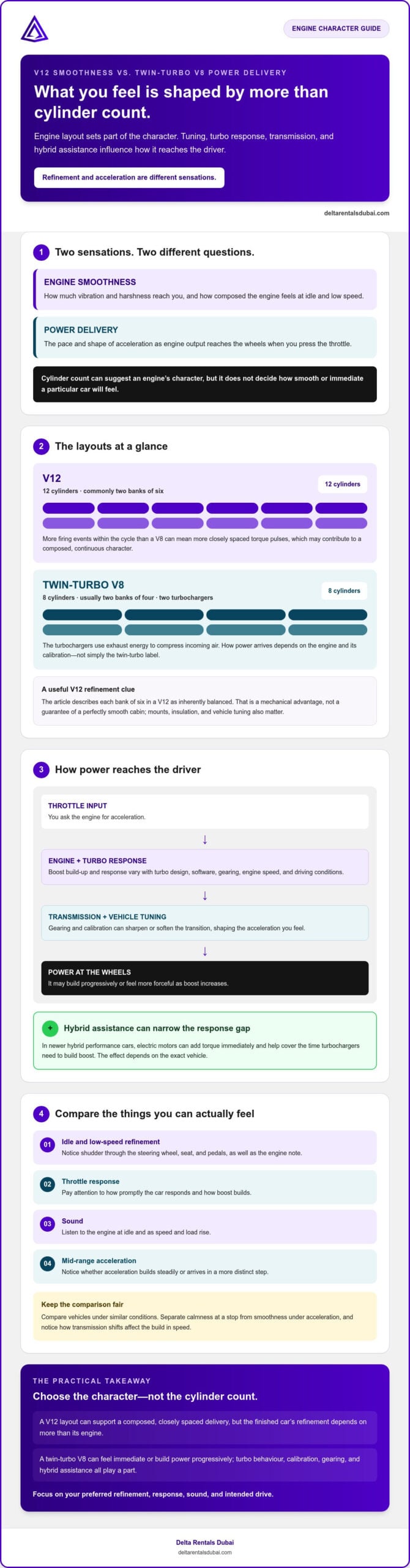
Smoothness and power delivery describe different sensations. Smoothness is how much vibration and harshness reach you; power delivery is how acceleration builds when you press the throttle. That distinction matters when comparing 12 cylinder smoothness to twin turbo v8 power delivery. A 12-cylinder engine has twelve cylinders working together, commonly arranged in two banks of six. A twin-turbo V8 has eight cylinders, usually arranged in two banks of four, with two turbochargers using exhaust energy to push more air into the engine.
In short, perceived smoothness is the engine’s felt vibration and sound; power delivery is the pace and shape of acceleration as engine output reaches the wheels. Cylinder count influences both, but doesn’t decide them. Engine layout and balance, turbo sizing, control software, transmission gearing, mounts, cabin insulation, and overall vehicle tuning all affect what the driver experiences.
What does engine smoothness feel like from the driver seat?
At low speed, refinement shows up as minimal shudder through the steering wheel, seat, and pedals, along with a composed engine note. A V12’s layout can reduce certain vibration forces: each bank of six is described as inherently balanced. That’s a useful mechanical advantage, not a promise that every V12 feels perfectly smooth. Engine mounts and sound insulation can soften or reveal vibration, while vehicle tuning shapes how the engine sounds and responds.
Low-speed refinement is also different from smooth acceleration under load. A car can feel calm at idle but deliver acceleration in distinct steps as the transmission shifts or engine output rises. During a comparison, notice both sensations separately: how composed the car feels at a stop and how steadily it gains speed.
What does twin-turbo V8 power delivery mean?
Turbochargers use energy in the exhaust gases to spin turbines that compress incoming air. More air allows the engine to produce more power, but the way that power arrives depends on the engine and its calibration. Turbo response can vary with turbo design, software, gearing, engine speed, and driving conditions. A twin-turbo V8 isn’t automatically laggy, nor does it always deliver an immediate surge.
Think of acceleration as a rising curve: it might build progressively or become more forceful as boost increases. The transmission can sharpen or soften that transition. Hybrid assistance, where fitted, can also change the initial response, so the engine label alone won’t tell you how the car feels from the driver’s seat.
How cylinder layout and twin turbochargers shape the way power arrives
The sensation starts with how evenly the engine produces torque. In a typical four-stroke engine, each cylinder fires once every two crankshaft revolutions. A V12 has more firing events within that cycle than a V8, which can make its torque pulses feel closely spaced and contribute to a composed, continuous character. Firing frequency is only one part of the experience, though. Crankshaft design, cylinder arrangement, engine mounts, and calibration all influence how much vibration reaches the cabin.
Cylinder count can suggest an engine’s character, but it can’t predict a car’s acceleration on its own; layout, boost control, gearing, throttle mapping, and traction determine how power feels at the wheels. V, flat, and other engine layouts have different packaging and balance characteristics, and even engines with the same cylinder count can feel distinct. The engine’s mechanical behaviour is one layer; the vehicle can further refine or amplify it.
Why can a 12-cylinder feel exceptionally refined?
With more cylinders producing closely spaced power strokes, a V12 can deliver torque with fewer pronounced gaps between firing events. That may contribute to smoothness, but it doesn’t guarantee a vibration-free cabin or a seamless drive. Mounts and sound insulation affect what you feel and hear, while the transmission and engine calibration shape how smoothly acceleration builds. When comparing cars, distinguish the engine’s inherent balance from the refinement engineered around it.
How do twin turbochargers change V8 response?
A turbocharger uses exhaust flow to drive a compressor, increasing the air entering the engine. As boost builds, torque may rise across part of the rev range, but the curve depends on turbo design and control software. A twin-turbo setup doesn’t prescribe one response: engine speed, throttle mapping, gear choice, and operating conditions all matter. For a general comparison of engine tendencies, see this overview of V8 vs. V12 power delivery.
The gearbox can make the same engine feel eager or relaxed. A downshift places the engine in a more responsive range; a taller gear can soften the initial surge. Traction matters, too: if the tyres can’t use the available force, acceleration may feel restrained even as the engine produces power. In hybrid systems, an electric motor may add torque before turbo boost builds, changing the character again.
That’s why comparing 12 cylinder smoothness to twin turbo v8 power delivery means assessing the complete car, not just its engine badge. If you’re considering a performance-car rental, ask about suitable vehicles and confirm their specifications for the exact model year.
12-Cylinder vs. twin-turbo V8: compare smoothness, response, sound, and acceleration
The useful comparison isn’t “which engine is better?” but “which response suits the drive?” A V12 may deliver a refined, progressive rise in power, while a twin-turbo V8 may feel especially forceful through the mid-range. Treat these as tendencies, not guarantees. Specific engine design, transmission, vehicle setup, and hybrid assistance can outweigh broad expectations.
| Driving trait | 12-cylinder tendency | Twin-turbo V8 tendency |
|---|---|---|
| Low-speed refinement | Can feel especially composed, depending on mounts and cabin isolation. | Can also be smooth when well calibrated and insulated. |
| Throttle response | May build progressively; gearing and engine tuning shape the response. | Boost and software affect how quickly power rises; hybrid assistance can alter initial response. |
| Mid-range acceleration | May feel continuous and measured. | Can deliver a pronounced surge as boost builds, though calibration varies. |
| Sound | Often has a distinctive, layered engine note, depending on exhaust design. | May sound deeper or more forceful, but exhaust tuning matters. |
| Overall character | Refinement may be a priority. | Strong response may be a priority. |
Which engine usually feels smoother at everyday speeds?
A well-engineered V12 can feel exceptionally refined at low speeds, but there’s no universal winner. Engine mounts, cabin isolation, transmission shifts, and the road surface all influence what reaches the driver. A carefully tuned twin-turbo V8 can make steady progress without abruptness, too. On rough roads, tyre and suspension behaviour may shape perceived refinement as much as, or more than, the engine layout.
Which engine feels stronger when you accelerate?
A V12 may deliver a progressive rise in power, while a twin-turbo V8 can feel more muscular as boost builds. But a dramatic surge isn’t proof of greater performance. Gear selection, throttle mapping, traction, vehicle mass, and hybrid systems all affect the impression. In a hybrid, electric torque may help fill the interval before turbo boost rises, making response feel more immediate.
That’s why comparing 12 cylinder smoothness to twin turbo v8 power delivery calls for attention to the exact vehicle, not just its cylinder count. More cylinders don’t automatically mean more usable power or a better experience. Focus on the qualities you notice: smooth cruising, quick response, a particular sound, or a satisfying build of acceleration.
How to choose between 12-cylinder smoothness and twin-turbo V8 response
Choose by the sensations you value, then check how the complete vehicle delivers them. Engine labels offer a starting point, not a verdict. Use this checklist to focus a comparison on your own priorities:
- Set your refinement preference. Do you want a calm cabin and composed cruising, or are you comfortable with more vibration and mechanical presence?
- Consider the response you enjoy. Decide whether you prefer power that builds progressively, a stronger mid-range surge, or a balance of both.
- Listen from the driver’s seat. Engine and exhaust sound can seem different inside the cabin than outside it, and sound preference is personal.
- Match the experience to the drive. Think about whether you want relaxed travel, performance-focused enjoyment, or a car that can offer both.
Choose refinement or a more pronounced power surge
A V12 may appeal if composed cruising and a continuous-feeling rise in power matter most. A twin-turbo V8 may suit you if you enjoy a more noticeable push as boost builds. Neither character is guaranteed by the engine type. Compare vehicles on a legal, safe drive, or as a passenger, and pay attention to throttle response at ordinary speeds as well as cabin refinement. Confirm each vehicle’s exact model year and specifications before drawing a model-to-model conclusion.
Sound deserves its own judgment. Cabin insulation, exhaust tuning, and driving mode can change what you hear from behind the wheel, so an exterior sound clip won’t necessarily represent the in-car experience. If possible, listen at a steady speed as well as during acceleration.
Use the vehicle, not just the engine label, to decide
Compare the transmission, driving modes, throttle mapping, and vehicle weight when reliable specifications are available. These details influence whether power feels immediate, gradual, or forceful. Try to compare vehicles in similar conditions, using similar routes and drive settings where possible. Keep your throttle input consistent, too. That makes differences easier to notice than switching between cars on different roads or in unrelated modes.
A Porsche 911 GT3 RS can also serve as a reference point for a performance-focused car beyond this V12-versus-twin-turbo V8 comparison. Check its specific configuration for the model year being considered. For a real-world comparison, confirm the exact vehicle specifications first, then focus on how its response and refinement feel to you.
If you’re ready to explore a performance-car experience, ask about a suitable vehicle and confirm its current specifications and availability.
Make the engine comparison real with a performance-car rental enquiry
There’s no universal winner in the V12-versus-twin-turbo V8 comparison. The better fit depends on what you value: composed refinement, a strong response when you press the throttle, a particular engine note, or a balance of these qualities. Comparing 12 cylinder smoothness to twin turbo v8 power delivery gives you a useful framework, but the specific vehicle and its setup determine the experience.
Delta Rentals Dubai offers performance-car rentals in the UAE, including the Porsche 911 GT3 RS and Lamborghini Revuelto. These are vehicle options to ask about, not a promise that either matches a particular engine preference. Exact specifications can vary by model year, so check the details before drawing a comparison.
Match your preferred driving character to an available vehicle
Start with the experience you want. Do you prioritize calm refinement, immediate-feeling response, or an engine sound that makes the drive feel more engaging? Then ask which suitable vehicles are currently available and verify their specifications. Don’t assume a vehicle’s engine layout, turbocharging, or hybrid assistance from its name alone. Confirm the exact model year and configuration before deciding whether it fits your preference.
What to confirm before making an enquiry
For a clear comparison, ask about the specific vehicle and model year, then confirm its engine details, transmission, and any hybrid assistance. Clarify current availability and rental terms directly, too. These details help you understand what you’re enquiring about without relying on general engine stereotypes or assuming a particular driving sensation.
- Vehicle: Which exact model and model year are being discussed?
- Specification: What engine, induction system, hybrid assistance, and transmission does it have?
- Experience: Can you ask about its character and whether a suitable alternative is available?
- Rental details: What terms and availability should you confirm before proceeding?
Use the comparison to identify your priorities, then verify the car in front of you. Discuss your preferred performance-car experience and ask about exact specifications, current availability, and rental details.
Choose the performance character that feels right to you
The clearest lesson from comparing 12 cylinder smoothness to twin turbo v8 power delivery is that cylinder count offers a clue, not a guarantee. Engine balance can contribute to refinement, while turbocharging, hybrid assistance, transmission, and vehicle tuning all shape how acceleration arrives. A V12 may appeal if you value a composed, progressive feel; a twin-turbo V8 may suit you if you enjoy a stronger surge. The right choice depends on the whole car and the sensations you prefer.
For a genuine comparison, check the exact model year and specifications, then focus on how the vehicle responds, sounds, and feels from the driver’s seat. Delta Rentals Dubai lists the Porsche 911 GT3 RS and Lamborghini Revuelto among its rental offerings. Confirm each vehicle’s current availability and specification before deciding which experience may suit you.
To explore a performance-car rental, contact Delta Rentals Dubai to discuss your preferred driving character and confirm vehicle details, availability, and rental terms.
Frequently Asked Questions
Is a 12-cylinder engine smoother than a twin-turbo V8?
A 12-cylinder can feel smoother, but it isn’t automatically smoother in every car. Its configuration can produce closely spaced firing events and favorable balance, helping create a refined feel. Engine mounts, transmission calibration, cabin insulation, road surface, and vehicle tuning also shape vibration and noise. A well-engineered twin-turbo V8 can feel composed at low speeds, while a V12 may still transmit noticeable sound or vibration.
Does a twin-turbo V8 have more power than a 12-cylinder engine?
Not necessarily. Either engine type can produce more power, depending on the specific design and vehicle. Displacement, turbocharger setup, engine tuning, hybrid assistance, and other engineering choices all matter. Cylinder count alone doesn’t establish a power ranking. For a meaningful comparison, check verified specifications for the exact models and model years, then consider how the transmission and vehicle weight affect the performance you experience.
What does twin-turbo power delivery feel like?
Twin-turbo power delivery can feel like acceleration building as the turbochargers use exhaust energy to increase the air entering the engine. Depending on the design and calibration, the push may rise progressively or become more pronounced through the mid-range. Throttle mapping, gear selection, and driving conditions affect the sensation. In a hybrid, electric motor torque may also make the initial response feel more immediate.
Can a V8 feel as smooth as a 12-cylinder?
Yes, a well-tuned V8 can feel very smooth, particularly during steady driving. Engine balance matters, but so do mounts, cabin insulation, transmission behaviour, and how the vehicle is calibrated. Those features can reduce vibration and soften engine noise. A V12 may have mechanical characteristics that support refinement, but the complete vehicle determines what reaches the driver. Compare specific cars rather than relying on cylinder count alone.
Which engine responds faster when you press the accelerator?
There’s no universal winner. A naturally aspirated engine, a twin-turbo engine, and a hybrid-assisted powertrain can each respond differently depending on their design and setup. Turbo response varies with engine speed, boost control, software, and gearing. A transmission downshift can also change how quickly acceleration builds. To compare fairly, consider the exact vehicle and assess its response in similar driving conditions, using the same type of throttle input.
Does a 12-cylinder always sound better than a twin-turbo V8?
No. Engine sound is subjective, and neither cylinder layout guarantees a more appealing note. Exhaust design, engine tuning, cabin insulation, and driving mode all influence what you hear. The sound from outside the car can differ substantially from the sound inside the cabin, too. If sound matters to you, listen from the driver’s seat and pay attention at different engine speeds, not just during a brief acceleration.
What should I compare before choosing between these engine experiences?
Compare low-speed refinement, throttle response, mid-range acceleration, sound, transmission behaviour, and the vehicle’s intended character. The key to comparing 12 cylinder smoothness to twin turbo v8 power delivery is to assess the whole car, not just its engine label. Confirm the exact model year, engine specification, turbocharging or hybrid assistance, and driving modes. If possible, experience both vehicles under similar conditions before deciding which feel suits you.