

The luxury SUV with the most advanced anti-roll technology isn’t automatically the better choice. Comparing active anti roll bars with traditional suspension in luxury suvs starts with how you drive, not a badge or marketing claim. Active systems can adjust their resistance to body roll, while conventional anti-roll bars have a fixed mechanical effect.
Technology designed to balance cornering control with a composed ride can be appealing. But the full suspension setup matters, and added complexity may not make a noticeable difference on your usual journeys. Comfort, handling, maintenance considerations, and how you use the SUV all deserve a fair comparison.
This guide explains how active and passive systems work, what each may offer, and which trade-offs to consider. It also covers what to verify, including the exact model year, trim, and fitted equipment, since specifications can vary. The goal is to help you choose based on your needs, not the assumption that newer is always better.
Key Takeaways
- Learn how passive anti-roll bars resist body lean and how active systems can adjust their response as the vehicle moves.
- Compare comfort, body control, system complexity, and maintenance considerations without assuming one setup is always superior.
- When comparing active anti roll bars with traditional suspension in luxury suvs, focus on how the complete system suits your driving priorities.
- Check the exact model, trim, and model year, then confirm suspension equipment in official specifications or directly with the provider.
- For a rental, consider the full driving experience and verify the vehicle’s current equipment instead of choosing based on one suspension feature alone.
What Active Anti-Roll Bars and Traditional SUV Suspension Actually Do
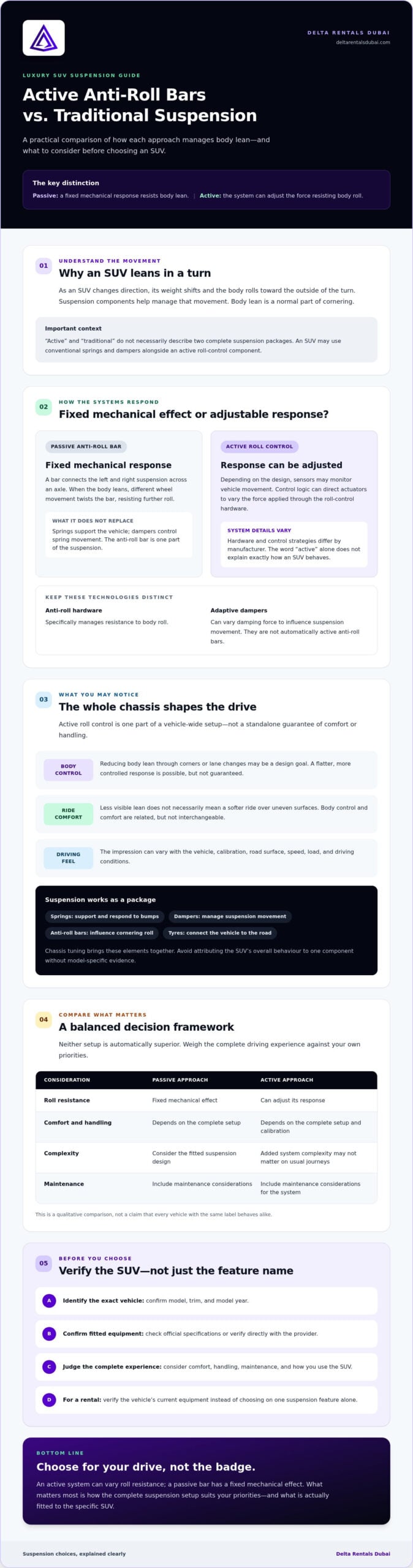
Body lean is a normal part of cornering. As a luxury SUV changes direction, its weight shifts and the body rolls toward the outside of the turn. Suspension components help manage that movement, but “traditional” and “active” aren’t necessarily two separate, complete suspension packages. An SUV may combine conventional springs and dampers with an active roll-control component.
A passive anti-roll bar resists body lean through a fixed mechanical connection; an active anti-roll system can vary the force resisting that lean. The traditional anti-roll bar, also called a sway bar, links suspension movement across an axle and twists as the wheels move differently. Its design and effect depend on the vehicle.
How a conventional suspension manages body movement
Springs support the vehicle’s weight and compress or extend as the wheels encounter bumps and dips. They store and release energy, while dampers control spring movement to limit continued bouncing after an input. Together, these components manage wheel travel and body motion.
A passive anti-roll bar connects the left and right suspension across an axle. When the body leans in a corner, the difference in wheel movement twists the bar, which resists further roll. Its mechanical response isn’t actively adjusted while driving. The bar is one part of the suspension, not a substitute for springs or dampers.
What makes an anti-roll bar active
An active system can change how much force it applies to resist body roll. Depending on its design, sensors may monitor vehicle movement and send information to control logic, which directs actuators to adjust the system’s response. Hardware and control strategies vary by manufacturer, so the word “active” alone doesn’t tell you exactly how a particular SUV behaves.
Active roll control may work alongside conventional springs and dampers or form part of a broader suspension design. It isn’t automatically the same as adaptive damping: dampers control suspension movement, while anti-roll hardware specifically manages roll resistance. Some vehicles also use semi-active dampers without active anti-roll bars.
This is why comparing active anti roll bars with traditional suspension in luxury suvs calls for more than an either-or label. Check the exact model, trim, and model year, then confirm the fitted equipment in official specifications or with the vehicle provider. Technology names and driving feel can vary, so don’t assume a setup’s behaviour from its marketing label.
How Active Roll Control Changes the Luxury SUV Driving Experience
Active roll control is designed to respond to vehicle movement as it happens. Depending on the system, sensors monitor inputs such as steering and body motion. Control logic interprets those signals and commands actuators to alter the force applied through the roll-control hardware. The aim is to manage body movement dynamically, rather than rely only on a passive bar with a fixed mechanical response. The hardware and calibration vary, so this process isn’t identical in every SUV.
Active roll control is one part of a vehicle-wide chassis setup, not a standalone guarantee of comfort or handling. Its effect depends on how it works with the rest of the vehicle and how the manufacturer has tuned the complete system.
What drivers may notice through corners and lane changes
Reducing body lean through corners or lane changes may be a design goal of active roll control. A driver might notice a flatter, more controlled response, but that impression isn’t guaranteed. It varies with the vehicle, its calibration, road surface, speed, load, and driving conditions.
Body control and ride comfort are related, but they aren’t interchangeable. Less visible lean doesn’t necessarily mean a softer ride over uneven surfaces. Suspension tuning can prioritize different qualities, and tyres also affect grip, impact harshness, and how connected the vehicle feels. Judge the complete experience rather than one sensation in isolation.
Why suspension systems work as a package
Springs support the SUV and respond to bumps; dampers manage suspension movement; anti-roll bars influence how the body responds to cornering. Tyres connect the vehicle to the road, while chassis tuning shapes how these parts work together. Changing one element can affect the balance a driver notices, so don’t attribute the vehicle’s overall behaviour to its anti-roll system alone without model-specific evidence.
Keep the technology terms distinct. Adaptive dampers can vary damping force to influence how suspension movement is controlled. Air suspension uses air springs and may allow changes in ride height or spring characteristics, depending on its design. Neither term automatically means the SUV has active anti-roll bars. A vehicle may combine these technologies or offer some without the others.
That’s why comparing active anti roll bars with traditional suspension in luxury suvs means checking the exact specification and considering the drive you want. If you’re considering a rental, ask about current luxury SUV options and confirm the model year, trim, and fitted equipment. Ask about current luxury SUV options.
Active Anti-Roll Bars vs. Traditional Suspension: A Practical Comparison
Neither setup wins by default. An active system can adjust roll resistance, which may help manage body movement in particular conditions. A conventional arrangement uses a passive mechanical response. The result depends on the vehicle’s design and tuning, so compare the complete specification rather than relying on the word “active.”
| Consideration | Active anti-roll system | Traditional passive setup |
|---|---|---|
| Body-roll management | Can vary roll resistance according to the system’s design and control strategy. | Resists roll through a mechanical response that isn’t actively adjusted. |
| System complexity | May add sensors, control logic, actuators, and related hardware. | Generally a simpler mechanical arrangement, though the full suspension varies by vehicle. |
| Maintenance considerations | Ask which components are fitted and how they’re inspected or diagnosed. | Check the manufacturer’s service guidance for the specific suspension components. |
| Buyer priorities | May appeal if adaptable body control is a priority and the vehicle’s tuning suits you. | May suit drivers who prefer familiar behaviour and a less complex arrangement. |
Potential advantages and trade-offs of active systems
Adaptable roll control may help a manufacturer target different responses as driving conditions change. However, the system’s exact behaviour, operating conditions, and interaction with other chassis features need to be verified for the specific vehicle. Two SUVs described as having active roll control may use different hardware or calibration.
Sensors, actuators, and control systems also add components compared with a basic passive arrangement. That is a complexity consideration, not proof of poor reliability or higher maintenance in every case. Don’t assume a failure rate, repair cost, or service interval. Check the manufacturer’s information for the exact model and ask what maintenance or diagnostic requirements apply.
When a traditional setup may suit the driver
A passive setup can suit drivers who value a straightforward mechanical layout or predictable, familiar responses. A well-tuned combination of springs, dampers, tyres, and passive anti-roll bars can meet varied everyday driving needs. “Traditional” doesn’t mean outdated, harsh, or less comfortable.
The key misconception is that newer technology must be better for every driver. When comparing active anti roll bars with traditional suspension in luxury suvs, weigh the driving feel you want against the vehicle’s overall design and the added system complexity. Confirm the exact model year and trim, then check the suspension equipment and manufacturer guidance before deciding.
How to Evaluate Suspension Before Choosing a Luxury SUV
Start with the vehicle’s exact specification, then assess how it feels during an ordinary drive. This keeps marketing labels from standing in for the equipment actually fitted and helps you judge whether the complete setup suits your priorities.
Questions to ask about equipment and specification
- 1. Identify the exact model, trim, and model year. Suspension equipment can change between versions and production years, so don’t rely on a model name alone.
- 2. Ask which systems are fitted. Confirm whether the specific vehicle has active roll control, adaptive dampers, air suspension, or another option. These terms describe different technologies.
- 3. Check for market and trim differences. Ask whether equipment varies by trim, model year, or the vehicle’s original market specification.
- 4. Verify the claim in an official source. Consult the manufacturer’s specification for that exact vehicle or ask the provider to confirm the equipment. Request documentation if the distinction matters to your choice.
- 5. Confirm the actual vehicle, especially for a rental. Ask about the current vehicle’s model year, trim, and suspension equipment instead of assuming every example in a model range is identical.
For a wider view of the vehicle and driving experience, consult a relevant luxury SUV guide alongside the manufacturer’s specification. A guide can help you identify what matters, but it shouldn’t replace model-specific equipment verification.
What to notice during a normal drive
Choose a suitable legal route and drive at a comfortable, appropriate pace. Notice how the SUV absorbs ordinary road imperfections, how much body movement you feel through normal bends, and whether the steering response feels natural. Consider passenger comfort too. A setup that feels composed from the driver’s seat may not be everyone’s preferred ride.
If possible, compare similar vehicles on the same route and under similar conditions. Road surface, speed, tyres, passenger load, and driving style can all affect impressions, so change as few variables as practical. Don’t test suspension through excessive speed, abrupt lane changes, or other unsafe manoeuvres on public roads.
Use your priorities to guide your questions: do you value composed body movement, familiar responses, or a less complex mechanical arrangement? Then verify the equipment instead of inferring it from driving feel alone. If you’re considering a rental, ask about current luxury SUV options and their verified specifications.
Choose the Luxury SUV Setup That Fits Your Drive
The right setup depends on what you value: controlled body movement, familiar suspension behaviour, or a less complex mechanical arrangement. Active roll control may suit a driver who values adaptable body control, but reduced lean alone doesn’t make an SUV the better choice. Consider the complete chassis and confirm what’s fitted to the exact vehicle.
Match suspension priorities to the journey
For everyday travel with passengers, consider ride comfort alongside cornering composure. Ask how the SUV feels over the road surfaces you expect to encounter, and take passenger preferences into account. For driving enthusiasts, assess the wider chassis setup, including suspension tuning and tyres. A flatter cornering response is only one part of the experience, not proof of overall superiority.
If you’re choosing a rental, focus on the vehicle you’ll actually receive. Confirm its model year, trim, and suspension specification rather than relying on a technology label or assumptions about a model range. Comparing active anti roll bars with traditional suspension in luxury suvs is most useful when you connect verified equipment to your own priorities.
Explore a luxury SUV experience with confidence
Delta Rentals Dubai offers premium vehicle rentals across the UAE, including the Range Rover Sport V8 as a listed rental offering. That listing doesn’t confirm any particular suspension technology or configuration. Ask about current luxury SUV options, then verify the specific vehicle’s equipment before making suspension a deciding factor. You can also explore luxury SUV rental options.
Choose for the whole drive: how composed the SUV feels, how comfortable it is for everyone on board, and whether its behaviour suits your plans. Enquire about current luxury SUV rental options and ask which model year, trim, and suspension equipment are confirmed.
Choose with Confidence, Then Enjoy the Drive
Active roll control can offer adjustable resistance to body movement, while a passive setup relies on a fixed mechanical response. Neither is automatically the better choice. The right fit depends on your priorities, the complete suspension and chassis tuning, and the equipment fitted to the vehicle.
The practical value of comparing active anti roll bars with traditional suspension in luxury suvs is looking beyond the technology label. Confirm the model year, trim, and specification, then consider comfort, body control, and system complexity in the context of how you’ll use the SUV.
Delta Rentals provides premium vehicle rentals across the UAE, with the Range Rover Sport V8 among its listed offerings. Confirm the suspension equipment for the specific vehicle. Ask Delta Rentals about current luxury SUV rental options and verify the vehicle’s model year, trim, and suspension equipment before you decide.
Frequently Asked Questions
What is an active anti-roll bar in an SUV?
An active anti-roll bar is part of a system designed to adjust resistance to body roll as the SUV moves. Depending on the design, sensors monitor vehicle movement and control logic directs actuators to change the force applied by the roll-control hardware. This differs from a passive bar, whose mechanical response isn’t actively adjusted while driving. Systems vary, so check the manufacturer’s description for the specific vehicle.
Are active anti-roll bars better than traditional suspension?
Not for every driver or every journey. Active roll control may offer adaptable resistance to body movement, while a passive setup has a simpler mechanical response. The result depends on the vehicle’s full suspension design, tuning, tyres, and intended use. When comparing active anti roll bars with traditional suspension in luxury suvs, consider how the vehicle feels, its system complexity, and your priorities rather than assuming newer technology is automatically superior.
Do active anti-roll bars improve comfort in a luxury SUV?
They may contribute to a more controlled feel, but they don’t guarantee a more comfortable ride. Body-roll management and comfort are related aspects of vehicle behaviour, not the same thing. Springs, dampers, tyres, seat design, and chassis tuning also shape how an SUV feels over bumps and through corners. If comfort matters, assess the complete vehicle during a normal drive and consider passenger feedback, not just its anti-roll technology.
Are active anti-roll bars the same as adaptive suspension?
No. Active anti-roll bars adjust resistance to body roll, while adaptive dampers vary damping force to manage suspension movement. Air suspension is another distinct technology, using air springs and, depending on the design, potentially adjusting ride height or spring characteristics. A vehicle may combine these systems, but terms like “adaptive suspension” don’t confirm that active anti-roll hardware is fitted. Check the manufacturer’s specification for the exact model and trim.
Can you tell whether a luxury SUV has active anti-roll bars from its trim name?
Not reliably. A trim name may refer to styling or a package and doesn’t, by itself, verify specific suspension hardware. Equipment can differ by model year, trim, and market specification. Check the official specification for the exact vehicle or ask the provider to confirm whether active roll control is fitted. If the feature matters to your decision, request a clear source rather than relying on a badge or general model description.
What should I check before choosing a luxury SUV with active roll control?
Start with the exact model, trim, and model year. Confirm active anti-roll hardware in official specifications or directly with the provider, and ask whether adaptive dampers or air suspension are also fitted. Then assess ride comfort, body movement, and steering response on a suitable legal route at a normal pace. For a rental, verify the equipment of the individual vehicle, since a model name alone doesn’t confirm its configuration.