

A carbon tub isn’t automatically the more rigid chassis. When comparing all aluminum monocoque with carbon tub chassis rigidity, the material label alone can’t settle the question. It’s reasonable to be cautious when one manufacturer quotes a stiffness figure and another makes a broad performance claim. Unless the figures use the same measurement and test conditions, they may not be comparable.
This guide explains what chassis rigidity measures, where it matters, and why it doesn’t tell the whole story about how a car performs. It also shows how structure, material, manufacturing, and components such as subframes or battery packs can affect the result.
Before trusting a headline stiffness figure, check the measurement, test setup, and whether the number applies to the complete vehicle or just part of its structure. These checks make it easier to compare aluminium monocoques and carbon tubs based on evidence rather than assumptions.
Key Takeaways
- Separate torsional stiffness from bending stiffness, material strength, crash protection, and handling feel to understand what a rigidity claim actually describes.
- Compare how each chassis architecture carries loads through its floors, sills, bulkheads, pillars, and joints, rather than judging by material alone.
- When comparing all aluminum monocoque with carbon tub chassis rigidity, treat figures as comparable only when units, test methods, and vehicle configurations align.
- Before trusting a stiffness claim, identify the exact vehicle and chassis configuration, then check the measured property, test method, and tested assembly.
- Use evidence quality and engineering execution to reach a balanced comparison. Neither aluminium nor carbon fibre is a universal winner.
What Does Chassis Rigidity Mean in an Aluminium Monocoque or Carbon Tub?
Chassis rigidity is a vehicle structure’s resistance to deformation when forces act on it. It describes how much the chassis flexes under a particular load. It doesn’t tell you, by itself, whether the material is inherently strong or whether the car will feel better to drive.
A monocoque is a load-bearing body structure, where the body shell contributes to carrying forces. Monocoque explains the structural principle. “Aluminium monocoque” identifies the architecture and its primary material. “Carbon tub” usually describes a central structural tub made from carbon-fibre composite, often as part of a larger assembly with other components. Neither label establishes how rigid a complete vehicle is.
Rigidity can describe different responses. Torsional stiffness concerns twisting, while bending stiffness concerns deflection along the structure under a bending load. A figure for one property can’t stand in for the other. When comparing all aluminum monocoque with carbon tub chassis rigidity, first establish what each figure measures.
What Is Torsional Rigidity, and Why Does It Matter?
Torsional rigidity is resistance to twisting when forces act unevenly across the vehicle, such as when the structure is loaded at opposing corners. A chassis that deforms less in a defined test may help keep suspension mounting points in a more consistent relationship to one another. That’s a structural contribution, not a guaranteed handling result.
Chassis rigidity is only one part of the driving picture. Tyres, suspension, geometry, and setup also influence how a car responds and feels. A stiffness figure can help explain the structure, but it can’t predict the complete driving experience on its own.
Is Rigidity the Same as Strength or Safety?
No. Stiffness is resistance to deformation; strength is resistance to failure. A structure may resist small movements yet behave differently when loads become large. Neither property, by itself, establishes how well a vehicle protects occupants in a collision.
Crashworthiness needs separate evidence and test context, including what was tested and under which conditions. Treat chassis stiffness data as structural information, not a safety rating. Comfort, weight, repairability, and cost are also distinct comparison criteria. A rigidity result doesn’t answer them. Keeping these measures separate makes material claims easier to assess fairly.
How Aluminium Monocoques and Carbon Tubs Resist Chassis Deformation
Both architectures manage loads by directing forces through connected structural elements. Floors, sills, bulkheads, pillars, and joints work together. The floor and sills can help resist bending, while cross-car structures such as bulkheads help distribute loads between sides. The precise load path depends on the vehicle’s design, not just the material named in a brochure.
Construction details can outweigh material labels: the shape, orientation, and connection of each structural element determine how effectively the complete assembly resists deformation. A useful comparison therefore looks beyond the headline material and asks how the full structure is designed and joined.
How an All-Aluminium Monocoque Creates a Load-Bearing Structure
An aluminium monocoque uses parts of the body structure to carry loads. Depending on the design, formed sections, castings, panels, reinforcements, and bonded or mechanically joined areas may contribute. There’s no single layout for every vehicle. Section shape and wall thickness influence how a member responds to force, while joints affect how well loads transfer between connected components.
Reinforcements can strengthen selected load paths or connection points, but placement and execution matter. Don’t assume a specific alloy, casting method, or joining process from the phrase “all-aluminium.” Check authoritative, model-specific documentation before treating those details as facts.
How a Carbon-Fibre Tub Gains Rigidity
A carbon-fibre-reinforced polymer tub is built from layers of fibres held in a resin matrix. Fibres provide much of the reinforcement, and their direction affects how the laminate responds to a load. Layers can be arranged in different orientations to address forces acting along different paths. The result depends on the fibre direction, layup, laminate design, and how sections are formed and joined.
The tub is also part of a larger vehicle structure. Attached front and rear structures, suspension mounting areas, joints, and surrounding body components influence how forces pass through the assembly. A carbon tub shouldn’t be treated as an isolated material sample or as proof that every carbon structure has identical properties.
For a specific vehicle, look for construction details and stiffness evidence tied to its exact configuration. If you’re interested in the Porsche 911 GT3 RS rental, ask for rental information separately from any chassis-performance claims.
Aluminium Monocoque vs Carbon Tub: What Makes a Fair Rigidity Comparison?
A useful comparison starts with the test, not the material. Before interpreting a chassis figure, check what property it measures, which parts were included, and how the test was performed. Comparing all aluminum monocoque with carbon tub chassis rigidity is meaningful only when the published results describe comparable properties and test conditions.
Absolute stiffness is the measured resistance to deformation of the tested structure. Stiffness-to-weight relates that stiffness to the mass of the structure or assembly. These answer different questions. A lighter design could score well relative to its weight without having greater absolute stiffness. Confirm what mass is included before comparing a ratio.
| Comparison point | What to check | Why it matters |
|---|---|---|
| Architecture | Monocoque, central tub, or complete chassis assembly | Different structures carry loads through different components. |
| Material | Specific construction, including composite layup or aluminium components | A material label doesn’t describe the full design or its execution. |
| Measurement | Torsional or bending stiffness, absolute or weight-related | Different properties and ratios aren’t interchangeable. |
| Test scope | Bare tub, body-in-white, or complete vehicle | Included parts can change the result. |
| Evidence quality | Published method, units, test setup, and vehicle configuration | Missing details limit confidence in a direct comparison. |
Which Chassis-Rigidity Measurements Can Be Compared?
Torsional stiffness is commonly reported as torque divided by angular deflection, using units such as N·m/degree. Check that both figures use the same unit and convention. If values use different angular units, convert them before comparing. Confirm whether each result covers a bare tub, a body-in-white, or a complete vehicle, and whether attached structures are included.
Look for the test conditions: how the structure was supported, where loads were applied, and which fixtures and boundary conditions were used. If the manufacturer doesn’t provide its methodology, treat the evidence as limited. If units, test scope, or vehicle configurations don’t align, mark the figures not directly comparable rather than filling the gap with an industry average.
Why Material-Only Rankings Can Mislead
Material properties don’t reveal how the whole chassis behaves. Geometry, section design, laminate orientation, reinforcements, and joining methods all influence how loads travel through a structure. A comparison based only on “aluminium” versus “carbon” ignores those design choices.
For a vehicle-specific ranking, require credible documentation for both vehicles that identifies the measured property, units, test procedure, tested assembly, and configuration. Without that match, a numerical ranking may look precise while offering little reliable basis for choosing a winner.
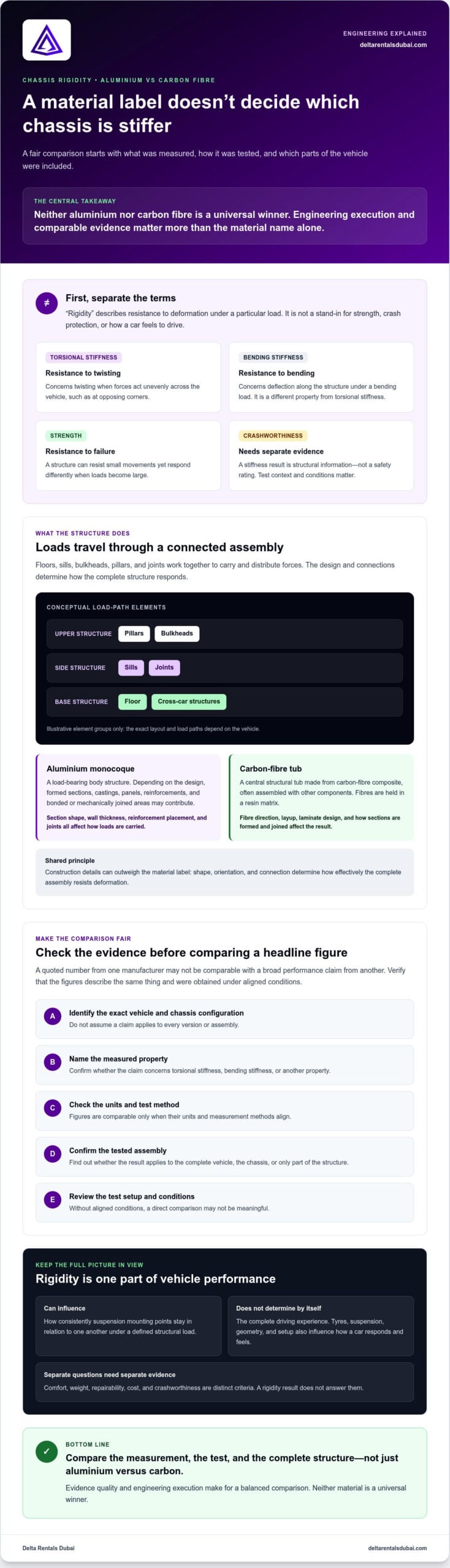
How to Evaluate Chassis-Rigidity Claims Without Falling for Material Hype
Use a repeatable check before accepting a stiffness figure as proof that one architecture is superior. This is especially useful when comparing all aluminum monocoque with carbon tub chassis rigidity, since similar-sounding claims may describe different vehicles, assemblies, or tests.
A Five-Question Checklist for Published Stiffness Figures
- Which exact vehicle and chassis configuration was tested? Record the model, version, and relevant structural configuration. Don’t assume results apply across model years or variants.
- What property does the figure measure? Confirm whether it reports torsional stiffness, bending stiffness, or another structural measurement. These aren’t interchangeable.
- What are the units and test conditions? Check the units, how the structure was supported and loaded, and whether the source describes fixtures and boundary conditions.
- What assembly was tested? Establish whether the figure covers a bare tub, body-in-white, or complete vehicle, and which attached structures are included.
- Can you compare it directly with the alternative? Look for matching measurement conventions, test methods, scope, and vehicle configuration. If key details are missing, mark the data as incomparable rather than estimating a missing value.
Then assess the source. A manufacturer’s published figure is a manufacturer claim, and it’s more useful when its method and scope are disclosed. Independent testing can add another perspective, but only when the procedure and tested assembly are clear. Engineering analysis may explain why a structure behaves as it does. Promotional language without a method or supporting data shouldn’t be treated as a measured result.
When Can the Porsche 911 GT3 RS Be a Useful Example?
The Porsche 911 GT3 RS is a useful example of how to investigate a model-specific claim, not a shortcut to a material or stiffness conclusion. Before stating its chassis construction or quoting a rigidity figure, verify the exact model and configuration against authoritative, model-specific documentation. Don’t infer a construction detail or stiffness number from the vehicle name alone.
For further reading, look for a model-specific guide that separates confirmed specifications from general engineering explanation. If you’re considering a Porsche 911 GT3 RS rental, contact Delta Rentals Dubai for rental information, keeping that separate from technical claims about the chassis.
The Right Chassis Comparison Starts With Evidence, Not a Material Winner
There’s no universal winner between an aluminium monocoque and a carbon tub. A useful rigidity comparison depends on the complete architecture, how its materials are designed and joined, and how the measurement was made. Material names offer a starting point, not a verdict. For anyone comparing all aluminum monocoque with carbon tub chassis rigidity, the strongest conclusion is the one supported by comparable, vehicle-specific evidence.
What Can Be Concluded, and What Still Needs Verification?
Give priority to authoritative manufacturer documentation and independent testing that identifies the vehicle, tested assembly, measured property, and method. If results use different test scopes or conditions, treat them as separate data points rather than ranking them. If a manufacturer doesn’t publish a figure, record it as unavailable. Missing information creates uncertainty; it doesn’t prove that the chassis is weaker or stronger.
Keep each conclusion within its evidence boundary. A rigidity figure describes a structural measurement, not crash protection, occupant safety, or how the car will feel on the road. Those questions need their own relevant evidence. Likewise, a published chassis value alone can’t settle trade-offs such as comfort, weight, repairability, or cost.
Before drawing a conclusion, ask:
- Does the source describe the exact vehicle and configuration?
- Are the test method and structural scope clear enough to assess?
- Does the alternative have evidence gathered on a comparable basis?
If any answer is no, state the limitation plainly. “Not enough comparable data” is more useful than a confident but unsupported material ranking.
Explore the Porsche 911 GT3 RS After the Engineering Deep Dive
The Porsche 911 GT3 RS can be a model-specific example only when its construction or stiffness claims have been verified against authoritative documentation. Its rental offering is a separate consideration, not proof of a technical specification or performance claim.
If you’d like to ask about the rental offering, Ask about Porsche 911 GT3 RS rental. Keep the engineering comparison evidence-led, and explore the rental on its own terms.
Make Your Next Chassis Comparison With Confidence
There’s no universal winner between an aluminium monocoque and a carbon tub. The useful answer depends on the full structure, its joints and reinforcements, and how its rigidity was measured. When comparing all aluminum monocoque with carbon tub chassis rigidity, trust figures only when the vehicles, test methods, units, and tested assemblies are genuinely comparable.
Keep the claims in their proper lanes. A stiffness figure describes resistance to deformation; it doesn’t prove crash protection or predict handling on its own. Start with authoritative manufacturer documentation, then look for independent testing that clearly explains its method. If key details aren’t available, treat the result as uncertain, not as evidence for a material-based verdict.
Ready to explore performance from behind the wheel? Delta Rentals offers Porsche 911 GT3 RS rental. The rental is separate from any chassis specification or engineering claim. Ask about Porsche 911 GT3 RS rental.
Frequently Asked Questions
Is a carbon tub more rigid than an all-aluminium monocoque?
Not automatically. Rigidity depends on the complete structure, including its geometry, reinforcements, joints, material execution, and the way it was tested. Carbon-fibre construction can be designed to resist loads efficiently, but the label alone doesn’t prove a particular tub is stiffer than a specific aluminium monocoque. Compare vehicle-specific measurements with matching units, test methods, and structural scope before drawing a conclusion.
What does chassis torsional rigidity mean?
Chassis torsional rigidity describes resistance to twisting under an applied torque. In a vehicle test, a load may be applied so the structure experiences opposing forces, and the resulting angular deflection is measured. The figure indicates how much the tested structure twists under the stated conditions. It doesn’t directly describe bending stiffness, crash protection, or how the car will feel to drive.
How is chassis rigidity measured?
Rigidity is measured by applying a defined load to a structure and recording how much it deforms. For torsional stiffness, results may be expressed as torque per degree of angular deflection, such as N·m/degree. The test setup matters: check the loading points, supports, fixtures, vehicle configuration, and included components. Without those details, a published number is difficult to interpret or compare fairly.
Does a stiffer chassis always handle better?
No. Chassis stiffness can help keep suspension mounting points in a more consistent relationship under load, but it’s only one factor in vehicle behaviour. Tyres, suspension design, geometry, and setup also shape handling and driver feel. A stiffness figure alone can’t guarantee a particular response or prove that one car will handle better. Treat it as structural information, not a complete measure of driving performance.
Why are carbon-fibre chassis structures often associated with high stiffness?
Carbon-fibre composites allow engineers to arrange reinforcing fibres in selected directions and layer them to suit intended load paths. That design flexibility can support high stiffness relative to weight in a carefully engineered structure. But carbon fibre isn’t one uniform material: fibre orientation, layup, laminate design, joints, and the surrounding vehicle structure all matter. A carbon label by itself doesn’t establish a chassis’s measured rigidity.
Can published stiffness figures for two cars be compared directly?
Only if the figures describe comparable measurements and tests. Confirm that both refer to the same property, use compatible units, and cover similar assemblies, such as a bare tub or a complete vehicle. Check the test method and vehicle configuration too. When comparing all aluminum monocoque with carbon tub chassis rigidity, missing or mismatched information means the figures aren’t directly comparable, not that either design is superior.
What is the difference between chassis rigidity and chassis strength?
Rigidity is resistance to deformation under load; strength is resistance to failure. They’re related structural properties, but they don’t mean the same thing. A stiffness figure shows how a tested structure responds within the stated test conditions. It doesn’t establish crashworthiness or occupant protection, which require separate evidence and context. Keep those claims distinct when assessing vehicle specifications or comparing chassis designs.