

What if a hypercar’s biggest cost isn’t the purchase price, but the value it may lose while it sits unused? When calculating daily depreciation costs of hypercar ownership vs flexible hiring, the answer depends on more than the price on the invoice. Your resale estimate, ownership period and driving frequency all affect the comparison.
Ownership gives you control over which car you drive and when you drive it, without booking each occasion. But depreciation is a gradual loss in value, not a daily payment, and it’s only one part of ownership. Insurance, maintenance and financing can change the full cost. Hiring has its own terms to check, including mileage limits, but gives you access to a high-performance car without buying it or managing its resale.
This guide sets out a practical way to compare both options using your own assumptions and AED figures. It covers how to estimate daily ownership costs, compare like-for-like expenses and decide which approach fits your driving habits and appetite for commitment. If you’re still considering a purchase, an extended hire can also help you assess whether a car suits your needs before you commit.
Key Takeaways
- Estimate daily depreciation using the purchase price, expected resale value and ownership period.
- When calculating daily depreciation costs of hypercar ownership vs flexible hiring, include ownership expenses beyond depreciation and compare them with verified hire terms.
- Match the hire duration, expected use and included costs before treating a quote as a fair comparison with ownership.
- Consider driving frequency, your need for control, capital commitment and comfort with resale uncertainty.
- Use a worksheet to test different resale scenarios and additional costs, then check current hire terms before deciding.
Hypercar ownership vs flexible hiring: what does a daily cost really mean?
Buying a hypercar gives you control over the vehicle and when to sell it. Flexible hiring gives you access without the responsibility of resale. To compare the two, separate the car’s estimated loss in value from the cash costs of owning it.
Depreciation is the difference between what you paid for a vehicle and what you expect to receive when you sell it. Divide that estimated loss across your ownership period to get a daily figure. It’s an economic cost allocated over time, not necessarily money leaving your account each day. Your actual cash flow may instead involve a purchase payment, loan instalments or costs paid at different intervals.
Daily depreciation is the estimated purchase value minus expected resale value, divided across ownership days. The essential inputs are acquisition price, resale estimate and holding period. This practical estimate differs from accounting approaches such as straight-line depreciation. See how depreciation is calculated for an overview of depreciation methods.
What does daily depreciation measure?
It estimates the value a vehicle may lose between acquisition and eventual resale, allocated to each day you own it. The result isn’t a guaranteed resale outcome. Actual depreciation depends on the specific vehicle, its condition, the market when you sell and how long you keep it. A shorter or longer holding period can change the daily figure, even if the estimated total loss stays the same. Use a credible resale estimate and test more than one scenario.
Which costs belong in an ownership comparison?
Depreciation is only one part of ownership. To estimate the broader daily cost, identify relevant expenses, use a consistent period and divide comparable totals by the same number of days.
- Depreciation: estimated loss between purchase and resale value.
- Financing or capital opportunity cost: include loan interest or the potential use of capital elsewhere, as relevant. Avoid counting the same capital cost twice.
- Insurance, maintenance and storage: use estimates that reflect the vehicle and your circumstances.
- Taxes or other charges: include only those verified as applicable to your situation.
Keep these categories separate from the start. A hire quote and an ownership estimate aren’t directly comparable if they cover different durations, use or included expenses. Consistent inputs make the result more useful, while still recognising that estimates can’t predict every future cost. This is the starting point for calculating daily depreciation costs of hypercar ownership vs flexible hiring.
How to calculate a hypercar’s daily depreciation cost
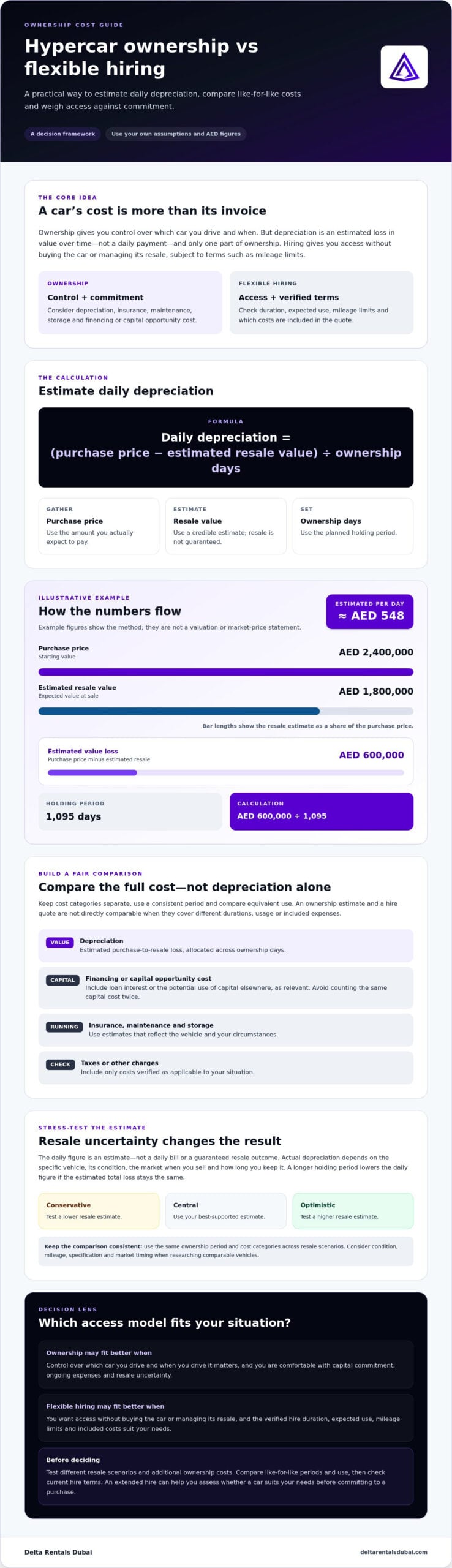
Gather three figures: the actual acquisition price, a realistic resale estimate and the number of days you expect to own the vehicle. Then use this formula:
Daily depreciation = (purchase price − estimated resale value) ÷ ownership days
For an illustrative example, assume a hypercar is purchased for د.إ 2,400,000, is expected to resell for د.إ 1,800,000 and is held for 1,095 days. The estimated loss is د.إ 600,000. Divided by 1,095, that works out to about د.إ 548 per day. These figures show how the calculation works. They aren’t a vehicle valuation or a statement of market prices.
Allocating the same estimated loss across a longer ownership period lowers the daily figure, but a different resale estimate can change the result. Treat the calculation as an estimate, not a daily bill or a guaranteed resale outcome. The IRS also describes an actual expense method for organising vehicle expenses, though that reference doesn’t determine a hypercar’s resale value.
Which inputs should owners gather before calculating?
Use the price you actually expect to pay, your planned holding period and a resale estimate supported by relevant market research. Check whether purchase and resale figures include applicable fees or taxes, and treat them consistently to avoid counting a charge twice. When researching comparable vehicles, consider condition, mileage, specification and market timing. These details can make two apparently similar resale estimates poor substitutes for one another.
How can resale uncertainty be handled?
Don’t rely on a single prediction. Create conservative, central and optimistic resale scenarios, using the same ownership period and cost categories for each. The calculation then shows how sensitive the result is to resale value, rather than creating a false impression of precision. Label each scenario as an estimate and check current market data before using figures in a decision.
This is a practical first step in calculating daily depreciation costs of hypercar ownership vs flexible hiring. Once you have an estimate, add relevant ownership expenses separately before comparing it with a hire quote. If you’re considering access without buying and reselling, you can enquire about current vehicle availability and rental terms.
Ownership vs hiring: compare the full daily cost, not depreciation alone
Depreciation is one part of the ownership picture. For a fair comparison, add relevant running and capital costs, then compare the total with a current written hire quote for the same access period and expected use. AAA’s overview of the full daily cost of ownership also explains why expenses beyond the purchase price matter.
What belongs in a fair ownership-versus-hiring table?
Choose a comparison period first, such as a month or a year, and show every amount in AED for that period. Don’t divide ownership costs by calendar days and compare them with hire charges for only a few driving days without making the difference clear. Keep depreciation separate from other owner expenses to avoid omissions and double counting.
| Cost category | Ownership | Flexible hiring |
|---|---|---|
| Vehicle access | Depreciation, allocated across the stated ownership period | Charge from a current written quote for the matched duration |
| Other costs | Relevant financing or capital cost, insurance, maintenance and storage | Items specifically included in the quote or agreement |
| Usage and terms | Expected driving pattern and any costs tied to use | Check mileage limits, insurance terms, deposit, delivery and other charges in the agreement |
Include hire terms and charges only after checking the specific agreement. Don’t assume insurance, delivery or other items are included, or that a deposit is a final cost. Record whether each amount is daily, weekly or for the full period, and note what it covers.
How do commitment and financial exposure differ?
Ownership ties capital to one vehicle and leaves you exposed to its eventual resale outcome. Hiring avoids the need to resell, but access depends on booking terms and vehicle availability. Neither option is automatically cheaper. The answer depends on owner costs, hire terms and how often you use the car.
Frequent use can change the comparison, so model your actual driving pattern. If you plan to drive on selected occasions, compare the total hire cost for those days with ownership costs over the same period, while noting that ownership also provides access between drives. For regular use, repeat the calculation using your expected schedule and include all relevant costs on both sides. This makes calculating daily depreciation costs of hypercar ownership vs flexible hiring part of a broader, like-for-like decision, rather than a verdict based on depreciation alone.
When does hypercar ownership or flexible hiring make more sense?
There’s no universal usage threshold that makes buying or hiring the better option. Start with your expected annual use, how much you value access to one specific vehicle, the capital you’re comfortable committing and your tolerance for resale uncertainty. Then compare complete costs over the same period. Frequent, predictable driving is a reason to model ownership carefully, not proof that it will cost less.
| Decision factor | Ownership may fit if… | Hiring may fit if… |
|---|---|---|
| Annual usage | You expect sustained, regular use and can account for ongoing owner responsibilities. | You expect occasional drives or want access for a defined experience. |
| Access preference | Having one particular vehicle available to you matters most. | You prefer access for selected periods without keeping the vehicle long term. |
| Capital commitment | You’re comfortable tying capital to the vehicle and handling its upkeep. | You’d rather avoid purchasing and later reselling the car. |
| Resale uncertainty | You accept that the final sale value may differ from your estimate. | You prefer not to carry the vehicle’s resale outcome, subject to hire terms. |
Which ownership profile should run the numbers?
Ownership merits a closer calculation if you expect to drive regularly, want the same vehicle over time and are prepared to manage maintenance and resale. Ask whether having that specific car matters more than choosing when you access a vehicle. If the holding period or resale value is uncertain, test several resale scenarios. Different assumptions can shift the estimate, so don’t rely on a single projection.
Which hiring profile should compare flexible access?
Hiring can suit drivers who want temporary access without long-term resale exposure. Before comparing costs, check the booking duration, mileage conditions, insurance terms, deposit, other charges and vehicle availability in the applicable agreement. For model-specific details, Delta Rentals Dubai lists a Porsche 911 GT3 RS rental. Confirm current availability and terms before making plans.
For a simple break-even check, calculate the estimated ownership cost for your chosen period, including depreciation and other relevant owner costs. Compare it with the verified hire cost for equivalent access and your expected use. Use a written quote and matched duration, and treat the result as a scenario, not a universal rule. Financial cost is only one consideration: convenience, emotional value and the satisfaction of owning a particular car may matter too. If flexible access is worth exploring, enquire about current availability and rental terms.
Choose your hypercar access model and take the next step
Turn your comparison into a decision you can check and revisit. Estimate ownership costs, test different resale assumptions and compare them with written hire terms for equivalent access. Then weigh the results against the level of control and flexibility you want. This keeps calculating daily depreciation costs of hypercar ownership vs flexible hiring grounded in your own plans, not a generic rule.
A practical comparison worksheet
Record each figure in AED and note its date and source. Align the ownership and hire periods, and label estimates clearly.
- Vehicle and purchase value: record the model and actual expected acquisition price.
- Resale scenarios: enter conservative, central and optimistic estimates, with the source or reasoning for each.
- Ownership days: note the planned holding period in days.
- Additional ownership costs: list relevant financing or capital cost, insurance, maintenance and storage separately.
- Hire comparison: record the written quote, dates, duration, expected use and what the amount includes.
- Terms to check: note mileage conditions, insurance terms, deposit, delivery and other charges stated in the agreement.
Recheck the arithmetic when an assumption changes. A different resale estimate, ownership period or hire duration can alter the result. Keep dated notes to track which information was current when you made the decision, and don’t treat an estimate as a confirmed future cost.
Confirm the details before deciding
Before relying on a hire comparison, confirm your intended dates, rental duration, vehicle availability, mileage conditions and insurance terms. Delta Rentals Dubai provides premium supercar and luxury vehicle hire across the UAE, including Porsche 911 GT3 RS rental. Confirm availability and applicable terms directly. For an overview of vehicle categories, explore Delta’s luxury car rental options.
For an enquiry, have your preferred dates, requested vehicle, intended use and questions about rental conditions ready. Ask about current Porsche 911 GT3 RS availability and request the applicable terms in writing. You can enquire about flexible hypercar hiring to check the details for your plans.
Make your next hypercar decision with confidence
A clear comparison starts with realistic resale scenarios and an ownership period you can explain. Add the other costs of ownership, then compare the total with a current hire quote for the same duration and expected use. Calculating daily depreciation costs of hypercar ownership vs flexible hiring helps frame the financial trade-off, but your driving habits, preference for ownership and comfort with resale uncertainty matter too.
If you value access without purchasing and later reselling a vehicle, flexible hiring may be worth considering. Delta Rentals Dubai provides premium supercar and luxury vehicle hire across the UAE, including Porsche 911 GT3 RS rental. Confirm current availability and applicable rental terms before making plans.
Have your preferred dates, requested vehicle and questions about the terms ready. Enquire about flexible hypercar hiring and compare the details with your ownership estimate. Choose the option that fits how you want to drive, with the numbers and terms in view.
Frequently Asked Questions
How do you calculate daily depreciation on a hypercar?
Subtract the estimated resale value from the purchase price, then divide the difference by the number of days you expect to own the car. This gives an estimated daily depreciation cost, not the full cost of ownership. Use a realistic holding period and research resale assumptions for the specific vehicle. When calculating daily depreciation costs of hypercar ownership vs flexible hiring, test multiple resale outcomes rather than relying on one prediction.
Is depreciation the same as the daily cost of owning a hypercar?
No. Depreciation estimates how much value the vehicle may lose over time. Total ownership cost can also include financing or capital opportunity cost, insurance, maintenance, storage and applicable charges. Record each category separately and check which costs apply to your circumstances. Watch for double counting, especially if a cost is already reflected in another figure. Depreciation alone doesn’t show the full financial commitment.
Can hiring a hypercar cost less than owning one?
It can, depending on how often you drive, how long you would own the car, its eventual resale value and the actual hire terms. Occasional access may help you avoid purchase and resale exposure, while frequent or extended use calls for a careful like-for-like comparison. Compare costs over the same period and check the written terms, including mileage conditions, insurance, deposits and additional charges, before deciding which option suits you.
What costs should be included when comparing hypercar ownership with hiring?
For ownership, estimate depreciation separately from financing or capital opportunity cost, insurance, maintenance, storage and any relevant fees. For hiring, use a current quote and check its duration, mileage conditions, insurance terms, deposit, delivery and other charges. Costs and inclusions depend on the specific arrangement. Verify each item in the written terms rather than assuming it’s included, and don’t rely on unverified prices when making your comparison.
How does ownership duration affect daily depreciation?
Daily depreciation is estimated value loss divided by the number of ownership days, so changing the holding period changes the daily figure. That doesn’t mean a car’s value declines evenly each day or predict its eventual resale price. Test several plausible ownership periods alongside different resale scenarios. Use current, vehicle-specific evidence for your assumptions instead of applying a generic depreciation percentage to every hypercar.
What should I check before hiring a Porsche 911 GT3 RS?
Confirm current vehicle availability, your intended dates and hire duration, mileage conditions, insurance terms, deposit and any additional charges. Ask for the applicable conditions in writing before booking, as terms can vary. Prepare your planned usage and questions so you can check the details directly with Delta Rentals Dubai through its enquiry channel. Verify availability and rental terms for your requested dates.