
What if the fastest cruising speed isn’t the most efficient choice for your route? A yacht’s fuel-efficient speed is a measured operating point, not a universal number. When calculating private yacht cruising speed versus fuel consumption efficiency, compare how much fuel a specific vessel uses at each speed, rather than relying on a figure borrowed from another yacht.
It’s reasonable to expect faster travel to use more fuel, but the trade-off can be hard to judge. Published figures may differ from real-world results when passenger load, weather, or sea conditions change. Compare like with like: fuel consumed per hour shows the immediate burn rate, while dividing speed in knots by gallons per hour gives nautical miles per gallon. You can also divide hourly fuel use by speed to estimate fuel consumed per nautical mile.
This guide explains how to make those calculations, compare speeds fairly, and understand why a small speed increase can bring a disproportionate rise in fuel use. You’ll also learn which vessel-specific fuel-flow and cruising-speed details to request before planning a trip, including when considering Delta Rentals Dubai’s luxury yacht rental service.
Key Takeaways
- For calculating private yacht cruising speed versus fuel consumption efficiency, compare fuel used per nautical mile, not just hourly fuel flow.
- Use consistent units: divide fuel flow in litres per hour by speed in knots to estimate litres per nautical mile.
- Compare speeds using the same yacht and route assumptions, then consider journey time and estimated total fuel alongside efficiency.
- Record stable readings at captain-approved operating settings, and note conditions that could affect the results.
- Before planning a yacht charter, ask about vessel-specific speed and fuel-flow data, the conditions behind the figures, and what the charter terms include.
What Does Yacht Cruising Speed Versus Fuel Efficiency Actually Measure?
How much fuel does a yacht use to cover a distance at a chosen speed? That’s the practical question behind calculating private yacht cruising speed versus fuel consumption efficiency. Speed tells you how quickly the yacht moves. Fuel flow tells you how much fuel the engines consume over time. Efficiency connects the two by showing the fuel used to travel a distance.
Cruising speed, fuel burn, and efficiency: the units to know
A yacht’s cruising speed is commonly stated in knots. One knot equals one nautical mile per hour. Fuel flow is often measured in litres per hour (L/h), which shows consumption over time but not how far the yacht travels on that fuel.
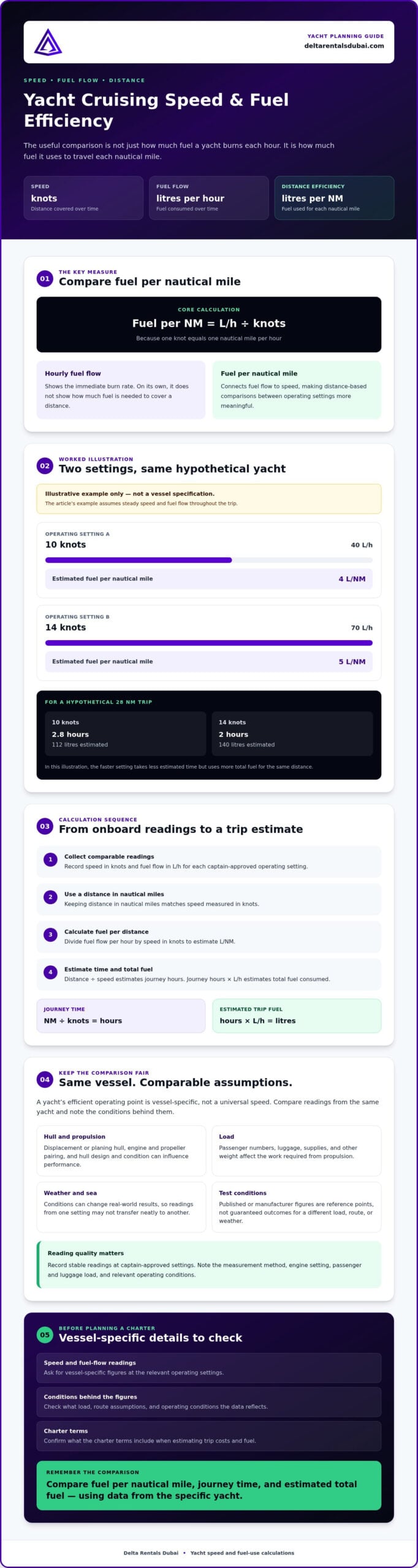
Fuel consumed per nautical mile (L/NM) is a distance-based measure. Calculate it by dividing fuel flow in litres per hour by speed in knots. For example, at a hypothetical 12 knots and 60 L/h, the yacht uses 5 L/NM. This makes comparisons across speeds more meaningful: hourly burn might rise at a faster setting, while fuel use per nautical mile shows whether each mile also becomes more fuel-intensive.
Quotable definition: Fuel efficiency per nautical mile is fuel flow per hour divided by speed in knots, expressed as litres consumed for each nautical mile travelled.
Why one ‘ideal’ yacht speed does not fit every vessel
A displacement hull moves through the water, while a planing hull is designed to rise and travel on the water’s surface at speed. Neither type has one universally efficient cruising speed. A slow steaming strategy illustrates the broader principle: a lower speed can reduce fuel use, but the best balance depends on the vessel and the journey.
Engine and propeller pairing, hull design and condition, and the yacht’s load all influence the result. Passenger numbers, supplies, and other weight affect the work propulsion requires. Weather and sea conditions also affect actual performance, so readings taken in one setting may not apply neatly to another.
Manufacturer figures are useful reference points, not guaranteed outcomes. They may reflect test conditions that differ from a charter’s load, route, or weather. For a fair assessment, use figures tied to the actual vessel and note the conditions under which they were recorded. That context is essential to interpreting calculating private yacht cruising speed versus fuel consumption efficiency reliably.
How to Calculate Yacht Fuel Consumption at Different Cruising Speeds
To compare cruising speeds, use fuel-flow readings from the specific yacht rather than generic estimates. The calculation is straightforward, but the result is only useful if speed and fuel flow were recorded under comparable conditions.
What data do you need before calculating fuel efficiency?
Ask for vessel-specific readings showing speed in knots and fuel flow in litres per hour (L/h) at the same operating setting. Record the measurement method, engine setting, passenger and luggage load, and relevant operating conditions. Prefer verified onboard readings or data supplied by the operator. Generic figures can illustrate a calculation, but they shouldn’t stand in for the yacht’s own performance data.
Turn speed and fuel flow into fuel per nautical mile
- Collect comparable readings. Note speed in knots and fuel flow in L/h at each approved operating setting.
- Set the planned distance. Use nautical miles so the distance matches speed measured in knots.
- Calculate fuel per nautical mile. Divide fuel flow per hour by speed in knots. The compatible units produce L/NM: fuel per nautical mile = L/h ÷ knots.
- Estimate journey time and total fuel. Divide distance in nautical miles by speed in knots to estimate hours. Multiply those hours by fuel flow in L/h to estimate fuel consumed.
Illustrative example only, not a vessel specification: Suppose a yacht records 40 L/h at 10 knots and 70 L/h at 14 knots. At the lower setting, its estimated rate is 4 L/NM. At the higher setting, it’s 5 L/NM. For a hypothetical 28-nautical-mile trip, the estimates are 2.8 hours and 112 litres at 10 knots, versus 2 hours and 140 litres at 14 knots. These simple estimates assume steady speed and fuel flow throughout the trip.
Hourly burn alone can’t tell you which setting uses less fuel for a journey. The faster setting may cover the same distance in less time, so compare fuel per nautical mile and estimated trip fuel as well as hourly flow.
The Geography of Transport Systems describes how ship fuel consumption can rise nonlinearly with speed. Its exponential function of fuel consumption discussion provides useful context, though its ship analysis isn’t a yacht-specific forecast. For calculating private yacht cruising speed versus fuel consumption efficiency, rely on readings for the vessel and conditions you’re assessing.
Delta Rentals Dubai offers luxury yacht rental services. Before planning, confirm which vessel is available and whether its specific performance data can be provided. For a separate vehicle enquiry, use the car rental enquiry link; it is not a yacht-specific contact channel.
How to Compare Speeds Without Mistaking Fuel Burn for Efficiency
A fair comparison uses the same yacht, the same route assumptions, and readings taken under conditions that are as similar as possible. A faster setting may shorten the journey but increase fuel used per nautical mile. Decide what matters for the trip before judging which speed is better.
Which comparison metric should you use?
Build a comparison table with one row for each speed setting and columns for speed, fuel flow, estimated journey time, fuel per nautical mile, and total estimated trip fuel. This puts the trade-offs side by side without treating hourly burn as the whole story.
- Litres per nautical mile: Compare distance efficiency across speeds for the same vessel.
- Total estimated fuel: Plan a particular route by considering both fuel flow and time underway.
- Litres per hour: Understand the engine’s fuel-flow rate at a setting, but don’t use it alone to rank efficiency.
These measures answer different questions. A setting can consume more fuel each hour yet cover more distance in that hour. Whether it uses less fuel for the full route depends on the vessel’s measured performance. The lowest fuel use per nautical mile may also fail to meet a schedule where arrival time matters. Choose the metric that matches your priority, then review the others for context.
What can distort a speed-versus-fuel comparison?
Conditions can change the result even when the yacht and engine setting stay the same. Note wind and waves, current, water depth, route direction, passenger load, onboard equipment, hull cleanliness, and engine condition. A following current and a head current can produce different progress over the ground. Where possible, distinguish the yacht’s measured speed through the water from distance covered along the route.
Log the Beaufort scale as a description of wind conditions, not as a replacement for actual onboard speed and fuel-flow readings. For a useful comparison, record conditions with each measurement and avoid drawing firm conclusions from unmatched runs.
Take extra care if a speed change moves the yacht into a different hull operating regime, such as the transition toward planing. Fuel flow and speed may not change in a simple, steady relationship there. Use measured data for the specific vessel and consult the captain about suitable operating settings. Mercury Marine’s guide can help owners find the ideal cruising speed, but vessel-specific readings remain essential.
That’s the core of calculating private yacht cruising speed versus fuel consumption efficiency: compare like with like, then weigh distance efficiency against journey time and total fuel for the trip.
How to Measure and Refine a Yacht’s Real-World Cruising Efficiency
Published figures and calculations provide a starting point. To understand a yacht’s actual performance, collect repeatable onboard readings with the captain’s approval, then document the conditions behind each one. Never change speed or engine settings solely to gather data without the vessel operator’s direction.
A practical onboard data-collection checklist
At several captain-approved operating settings, allow readings to stabilise before recording them. Use the same measurement approach each time and capture the context alongside the numbers:
- Speed: Record GPS speed over ground. If available, note speed through water separately, since current can affect the difference.
- Fuel flow: Log the onboard engine fuel-flow reading and its units. Note whether the figure is for one engine or combined engines.
- Conditions: Write down the time, weather, wind, waves, current, route direction, and water conditions.
- Load: Record passenger numbers, luggage, and significant onboard equipment that may affect vessel weight.
- Operating setting: Note the setting or display reading used, without exceeding safe or approved limits.
Follow the captain’s and vessel operator’s instructions throughout. This checklist supports observation, not testing through risky manoeuvres or operation beyond approved limits.
How to interpret results and improve the estimate
Repeat observations under similar conditions before treating a difference as meaningful. If readings vary, report the spread or describe them as approximate rather than presenting a falsely precise figure. A changed current, load, weather, route, hull condition, or engine condition can limit direct comparison. Keep those factors visible in your notes instead of assuming they cancel out.
If data isn’t available, ask the operator where the speed and fuel figures came from, how they were measured, and what assumptions apply. Separate direct onboard readings from calculations based on those readings and from manufacturer reference figures. Each can be useful, but they don’t carry the same certainty for the conditions of a planned trip.
Checklist summary: Measure speed and fuel flow onboard at captain-approved settings, record conditions and load, repeat comparable observations, and label estimates and manufacturer references clearly.
This disciplined approach makes calculating private yacht cruising speed versus fuel consumption efficiency more useful for planning, while keeping the limits of each estimate clear. For a yacht charter, ask the operator whether vessel-specific speed and fuel-flow information is available and what conditions it reflects.
For a separate vehicle rental enquiry, send a car rental enquiry on WhatsApp. This contact link is for vehicle rental, not yacht-specific questions.
How to Use Fuel-Efficiency Calculations When Planning a Yacht Charter
Fuel calculations help turn a route idea into a more informed discussion about travel time and expected consumption. Use them to compare scenarios, such as a shorter route at one speed versus a longer itinerary at another. Treat the result as an estimate, not a promise: actual fuel use and journey duration can change with weather, currents, loading, and the captain’s decisions.
Questions to ask before relying on a yacht’s fuel estimate
Request figures for the specific vessel, and clarify what they represent before using them to plan. Ask:
- Are the speed and fuel-flow figures measured onboard, published by the manufacturer, or estimated?
- What speed, engine setting, route, and operating conditions do they describe?
- What passenger and luggage load was assumed, and are the fuel-flow units clearly stated?
- How might weather, currents, or route changes affect the estimate?
- What do the charter terms say about fuel arrangements and any related charges?
Confirm fuel terms directly with the provider. Don’t assume fuel is included, billed separately, or handled in a particular way. If the available figures don’t match your planned route or expected load, ask what assumptions would need to change before comparing options.
When a fuel-efficiency estimate is useful, and when it is not
Estimates are useful for comparing possible speeds, discussing a realistic schedule, and identifying what information is still missing. They can help you ask sharper questions before a charter, but they can’t guarantee exact consumption or arrival time. Conditions may change underway, and the captain remains responsible for operating the vessel safely.
For calculating private yacht cruising speed versus fuel consumption efficiency, the most relevant figures are vessel-specific readings with clearly stated conditions. If those details aren’t available, ask the operator to explain the source and limitations of any estimate rather than treating a generic figure as a forecast.
Delta Rentals Dubai offers a luxury yacht rental service. Confirm current vessel details and whether relevant performance information is available before planning. The WhatsApp link below opens a vehicle-rental enquiry, not a yacht-specific contact channel.
If you’re also considering a vehicle experience, you can send a car rental enquiry to Delta Rentals Dubai.
Plan Your Route With Clearer Fuel Expectations
A useful fuel estimate starts with vessel-specific speed and fuel-flow readings. Divide litres per hour by knots to compare fuel used per nautical mile, then consider estimated journey time and total trip fuel. Keep the vessel, route assumptions, load, and operating conditions in view, and treat the result as a planning estimate rather than a guarantee.
That’s the practical value of calculating private yacht cruising speed versus fuel consumption efficiency: you can ask more focused questions and weigh speed against distance efficiency before settling on a plan. Delta Rentals offers a luxury yacht rental service, but confirm current vessel details and whether relevant performance information is available before making specific plans.
For a separate vehicle rental enquiry, use Delta Rentals’ WhatsApp car rental enquiry. This link is for vehicle rental, not yacht-specific questions. With the right vessel data and clear questions, you can plan your next trip with greater confidence.
Frequently Asked Questions
How do you calculate yacht fuel consumption per nautical mile?
Divide the yacht’s fuel flow in litres per hour by its speed in knots to estimate litres per nautical mile. For example, a reading of 48 L/h at 12 knots gives 4 L/NM. Use readings from the same vessel and note the conditions they represent. This calculation assumes speed and fuel flow remain steady. Actual trip consumption can differ as conditions or operating settings change.
Does a yacht use more fuel when it cruises faster?
Usually, a yacht burns more fuel per hour at a higher cruising speed, but the increase isn’t always proportional to the speed gain. Hull design and the vessel’s operating regime affect the relationship, and consumption may rise sharply around a transition between regimes. Compare fuel per nautical mile and estimated fuel for the full route, not just hourly burn, using vessel-specific readings taken under comparable conditions.
What is the most fuel-efficient cruising speed for a yacht?
There isn’t one most efficient speed for every yacht. The best point depends on its hull, engines, propellers, load, and conditions. Find it by comparing measured fuel flow and speed at several safe, captain-approved operating settings. Calculate fuel used per nautical mile for each, then consider journey time as well. Manufacturer figures can guide the comparison, but they may not reflect the yacht’s actual load or sea conditions.
How much fuel does a yacht use per hour?
Hourly fuel use varies with the yacht’s size, engine type, hull design, speed, load, and sea conditions, so a general figure may not describe the vessel you’re planning to use. Ask for the specific yacht’s fuel-flow readings in litres per hour, and clarify whether the reading covers one engine or all engines. Also ask what speed and operating conditions were recorded alongside that figure.
Can you calculate yacht fuel use from speed alone?
No. Speed alone tells you how quickly the yacht is moving, but not how much fuel its engines consume at that speed. For calculating private yacht cruising speed versus fuel consumption efficiency, you need both speed and a corresponding fuel-flow reading. With those, you can estimate fuel per nautical mile. With a planned distance, you can also estimate journey time and total fuel, subject to changing conditions.
What happens to fuel efficiency in rough seas or strong currents?
Rough seas can increase the work required to maintain progress, while wind, waves, and route direction may affect speed and fuel flow. Currents also change progress over a route: a following current can raise speed over ground, while an opposing current can reduce it. Record conditions with onboard readings, and avoid applying calm-water estimates to a different journey without asking the vessel operator how conditions may affect them.
Is speed over ground the same as speed through water?
No. Speed over ground measures the yacht’s movement relative to the seabed, while speed through water measures its movement relative to the surrounding water. A current can make these readings differ. GPS typically provides speed over ground; a vessel may also have an instrument that reports speed through water. Note which measure you’re using, because speed through water and fuel flow can support an efficiency comparison, while speed over ground helps estimate progress along a route.