
What if the safest way to protect your rims from a raised lane divider is to change not just your speed, but your approach? On UAE roads, a sharp impact can bend a wheel, cause steering-wheel vibration, or raise questions when a rental vehicle is inspected. Avoiding rim deformation from hitting raised road lane dividers starts with spotting hazards early, not reacting at the last moment.
It’s understandable to worry about repair costs or being held responsible for damage you didn’t notice. Measured driving habits can reduce impact risk, and a careful inspection can help you spot warning signs early. The height and shape of a divider, your speed, your tire condition, and the direction of impact all matter.
This guide explains why raised dividers can damage performance rims, how to respond when you encounter one, and what to check if you suspect a wheel has been bent or cracked. You’ll also learn what to inspect before setting off in a performance vehicle.
Key Takeaways
- Learn how raised lane dividers can put performance rims at risk, and why impact speed and direction matter.
- Scan ahead and make lane changes early when safe. Avoid abrupt steering or braking as a wheel reaches an obstacle.
- Understand how correct tire pressure supports the wheel, and why under-inflation can leave the rim more exposed to impact.
- Recognize practical warning signs of possible rim damage so you know when to arrange a professional inspection.
- See how avoiding rim deformation from hitting raised road lane dividers also involves checking a rental vehicle’s tires and wheels before driving.
Understanding the Risk: Why Raised Lane Dividers Threaten Luxury Rims
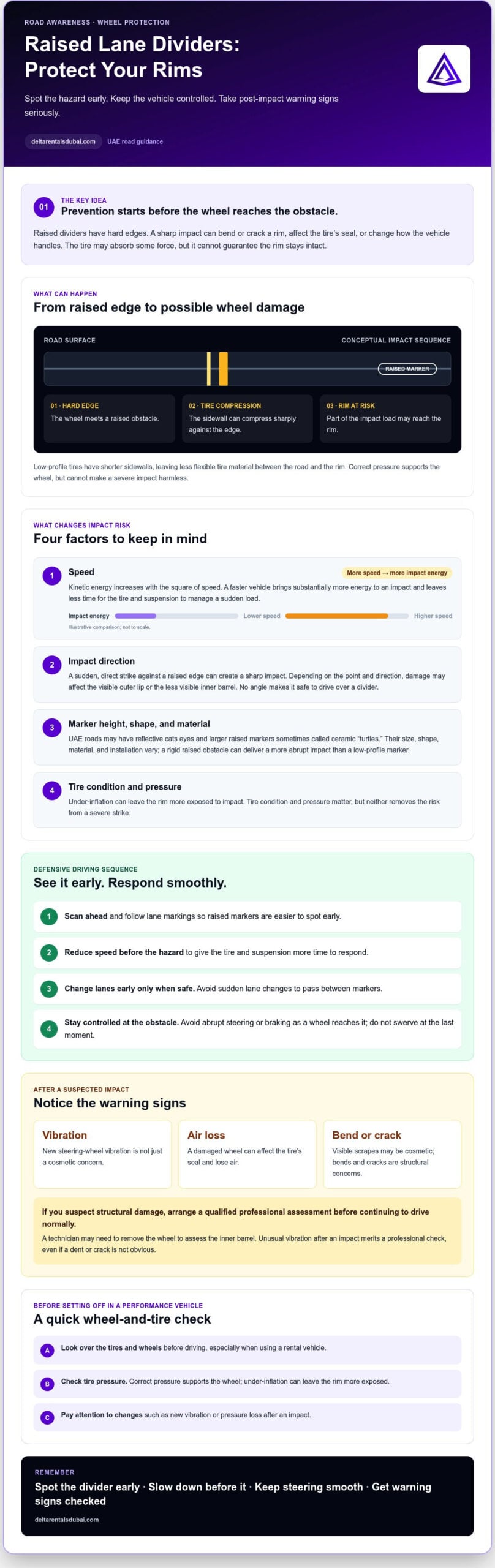
A raised divider is a small obstacle with a hard edge. When a wheel strikes it, the tire and rim can take a sharp vertical blow. Rim deformation means the wheel’s metal rim has bent or cracked under impact. The tire may absorb some of the force, but it can’t guarantee the rim stays intact. A damaged wheel can lose air or affect handling. Don’t dismiss new steering-wheel vibration as a cosmetic issue.
Raised markers help drivers see lane boundaries and road layouts. In the UAE, you may encounter reflective road studs, often called “cats eyes,” as well as larger raised markers sometimes described as ceramic “turtles.” Their material, size, shape, and installation vary, so don’t assume every marker will affect a wheel in the same way. A rigid, raised obstacle can deliver a more abrupt impact than a low-profile marker, particularly if struck at speed.
The rim is the outer section of the wheel that supports the tire. Anatomy of a wheel offers a useful overview of how the components fit together. Visible scrapes may be cosmetic, but bends and cracks are structural concerns. Damage can affect the tire’s seal and the vehicle’s stability. If you suspect structural damage, have it assessed by a qualified professional before continuing to drive normally.
The Vulnerability of Low-Profile Tires
Low-profile tires have shorter sidewalls, leaving less flexible tire material between the road and the rim. Compared with many luxury SUVs, performance cars such as the Porsche 911 GT3 RS may have a lower-profile tire setup, though specifications vary by vehicle and wheel. During a hard impact, the tire can compress sharply and allow the rim to strike the obstacle. This is sometimes called a pinch shock. Correct pressure matters, but it can’t make a severe impact harmless.
Types of Raised Dividers in the UAE
Reflective cats eyes are generally designed to improve visibility, while larger raised markers can present a more substantial obstacle. Plastic markers may flex or move differently from rigid ceramic ones, but material alone doesn’t determine the force on a wheel. Height, shape, mounting, tire condition, and speed all matter. Avoid crossing raised markers where possible, and don’t make a sudden lane change to try to pass between them.
Avoiding rim deformation from hitting raised road lane dividers begins with recognizing the obstacle early. Watch the road ahead, follow lane markings, and avoid striking raised markers where you can do so safely. Take any post-impact vibration or pressure loss seriously. A careful inspection can help distinguish surface scuffs from damage that needs professional attention.
The Physics of Impact: How Velocity and Angle Cause Deformation
A divider impact is shaped by more than the car’s speed. The wheel’s direction of travel, the marker’s profile, and how quickly the tire is forced to change direction all affect the load on the rim. Kinetic energy increases with the square of speed, so a faster-moving vehicle brings substantially more energy to an impact. Speed alone can’t predict the exact force on a particular wheel, but higher speed leaves less time for the tire and suspension to manage a sudden load.
Speed as the Primary Damage Multiplier
A rigid raised marker can create a brief, concentrated blow. At higher speed, the tire meets it with more energy and has less time to deform around its edge. That can transmit a sharp load to the wheel. Reduce speed before reaching road hazards, and don’t make an abrupt maneuver to cross or avoid a marker. If traffic or road conditions make a lane change unsafe, stay in control rather than swerving at the last moment.
Impact Geometry and Sidewall Compression
The direction of the hit changes how the load travels through the wheel. A sudden, direct strike against a raised edge can create a sharp impact, but no angle makes it safe to drive over a divider. If the tire is compressed hard against an edge, the rim may take some of the load. Depending on the point and direction of impact, damage can affect the visible outer lip or the less visible inner barrel. A technician may need to remove the wheel to assess it fully.
The suspension also compresses as it responds to the road input. If an impact is too sharp for the system to manage smoothly, force travels from the tire through the rim and into the suspension. Radial runout is the amount a wheel deviates from a true circular path as it rotates. A wheel can have runout without an obvious crack or dent, so unusual vibration after an impact merits a professional check.
Understanding these forces helps explain why avoiding rim deformation from hitting raised road lane dividers depends on anticipating hazards and keeping the vehicle controlled. If you’re considering a performance rental, ask about the vehicle’s condition before setting off.
Defensive Driving Techniques to Safeguard Your Wheels
Protecting a rim starts before the wheel reaches a divider. Scan ahead, leave room to respond, and make lane changes early when traffic and road markings allow. Smooth, planned driving reduces the chance of striking a raised marker abruptly. Don’t swerve at the last moment to avoid one. A sudden maneuver can create a more serious loss-of-control risk than the obstacle itself.
Make Lane Changes Smooth and Predictable
Move across the lane progressively rather than steering sharply toward or away from a divider. Don’t use a slalom pattern to weave between markers. It can surprise nearby drivers and compromise control, especially in traffic. Look ahead for reflective studs and changes in the lane edge. At night or in heavy rain, reduce speed and increase following distance because visibility and stopping room may be limited.
You may notice spaces between markers, but don’t assume a gap is a safe crossing point. Check the road layout, traffic, and lane markings, and change lanes only when the route is clear and permitted. If you can’t assess the surface safely, keep control of the vehicle and avoid abrupt steering.
Manage Braking and Weight Transfer
When conditions allow, brake progressively before reaching a hazard. Heavy braking as a wheel meets a divider can compress the front suspension and shift more vehicle weight onto the front wheels, increasing the load they’re already managing. Avoid braking sharply over an obstacle. Don’t accelerate sharply either. Aim for calm, consistent steering and a steady speed appropriate to the road, rather than abrupt throttle or brake inputs.
There’s no need to “unload” the front suspension with a sudden throttle input. That can upset the vehicle’s balance and reduce control. Prioritize a safe, predictable response over trying to manipulate suspension movement.
Use Vehicle Settings with Care
If your car has adjustable suspension, follow the owner’s manual for the conditions and settings available. A comfort-oriented setting may change how the suspension responds, but it can’t guarantee protection from rim damage or make a divider safe to cross. Avoid switching modes during a sudden maneuver. Keep your attention on the road and make adjustments only when it’s safe.
These habits support avoiding rim deformation from hitting raised road lane dividers, but no technique removes all impact risk. If a wheel takes a hard hit, watch for vibration, tire-pressure loss, or unusual handling and arrange a professional inspection.
Preventive Maintenance: Tire Pressure and Rim Protection
Correct tire pressure helps the tire maintain its shape and absorb road impacts before they reach the rim. Think of the tire as part of the wheel’s cushioning system, not a guarantee against damage. Under-inflation reduces its support and can increase the chance of the rim taking a hard hit. If a pressure check shows the tire is below the vehicle maker’s recommendation, correct it promptly rather than treating low inflation as harmless.
Check Pressure the Right Way
Use the manufacturer’s recommended pressure on the vehicle’s door-jamb placard, not the maximum pressure printed on the tire sidewall. Check when the tires are cold, before driving or after the vehicle has been parked long enough to cool. Driving heats the tires and changes the reading, so don’t release air from a warm tire just to match a cold-pressure target. UAE ambient heat can affect readings too, which makes consistent cold checks more useful than guessing or making routine adjustments for highway versus residential driving. Follow the vehicle maker’s guidance for pressure and driving conditions.
A Tire Pressure Monitoring System (TPMS) is a helpful alert, not a substitute for checking pressures. A TPMS warning means you should check the tires as soon as it’s safe and use the vehicle placard as your reference.
Inspect for Damage and Air Loss
After a hard impact, look over the visible rim and tire for fresh scrapes, dents, cracks, or unusual bulges. A flat-looking section or repeated pressure loss deserves attention. A small bend can interfere with the tire’s seal against the rim, causing a bead leak that may be difficult to spot without a proper inspection. Steering-wheel vibration or a new change in handling can also signal wheel or tire damage.
Rim protectors may help with minor, low-speed contact, but they can’t reliably prevent structural damage from a forceful impact. Some may also trap moisture against the wheel. Treat them as a limited buffer, not permission to touch dividers or curbs.
Have a professional determine whether damage is cosmetic or structural before choosing repair or replacement. A bend may be repairable, but cracks and other structural defects require careful assessment. Appearance alone can’t confirm that a wheel is safe. These checks support avoiding rim deformation from hitting raised road lane dividers by helping you catch pressure problems and impact damage early. If you’re considering a performance rental, ask about tire and rim maintenance before booking.
Elite Performance Standards: How Delta Rentals Protects Your Drive
A performance drive starts with understanding the condition of the vehicle you’re taking out. Delta Rentals Dubai offers high-performance vehicles, including the Porsche 911 GT3 RS and McLaren Artura. Before setting off, inspect the tires and rims, and raise any visible concerns during the handover. Clear questions about the specific vehicle can help you understand what to check before driving.
Check the Vehicle Before You Set Off
Tire profiles, recommended pressures, and driving responses vary by model. Check the owner guidance and confirm the correct pressure and any relevant operating notes rather than assuming every performance car behaves the same. If you’re comparing a supercar with an SUV for regular highway use, don’t assume the SUV has more tire sidewall cushioning. That depends on the specific vehicle and tire setup. Ask about the vehicle you’re considering and choose based on your driving needs.
During the handover, inspect each visible rim and tire for scrapes, dents, cracks, bulges, or signs of low pressure. If you notice a warning light, unusual vibration, or anything that seems wrong, raise it before driving. Make sure any concerns are recorded through the agreed handover process.
Clear Expectations, Greater Confidence
Before accepting a rental vehicle, read the rental terms and ask how pre-existing wheel marks, new damage, and post-rental inspections are documented. Take clear handover photos of the wheels and tires, and make sure any concerns are recorded through the agreed process. This creates a shared reference point and helps you understand your responsibilities without relying on assumptions.
Delta Rentals Dubai lists 300+ 5-star Google reviews. Reviews can be one factor when comparing rental options, alongside the condition of the specific vehicle you’re considering. If you prefer an SUV, review the available vehicle options and confirm the tire setup rather than treating vehicle category as a guarantee of extra rim protection.
For avoiding rim deformation from hitting raised road lane dividers, responsible driving and a careful vehicle check both matter. Choose a vehicle suited to your plans, understand its tire-pressure guidance, and inspect the wheels before and after your drive. A considered handover and clear expectations make it easier to enjoy the performance while staying alert to road hazards.
Protect Your Wheels and Enjoy the Drive
Avoiding rim deformation from hitting raised road lane dividers comes down to calm decisions: spot hazards early, slow down before reaching them, and avoid abrupt steering or braking at the point of impact. Keep tires at the vehicle maker’s recommended pressure, then take new vibration, pressure loss, or visible wheel damage seriously.
Before driving a rental, inspect the rims and tires, photograph their condition, and ask how existing marks are documented. Delta Rentals offers performance vehicles such as the Porsche 911 GT3 RS and McLaren Artura. Ask about the specific vehicle’s condition and handover details before setting off.
Ready to plan a performance drive? Ask Delta Rentals about your next supercar rental, and clarify the vehicle’s condition and handover details before driving. Stay alert to road hazards and enjoy the journey.
Frequently Asked Questions
Can a single hit on a road divider really bend a high-performance rim?
Yes, one hard impact can bend or crack a rim, particularly if the wheel strikes a rigid raised divider at speed or the tire has limited sidewall cushioning. The outcome depends on factors such as impact direction, tire condition, pressure, and wheel design. Damage isn’t always obvious immediately. If the car develops vibration, loses tire pressure, or handles differently after a hit, arrange a professional wheel and tire inspection.
What are the signs that my rim has been deformed from hitting a divider?
Watch for steering-wheel vibration, new changes in handling, repeated tire-pressure loss, or a visible dent, crack, or fresh scrape on the wheel. A bent rim can also prevent the tire from sealing properly, causing a slow leak. Some damage is difficult to see while the wheel is on the car, so a clean appearance doesn’t rule it out. Stop driving if the tire is losing air or the vehicle feels unsafe, and seek professional assessment.
Is it safer to hit a road divider at higher or lower speeds?
Lower speed generally reduces the energy involved in an impact, but deliberately hitting a divider is never a safe driving strategy. Slow down before reaching a hazard, keep control of the vehicle, and avoid sudden swerving or braking as a wheel meets it. If you can’t change lanes safely, prioritize staying in control and follow the road layout. After a hard strike, check for warning signs and have suspected damage inspected.
Do low-profile tires increase the risk of rim damage on UAE roads?
They can. A low-profile tire has a shorter sidewall, leaving less flexible material between the road and the rim to absorb a sharp impact. That can increase the chance of wheel damage if the tire is struck hard by a raised divider or another obstacle. Risk still depends on speed, impact direction, tire pressure, and the specific wheel and tire setup. Check the vehicle’s recommended pressure and drive cautiously around raised road features.
Will my car’s insurance cover rim deformation from road dividers?
It depends on your insurance policy, the circumstances of the incident, and any applicable exclusions or excess. Don’t assume damage is covered simply because it happened on a public road. Review your policy wording and contact your insurer to ask how wheel damage is assessed and what evidence they need. If you’re driving a rental, check the rental agreement as well, and report the incident through the specified process.
Can a bent rim be safely repaired, or does it need to be replaced?
A qualified wheel specialist should assess the rim before you decide. Some bends may be repairable, but cracks or other structural damage can compromise the wheel and may make replacement necessary. A low repair quote doesn’t confirm that a wheel is safe for road use. Ask the professional to distinguish cosmetic marks from structural damage, explain the recommended work, and confirm whether the repaired wheel is suitable for continued use.
Does tire pressure affect how well my rims handle road impacts?
Yes. Correct tire pressure helps the tire support the wheel and absorb road inputs. Under-inflation can leave the rim more exposed during a sharp impact, while over-inflation isn’t a safe substitute for following the vehicle maker’s guidance. Use the recommended pressure on the vehicle’s tire information placard and check it when the tires are cold. A pressure warning or repeated air loss after an impact warrants prompt attention.
Are certain rim materials more resistant to deformation than others?
Material can influence how a wheel responds to impact, but it doesn’t determine durability by itself. Wheel design, construction, dimensions, manufacturing quality, and the force and direction of the strike also matter. Forged and cast wheels, for example, are made through different processes, but it’s not possible to name one as damage-proof across all applications. Choose wheels specified for the vehicle, and have any suspected structural damage professionally evaluated.