

The security deposit isn’t always the real expense. A foreign transaction fee or an unfavourable exchange rate can add a hidden cost before you’ve even driven away. If you’re focused on avoiding foreign transaction bank fees on luxury car security deposits, start by checking your card’s fee schedule. Many UAE-issued cards charge around 3.14% on overseas transactions, though your card’s terms may differ.
It’s understandable to worry about a large deposit tying up your credit limit, then wait for it to be returned. But a pre-authorisation is usually a temporary hold, not a completed payment. Knowing the difference helps you ask the right questions before booking. This guide explains how to compare card fees, choose local-currency payment over costly conversion offers, and consider multi-currency cards or eligible no-deposit options. You’ll also learn what to confirm about release timing and card acceptance, so you can plan with confidence. A little preparation can make arranging a luxury car rental across the UAE more straightforward.
Key Takeaways
- Start avoiding foreign transaction bank fees on luxury car security deposits by checking your card’s foreign-currency terms before booking.
- Compare traditional cards with multi-currency options, and confirm the wallet currency, conversion rate, and applicable fees before paying.
- Ask the rental company which payment methods it accepts for the deposit and how the hold or refund is handled.
- Use a pre-rental checklist to choose a suitable card, prepare the right currency, and reduce payment friction.
- Confirm the deposit terms for your chosen vehicle before you reserve, including whether a deposit is required and how it is processed.
The Hidden Costs of International Luxury Car Rentals
The advertised rental terms aren’t the only figures to check. If your card was issued outside the UAE, an AED security deposit may be treated as an international transaction, bringing a foreign transaction fee or an exchange-rate markup. As of September 2025, many UAE banks’ overseas card fees were approximately 3.14%, though charges vary by card and issuer. On an illustrative AED 20,000 transaction, 3.14% would equal AED 628. That can be a costly surprise for a payment that may only be a temporary deposit hold.
A hold can also create sticker shock without money being spent. Your available credit may drop, while your statement or banking app displays a pending amount in AED or a converted estimate in your home currency. The final posted amount can differ if your card network or issuer applies its exchange rate when the transaction is processed.
Understanding Foreign Transaction Fees (FX Fees)
Foreign transaction fees are charges your card issuer may apply when a payment is processed in a currency different from your card’s billing currency, or through an overseas processor. Check your card’s fee schedule before booking. On your statement, look for a separate “foreign transaction,” “international transaction,” or “currency conversion” line, as well as any difference between the pending and posted totals.
Keep the rental company’s charges and deposit terms separate from your bank’s charges. The rental company sets its own fees and deposit conditions; your bank or card network may add conversion or transaction costs. Ask which amount is a rental charge, which is a refundable security deposit, and whether the deposit is a hold or a completed charge. A hold, also called an authorization hold, reserves available funds without immediately settling the full amount. It doesn’t automatically mean your bank has charged an FX fee, but issuer rules differ. Don’t assume the bank charges a fee simply because the hold remains in place.
The Impact of Currency Conversion Spreads
The mid-market rate is a reference exchange rate. A bank or card provider may use a different rate, and the gap between the reference rate and the rate applied to your transaction is the conversion spread. It can be less visible than a separately listed fee, so compare your provider’s rate and terms rather than checking only for a fee line.
If a terminal or payment page offers to bill you in your home currency, that’s Dynamic Currency Conversion (DCC). DCC markups can add 5% to 10%, so seeing a familiar currency may come at a premium. Choose AED and let your card provider handle the conversion, after checking its fees and exchange-rate policy. This avoids a merchant-set conversion rate and makes your card charges easier to assess.
Careful payment choices are central to avoiding foreign transaction bank fees on luxury car security deposits. Check the fee schedule, confirm how the deposit is processed, and review the posted transaction before assuming the displayed amount is final.
Pre-Authorization vs. Direct Charges: Protecting Your Capital
A security deposit can appear on your card without the rental company receiving it as a completed payment. With a pre-authorisation, the provider asks your card issuer to reserve an amount of available credit. The funds are temporarily blocked, then the hold is released or adjusted after the rental, subject to the agreement. A direct charge works differently: the payment is processed, and any return requires a separate refund.
For an international card, an AED hold may be converted to an estimated amount in your card’s billing currency when calculating available credit. The final exchange rate and any foreign transaction fee can depend on how your issuer and card network process the authorisation and later settlement. A hold may avoid fees that apply only to completed transactions, but don’t assume it will. Ask your bank how it treats AED authorisations.
How Pre-Authorisations Affect Your Available Credit
A pre-authorisation reserves credit without immediately transferring the deposit to the rental company. That can make release more straightforward than processing a separate refund, but it doesn’t guarantee that no FX fee will apply. The hold also ties up part of your credit limit. Banks don’t necessarily charge a transaction fee simply because a hold remains active; any fees depend on issuer policy, while reduced available credit may be the practical concern.
Before pickup, tell your bank you expect a large AED card authorisation and ask whether it charges fees on pending holds or only on settled transactions. Confirm with the rental provider whether it will process the deposit as a pre-authorisation, and keep the agreement or receipt showing the transaction type. For context, the US Consumer Financial Protection Bureau defines a finance charge; that US regulation isn’t a guide to how your UAE or home-country issuer handles a particular hold.
The Risk of “Charge and Refund” Models
If a deposit is charged and later refunded, your card may convert the outgoing and incoming transactions at different exchange rates. Your issuer may also apply fees to both transactions, depending on its terms. That can leave you with less than the original amount even when the full deposit is approved for refund. Exchange rates can move during the rental period, so the refund’s home-currency value may differ from the original charge.
There’s no single standard hold duration. Timing depends on the rental company’s release process and your card issuer’s processing. UAE rental-deposit guidance gives a refund period of up to 30 days after return when there are no outstanding fines or damage claims. A released card hold and a refund from a settled charge are different processes.
Before handing over your card, ask:
- Will the deposit be a pre-authorisation or a completed charge?
- Will it be processed in AED, and can my card issuer charge an FX fee on the hold?
- When will you request release or issue a refund, and what documentation will I receive?
Clear answers make avoiding foreign transaction bank fees on luxury car security deposits more achievable. For details before you reserve, you can ask Delta Rentals about its deposit process.
Comparing Payment Methods for UAE Security Deposits
The best payment method is one the rental provider accepts for a deposit and your card issuer processes on clear, competitive terms. Don’t choose a card based on rewards alone. Check the foreign-currency fee, exchange-rate method, available limit, and whether the deposit will be pre-authorised or charged and refunded.
Traditional Credit Cards: The Pros and Cons
A credit card may offer a useful limit for a high-value hold and can keep the deposit separate from the cash in your bank account. Protections vary by card, issuer, and country, so review the terms rather than assuming a premium card covers every rental or vehicle. Cards such as Amex Platinum and Chase Sapphire have different versions and fee policies; confirm that your specific card works for AED transactions and rental deposits.
Foreign transaction fees can still apply, and carrying a balance may result in interest under your card agreement. Before travelling, notify your issuer about the expected large AED transaction and ask whether it could trigger a security check or be declined. The US Consumer Financial Protection Bureau provides an official definition of a finance charge, but its rules don’t establish the fees or protections on cards issued elsewhere.
Digital Banking and Multi-Currency Wallets
Multi-currency services can help you exchange money in advance and spend from a matching currency balance. Revolut and Wise are options some travellers consider, but features, card acceptance, account eligibility, and fees vary by country and plan. Check whether your account can hold AED, whether a rental deposit can be authorised against that balance, and what happens if the hold exceeds the available wallet funds. Holding AED may reduce conversion costs, but it doesn’t guarantee zero fees or acceptance.
Don’t assume funds will become available immediately after the rental provider releases a hold. The provider initiates the release, while your card issuer or wallet controls when the available balance updates. Ask both sides about timing and whether a security deposit is processed as a hold or a completed charge. This distinction matters: a released hold is not the same as a refund after a charge, which may involve separate currency conversions.
Are Debit Cards a Good Fit?
Debit cards may be accepted less often for security deposits. If accepted, the deposit may be taken as a direct charge, reducing spendable cash until the refund arrives. Confirm the payment method and process before booking, and avoid relying on funds you’ll need for daily expenses.
When avoiding foreign transaction bank fees on luxury car security deposits, compare the full terms, not just the advertised FX rate. UAE card options differ: some cards waive the bank’s portion of fees, while others advertise no international transaction fee. Verify current terms, network charges, and deposit acceptance directly with the issuer and rental provider.
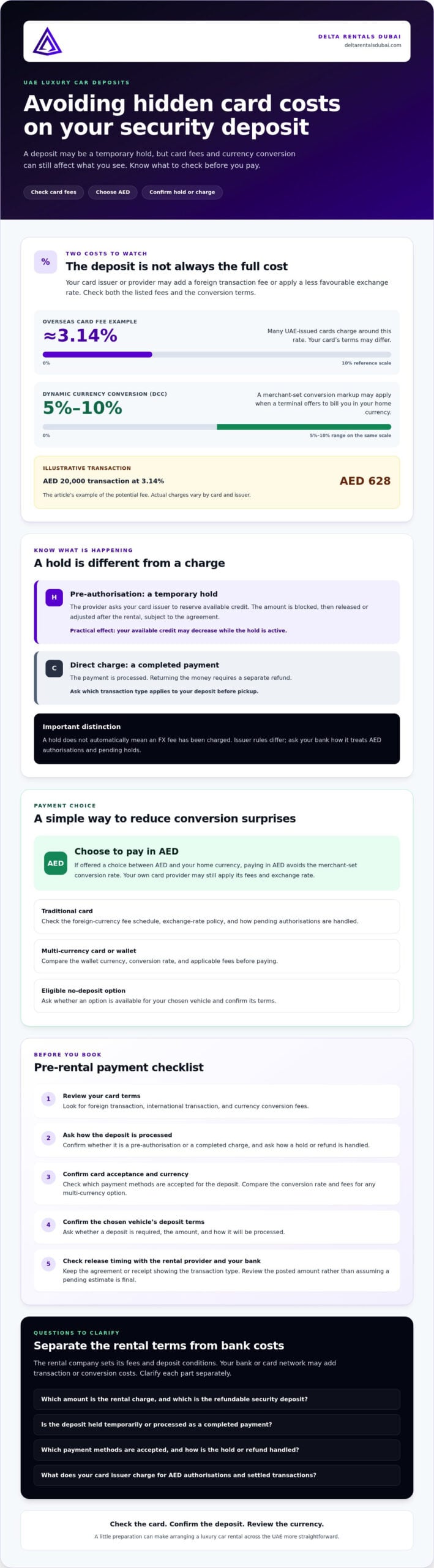
Step-by-Step Guide to Avoiding Foreign Transaction Bank Fees on Luxury Car Security Deposits
A little preparation can prevent payment surprises and help keep more of your credit available. Use this checklist before confirming a luxury rental. Card terms and deposit procedures vary, so verify each detail with your issuer and the rental provider.
Step 1: Choose a Card with Clear Foreign-Transaction Terms
Compare cards based on their foreign transaction fee, exchange-rate policy, and treatment of pending authorisations. A “zero FX fee” policy may waive the issuer’s fee but not every card-network cost, so check the full terms. Ask your bank specifically whether it applies charges to AED holds as well as settled transactions.
Confirm you have enough available credit for the deposit and other planned spending. If needed, ask your issuer whether a temporary limit increase is possible. Tell the bank about the expected high-value UAE transaction to reduce the chance of an avoidable decline. Also check that online and in-person card authentication, including 3D Secure where applicable, is enabled and that you can receive approval prompts while travelling.
Step 2: Prepare an AED Balance if Your Digital Account Supports It
If your digital bank offers a local-currency pocket, consider funding it with AED before the rental. Review the account’s conversion rate, fees, spending limits, and card rules first. A balance held in AED may avoid converting the deposit from your home currency at the point of payment, but it won’t guarantee a fee-free transaction or prove that the rental company will accept that card for a security hold.
Use the mid-market rate as a comparison reference, not a promise of the rate you’ll receive. Your provider’s rate and any markup determine your actual conversion cost.
Step 3: Confirm the Deposit Release Process
Before providing your card, ask whether the deposit is a pre-authorisation or a completed charge, how the release or refund is initiated, and what timeline to expect. The provider’s release request and your issuer’s processing time are separate steps. Keep the rental agreement and confirmation so you can track the expected amount and status.
Step 4: Pay in AED and Monitor the Transaction
Dynamic Currency Conversion is an offer to bill your card in your home currency instead of AED. Decline it if you want to avoid the merchant’s conversion rate and let your card provider handle the exchange. Check the payment terminal or digital prompt before approving.
After payment, review your banking app for a pending authorisation, a posted charge, or a refund. Save the receipt and note any displayed exchange rate or separate fee. If the status or amount doesn’t match what you agreed, contact the rental provider and your issuer promptly. This routine makes avoiding foreign transaction bank fees on luxury car security deposits more manageable.
For details before booking, ask Delta Rentals about the deposit process.
Seamless Rentals: Deposit Questions to Ask Delta Rentals
Deposit details are worth confirming before you book. Ask for the deposit amount, how it will be processed, which payment methods are accepted, and what happens after the vehicle is returned. Clear information helps you plan around your available credit and ask your bank the right questions about foreign transaction fees.
For your specific booking, ask whether the deposit is a pre-authorisation or a completed charge, and request details about the release or refund process. These are practical steps for anyone focused on avoiding foreign transaction bank fees on luxury car security deposits, since your bank’s charges depend on how it processes the transaction.
Check the Deposit Terms Before You Book
Confirm the terms for the vehicle and booking you have in mind. Delta Rentals Dubai offers no-deposit rental options, but don’t assume an option applies to every vehicle or booking. Confirm eligibility and conditions in advance, and check whether a deposit applies to your chosen rental. No deposit can mean no security-deposit hold, but it doesn’t automatically remove every potential card fee from other payments.
Release timing also involves the rental provider and your card issuer. Ask when the release will be requested and how you’ll be notified, then check your card app for updates. A provider’s release request doesn’t necessarily mean your available credit will refresh immediately, since issuer processing times can vary.
Choose a Vehicle That Fits Your Plans
Once you’ve reviewed the payment terms, choose a vehicle that suits your trip and budget. Delta Rentals Dubai’s fleet includes performance cars such as the Porsche 911 GT3 RS, Ferraris, and Lamborghinis, alongside luxury SUVs including Range Rover models and the Rolls-Royce Cullinan. Availability and rental terms can vary, so confirm the details for the specific car you’re considering. Match the rental choice to your payment plan, and leave room on your card for any authorised hold.
To discuss a vehicle before deciding, explore Delta Rentals Dubai’s UAE luxury car rentals and confirm the deposit terms for your preferred vehicle. A suitable payment method and a clear understanding of the release process can help you plan with confidence.
Plan Your UAE Rental with Confidence
A smoother deposit experience starts before you reserve. Check your card issuer’s rules for AED transactions and temporary holds, compare foreign-currency fees, and confirm whether the rental deposit is pre-authorised or charged and refunded. If offered a choice of billing currency, review the conversion terms before approving the payment. These checks make avoiding foreign transaction bank fees on luxury car security deposits more achievable, though the final fees depend on your bank, card network, and payment method.
Choose a rental partner whose vehicle and payment terms suit your plans, then keep your confirmation and monitor the transaction until the hold is released or any refund appears. Delta Rentals Dubai operates under the official trade name Triple D Rentals LLC, and its fleet includes the Porsche 911 GT3 RS for clients seeking a performance car, subject to availability and rental terms.
Ready to discuss a vehicle and clarify the deposit process? Contact Delta Rentals about your UAE rental.
Frequently Asked Questions
Can I rent a luxury car in the UAE without a credit card to avoid fees?
Possibly, but payment rules depend on the rental provider and vehicle. Debit cards may be accepted less often for security deposits, and a deposit paid by debit card may be processed as a charge rather than a temporary hold. Ask which cards are accepted, whether a deposit is required, and how it’s processed. Some providers offer no-deposit options, but check the eligibility and terms before booking.
How long does it typically take for a security deposit to be released?
Timing depends on whether the deposit was held or charged, and on the rental provider’s and card issuer’s processing. A released pre-authorisation may take additional time to disappear from your available balance. If a deposit was charged, a refund must be processed separately. UAE guidance states that rental deposits should be refunded within 30 days after the vehicle is returned, provided there are no outstanding fines or damage claims.
Will I get the exact same amount back if the exchange rate changes?
Not necessarily in your home currency. If the deposit was charged in AED and later refunded, your card provider may convert each transaction using a different exchange rate. Fees may also apply to either transaction, depending on your card terms. The AED amount refunded may match the amount charged, but the home-currency value shown on your statement can differ. Check whether the deposit is a hold or a completed charge.
Are foreign transaction fees charged on pre-authorised holds?
It depends on your bank and card network. Some issuers may assess fees on an authorisation, while others apply them only when a transaction settles. An AED hold can also appear as a converted pending amount without being a completed charge. Before booking, ask your issuer specifically how it treats foreign-currency holds, then confirm with the rental provider whether the deposit will be pre-authorised or charged and refunded.
What is the best credit card for avoiding fees on luxury car rentals?
There’s no single best card for every renter. Compare your card’s foreign transaction fee, network conversion costs, exchange rate, available credit, and treatment of AED pre-authorisations. Some cards waive the issuer’s fee but still pass on network charges, while others advertise no international transaction fee. To avoid foreign transaction bank fees on luxury car security deposits, verify the current terms directly with your issuer and confirm the card is accepted for the deposit.
Can I use a digital wallet like Revolut for a supercar security deposit?
Only if the rental provider accepts the wallet’s card for security deposits and your account supports the transaction. Acceptance for regular purchases doesn’t guarantee acceptance for a large pre-authorisation. Check your wallet’s AED balance options, conversion fees, transaction limits, and hold-release process. Ask the rental provider whether it can place a temporary hold on that card, and keep another accepted payment method available in case the authorisation is declined.
What should I do if my bank charges an FX fee on a refunded deposit?
Review the statement to identify whether the deposit was charged and refunded or simply held and released. Contact your bank with the transaction dates, amounts, and rental documentation, and ask how its foreign-transaction fee policy applies to both entries. If you believe a fee was applied incorrectly, request a review; any adjustment depends on your issuer’s terms. Also ask whether an exchange-rate difference, rather than a separate fee, explains the amount returned.
How can I verify if a rental company in the UAE is honest about its deposit policy?
Request the deposit amount, payment method, transaction type, and release or refund process in writing before booking. Check that the rental agreement matches what you were told, and look for credible customer feedback rather than relying on broad claims alone. Confirm the exact terms for your chosen vehicle and booking, including any conditions attached to a no-deposit option.