

What if the greatest vulnerability in your travel governance isn’t private airfare, but the unvetted rides booked for your most critical partners? Unpredictable ground transportation costs, missing receipts, and rogue bookings quickly drain operational budgets. Worse, sending an unvetted driver in a sub-par vehicle to collect a key stakeholder risks client embarrassment. Finance leaders understand that approving corporate expense accounts for executive client chauffeuring shouldn’t feel like an impossible gamble between strict audit compliance and premium hospitality.
Managing executive expectations while maintaining disciplined oversight is a continuous challenge, especially when fragmented invoices across departments create painful audit exposure. In this 2026 guide, you’ll learn how to establish, evaluate, and approve corporate expense accounts for executive client chauffeuring with complete fiscal control. We’ll examine structured approval frameworks, rigorous driver vetting standards, and consolidated billing workflows that protect your bottom line while delivering an impeccable impression on every single journey.
Key Takeaways
- Establish clear procurement controls, because approving corporate expense accounts for executive client chauffeuring requires specialized governance far beyond standard employee travel rules.
- Implement an objective multi-step authorization workflow that evaluates business justification, traveling delegation size, and anticipated annual volume before approving vendor accounts.
- Tier vehicle categories directly to client profile and occasion, aligning brand prestige with defensible internal fiscal policies.
- Eliminate missing receipts and rogue bookings by requiring consolidated monthly billing backed by itemized, audit-ready digital records.
- Protect corporate reputation by partnering with dedicated VIP chauffeuring providers that maintain thoroughly vetted professional chauffeurs and an elite executive fleet.
Why Approving Corporate Expense Accounts for Executive Client Chauffeuring Demands Strict Standards
Executive transport isn’t standard employee travel. Treating it like an everyday rideshare reimbursement creates massive blind spots across your balance sheet and corporate security. When evaluating and approving corporate expense accounts for executive client chauffeuring, procurement teams must enforce dedicated fiscal parameters that match the caliber of visiting stakeholders. Brand prestige and financial accountability must coexist seamlessly.
Defining the Scope of Executive Client Chauffeuring
Standard corporate travel policies handle point-to-point transit for internal staff through routine booking portals. Executive client transport serves a completely different objective: elite hospitality, flawless timing, and absolute operational certainty. Approving dedicated accounts prevents employees from booking arbitrary transport on company cards.
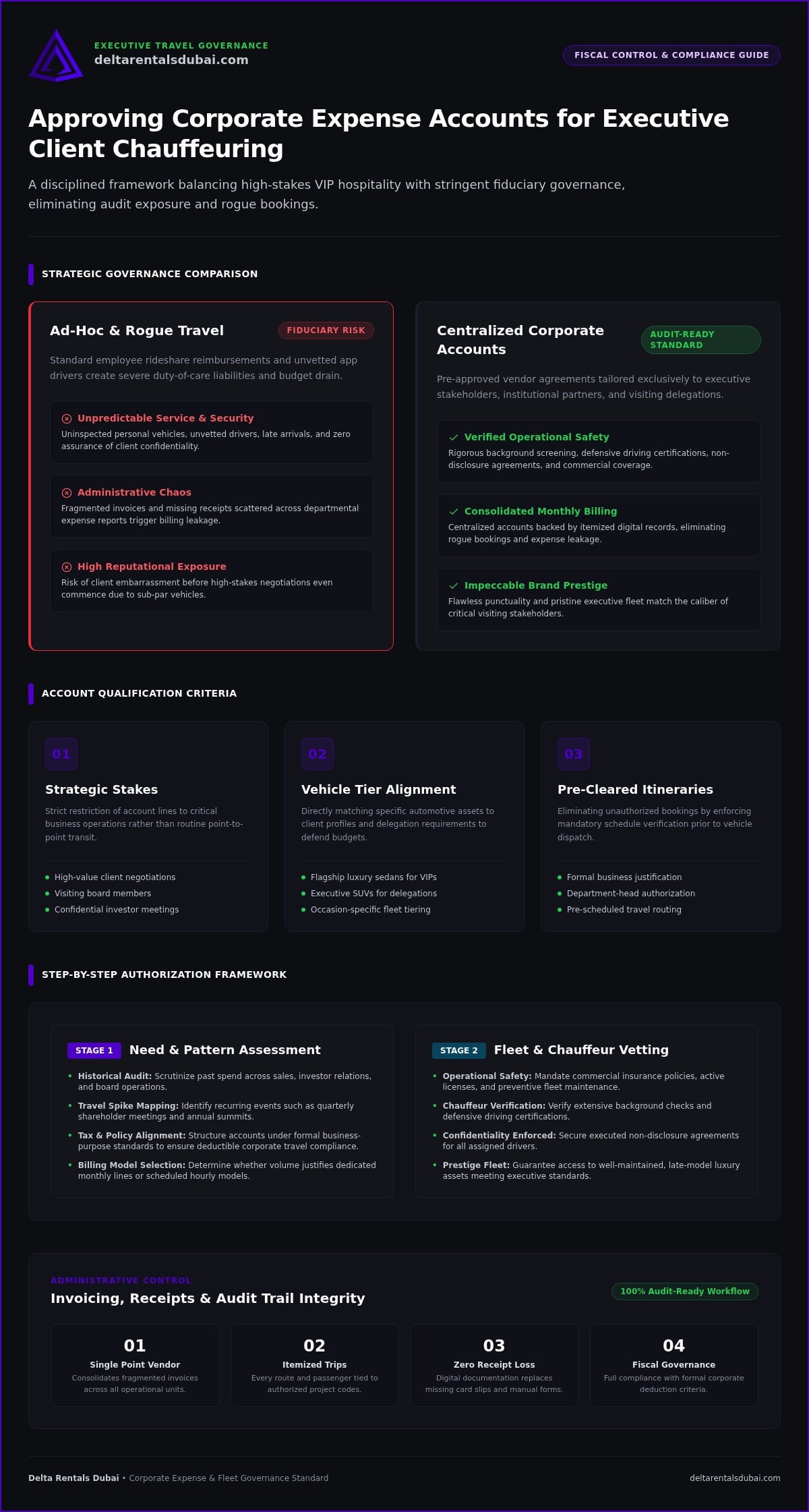
To keep budgets defensible, finance leaders need precise qualification criteria before opening account lines:
- Strategic stakes: Restrict account utilization to high-value client negotiations, visiting board members, or confidential investor meetings.
- Vehicle tier alignment: Match specific assets to guest profiles, choosing between executive SUVs for traveling delegations and flagship luxury sedans for individual VIPs.
- Pre-cleared itineraries: Require department heads to submit clear business justifications and schedules before dispatching vehicles.
The Fiduciary and Reputational Risks of Unmanaged Travel
Ad-hoc ride-hailing leaves enterprises vulnerable to serious duty-of-care liabilities. Public app drivers undergo unpredictable screening, pilot uninspected personal vehicles, and offer zero guarantee of confidentiality. A late pickup, a pungent cabin, or an unprofessional driver can instantly compromise a multi-million-dollar partnership before negotiations even begin.
Beyond reputational hazards, unmanaged travel creates administrative chaos. Rogue bookings scatter fragmented receipts across dozens of employee expense reports, causing billing leakage and painful reconciliations. Grounding your vendor approval process in established corporate governance principles protects enterprise resources while guaranteeing exceptional client treatment. Centralized, vetted accounts transform unpredictable ground travel into an audit-ready operational standard.
A Step-by-Step Framework for Authorizing Corporate Chauffeuring Accounts
Establishing an enterprise ground travel relationship shouldn’t rely on hasty, last-minute phone calls. Procurement teams need an objective, repeatable procedure before authorizing vendor agreements. By implementing a standardized workflow, approving corporate expense accounts for executive client chauffeuring transitions from an ad-hoc administrative headache into a predictable, value-adding asset.
Step 1: Assessing Corporate Need and Utilization Patterns
Start by auditing historical ground transport expenses across sales divisions, investor relations, and board operations. Map out recurring executive travel spikes, such as quarterly shareholder meetings, annual client summits, and multi-day roadshows. Analyze these patterns against formal travel policies; structuring accounts under clear business-purpose criteria ensures full alignment with IRS rules on business expenses for deductible travel. This volume audit reveals whether your organization benefits most from dedicated monthly billing lines or scheduled hourly arrangements.
Step 2: Vetting Provider Fleet Standards and Chauffeur Credentials
Never onboard a transportation partner without rigorous verification of their operational safety and service standards. Demand proof of primary commercial insurance policies, regulatory licenses, and meticulous fleet maintenance regimens. Chauffeurs must hold verified background checks, defensive driving certifications, and strict client non-disclosure agreements.
Fleet quality is equally decisive. Ensure the vendor maintains prestige, late-model options suited for discerning guests, including executive SUVs like the Cadillac Escalade or Range Rover, alongside flagship luxury sedans. If you are assessing fleet availability for demanding schedules, consulting specialized VIP chauffeuring specialists can quickly clarify capacity and service tier readiness.
Step 3: Configuring Internal Authorization Ladders
Fiscal governance requires distinct approval tiers before reservations are finalized. Set tiered authorization limits based on host seniority and guest profile:
- Pre-trip validation: Require department coordinators to log trip dates, passenger rosters, and business justifications into your procurement system prior to booking.
- Financial thresholds: Assign explicit signing thresholds to department directors, requiring VP or CFO sign-off for multi-day roadshows or multi-vehicle delegations.
- Emergency bypass protocols: Establish a documented fast-track procedure for urgent, same-day C-suite executive client changes.
Structuring these controls guarantees that approving corporate expense accounts for executive client chauffeuring remains transparent, compliant, and completely defensible during internal audits.
Structuring Expense Policy Controls: Luxury Hospitality Versus Fiscal Governance
Balancing elite hospitality with fiduciary restraint is the cornerstone of sound travel management. High-profile clients expect comfort and punctuality, but corporate controllers require clear guardrails to prevent uncontrolled budget creep. When approving corporate expense accounts for executive client chauffeuring, finance teams must formalize rules that separate appropriate client entertainment from excessive spending. Under IRS Publication 463, business travel deductions hinge on expenses being ordinary and necessary, making clear policy definitions essential for internal audit defense.
Establishing Fleet Tier Allocations by Client Category
A tiered fleet policy prevents booking guesswork while delivering the right level of prestige for every engagement. Rather than granting open access to any vehicle, link approved vehicle categories directly to the passenger roster and strategic context:
- Executive delegations: Assign premium, spacious SUVs like the Cadillac Escalade or Range Rover for visiting client teams, airport group pickups, and multi-stop site visits.
- C-suite and flagship negotiations: Reserve ultra-luxury sedans and flagship models such as Rolls Royce exclusively for board members, key acquisition targets, and enterprise partnership signings.
- Strategic fleet access: Review vehicle availability through our premier fleet selection to match corporate travel requirements with the ideal automotive tier.
Managing Ancillary Costs, Wait Times, and Incidentals
Unexpected add-ons quickly distort travel budgets. To maintain predictable monthly figures, your vendor agreement should eliminate ambiguous fees at the contract stage. Specify standard terms for flight tracking and buffer windows, ensuring delayed executive arrivals don’t trigger immediate surge charges or inflated standby rates.
Clear rules must also govern gratuities, road tolls, and parking expenses. Define whether gratuities are bundled into fixed contract rates or capped as approved line items. Address damage liabilities and security deposit waivers directly within your master corporate account agreement. Documenting these parameters upfront protects your treasury and ensures that approving corporate expense accounts for executive client chauffeuring consistently serves your strategic bottom line.
Streamlining Corporate Account Administration: Invoicing, Receipts, and Audit Trails
Eliminating administrative friction is the true measure of an effective transport program. Paper receipts and manual reimbursement forms invite lost documentation, accounting backlogs, and expense inflation. Streamlined administrative structures ensure that approving corporate expense accounts for executive client chauffeuring delivers measurable operational relief alongside complete fiscal clarity.
Implementing Centralized Billing and Project Cost Tagging
Establish a centralized direct-billing setup with your chauffeuring provider to replace chaotic personal credit card reconciliations. Under this model, the vendor issues a single, consolidated electronic statement at bi-weekly or monthly intervals. Accounts payable processes a single transaction rather than sorting hundreds of minor, ad-hoc receipts.
Accurate cost distribution requires mandatory data collection at the time of reservation. Require internal arrangers to assign specific client project codes, general ledger cost centers, and departmental identifiers before confirming any transport leg. When your billing platform imports these itemized digital lines directly into your enterprise resource planning system, finance teams can allocate transport costs to distinct client revenue targets with pinpoint accuracy.
To eliminate manual paperwork and secure clean corporate billing pipelines, set up a dedicated corporate transportation account tailored to your enterprise accounting requirements.
Ensuring Audit Readiness and Duty-of-Care Documentation
Internal tax compliance demands undeniable proof of legitimate business travel. A premier chauffeuring partner should supply digital ride logs that link directly to each billing line item. Ensure your provider delivers detailed records containing the following operational data:
- Timestamped GPS routes: Verified pickup locations, actual route miles, and exact arrival times to validate hourly invoices.
- Passenger manifests: Explicit records of visiting client names, host executives, and designated pickup contact numbers.
- Commercial documentation: Itemized listings covering all pre-arranged standby hours, airport fees, and applicable toll passages.
Schedule quarterly internal audits between procurement and finance controllers. Comparing transport billing logs against internal executive meeting calendars quickly flags unauthorized personal detours or policy deviations. This proactive reconciliation proves that approving corporate expense accounts for executive client chauffeuring establishes an airtight defense against tax penalties, eliminates rogue spend, and satisfies rigorous corporate duty-of-care expectations.
Selecting the Ideal Chauffeuring Partner: National Standards and Strategic Advantages
Selecting the right transportation vendor is the final, decisive stage in approving corporate expense accounts for executive client chauffeuring. Your chosen service acts as an immediate physical extension of your enterprise. An immaculate presentation builds immediate trust, while a sub-par vehicle or an unvetted chauffeur quickly undermines critical commercial relationships. Enterprise procurement teams can’t rely on retail booking widgets; they require established fleet operators equipped for corporate governance.
Prestige Fleet Breadth for Every Executive Requirement
A qualified partner maintains a diverse, meticulously maintained fleet suited to diverse hospitality tiers. Delegations requiring spacious group travel benefit from commanding prestige SUVs like the Cadillac Escalade and Range Rover. For high-stakes acquisitions and board-level guests, flagship models like the Rolls Royce Cullinan deliver an unmatched impression of hospitality and success.
Review our expert national chauffeur service guide to examine full fleet criteria and determine vehicle suitability across varying executive profiles.
Service Reliability, Non-Disclosure Agreements, and Discretion
Sensitive corporate negotiations don’t pause during airport transfers. Executive passenger cabins function as mobile boardrooms, making client privacy paramount. Ensure your transportation agreement requires strict confidentiality terms and driver vetting protocols:
- Executed non-disclosure agreements: Chauffeurs must sign comprehensive NDAs protecting all proprietary discussions heard in transit.
- Dedicated account managers: Priority dispatch and dedicated single-point-of-contact support eliminate call-center delays during sudden flight changes or itinerary updates.
- Transparent operational standards: Clear contracts prevent surprise line-item fees, keeping accounting audits straightforward.
Always audit market reputation prior to signing master agreements. Selecting a chauffeuring partner backed by over 300 five-star client reviews ensures proven reliability, route expertise, and flawless professionalism. Integrating these partner standards guarantees that approving corporate expense accounts for executive client chauffeuring protects your executive guests and your balance sheet alike.
Elevate Your Executive Ground Travel Governance
Achieving absolute fiscal control over executive transportation doesn’t require sacrificing premium hospitality. By establishing structured authorization workflows, defining strict fleet tier parameters, and utilizing centralized digital billing, procurement leaders eliminate rogue spend while maintaining impeccable duty-of-care standards. Done right, approving corporate expense accounts for executive client chauffeuring elevates critical business relationships and protects enterprise compliance simultaneously.
Your traveling stakeholders deserve punctuality, discretion, and ultimate comfort. Partnering with a dedicated VIP chauffeuring service backed by over 300 five-star client reviews ensures that visiting executives experience premier hospitality. With an executive fleet featuring the Cadillac Escalade, Range Rover, and Rolls Royce Cullinan, your organization can confidently host VIP clients without fiscal surprises. Establish a corporate executive travel account today to transform unpredictable ground transit into an effortless operational asset.
Frequently Asked Questions
What criteria should finance controllers prioritize when approving executive chauffeuring accounts?
Finance controllers should prioritize primary commercial liability insurance, driver vetting protocols, and transparent billing structures. Operational compliance matters just as much as vehicle luxury. Providers must supply itemized digital invoices and execute strict non-disclosure agreements for chauffeur conduct. Evaluating verified market reputation ensures you partner with an established fleet operator rather than an unvetted broker. This due diligence ensures approving corporate expense accounts for executive client chauffeuring remains safe and audit-proof.
How do corporate expense accounts for chauffeuring differ from standard employee travel reimbursements?
Standard travel reimbursements rely on employees paying out-of-pocket for ad-hoc transit and submitting receipts later. Dedicated corporate chauffeuring accounts bypass employee cards completely through direct enterprise billing. They enforce pre-authorized vehicle classes, ensure vetted executive chauffeurs, and lock in contracted billing terms. This structure prevents unauthorized personal rides, eliminates receipt tracking delays, and maintains consistent high-level hospitality for visiting partners.
Can corporate chauffeuring expenses be restricted by vehicle category and employee seniority level?
Yes, procurement policies routinely enforce tiered access controls based on organizational hierarchy and guest profile. Internal travel portals can restrict booking privileges so that only directors or senior partners can authorize transport. Policies can also limit vehicle selection, designating executive SUVs like the Cadillac Escalade for visiting teams while reserving flagship models like the Rolls Royce Cullinan strictly for board-level clients and executive leadership.
What documentation is required to verify tax compliance and audit trails for executive chauffeuring?
Tax authorities require documentation proving a legitimate business purpose for deductible transportation. Every booking must log the visiting client’s name, host executive, date, specific route, and project billing code. Modern corporate chauffeuring accounts furnish itemized digital summaries detailing GPS timestamps and exact transit durations. These detailed records establish defensible accountable-plan documentation, ensuring total compliance during internal and external financial audits.
How do dedicated corporate transportation accounts handle security deposits and incidental charges?
Dedicated enterprise accounts manage deposits and incidentals through a master corporate agreement rather than per-ride credit card holds. Standard agreements often waive individual vehicle deposits for pre-approved corporate clients. Incidental expenses such as tolls, extra wait time, and parking fees appear as distinct, itemized lines on the consolidated monthly statement, providing clear transparency and eliminating surprise card charges.
Why is professional client chauffeuring preferred over commercial ride-hailing for executive hospitality?
Professional chauffeuring guarantees vetted, professionally trained chauffeurs operating pristine, high-end fleet vehicles. In contrast, standard ride-hailing carries risks of variable vehicle cleanliness, unpredictable wait times, and zero privacy guarantees. In high-stakes corporate hospitality, a late arrival or sub-par car can damage crucial commercial relationships. Executive chauffeuring delivers seamless punctuality, signed confidentiality agreements, and a commanding executive presence that reflects your brand’s excellence.
How does a centralized billing arrangement improve internal travel budget management?
Centralized billing replaces hundreds of scattered employee expense claims with a single, consolidated electronic invoice. Finance teams can easily cross-reference transport logs against corporate cost centers and project codes before payment. This visibility prevents duplicate claims, eliminates administrative backlogs, and highlights actual spending trends across departments. Streamlining this workflow makes approving corporate expense accounts for executive client chauffeuring an efficient, cost-controlled procurement process.