
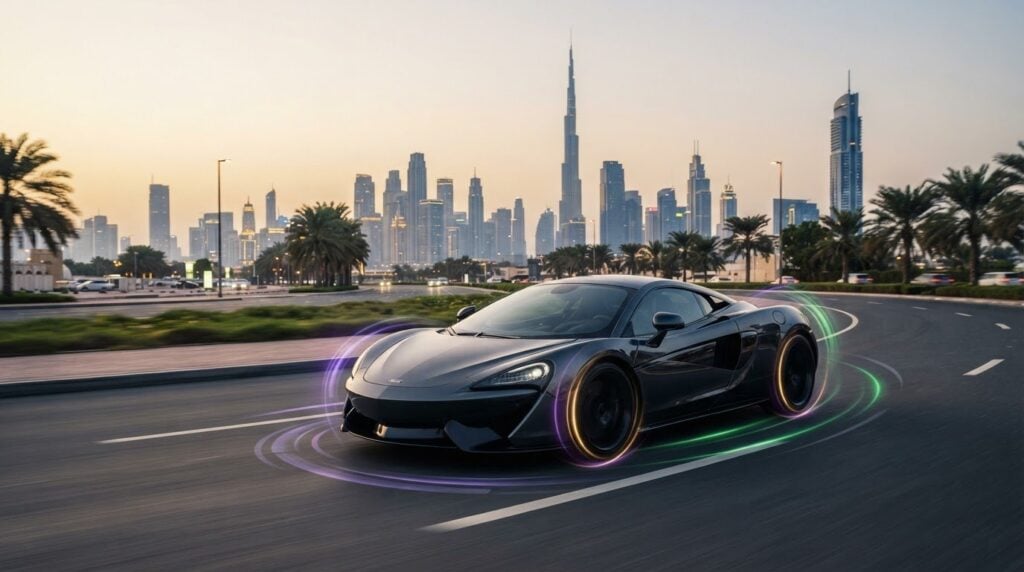
The drive mode switch on your steering wheel is not a digital leash built to ruin your fun. Modern supercar electronic stability control modes actually expand your performance envelope rather than restricting it. Staring down triple-digit horsepower while deciphering proprietary jargon like Ferrari’s Side Slip Control, McLaren’s Variable Drift Control, or Porsche Stability Management naturally creates hesitation. Nobody wants to risk losing the rear end of an elite machine simply because they misjudged a chassis setting.
True performance driving does not require shutting off your electronic safety nets. You will master how these systems manipulate slip angles and active yaw dynamics, giving you the tools to maximize track-bred capability without crossing into reckless territory. Here is your definitive blueprint to choosing the exact mode for fluctuating pavement temperatures, cornering loads, and high-speed maneuvers, so you can drive high-output exotics with absolute confidence and mechanical respect.
Key Takeaways
- Discover how multi-axis inertial sensors calculate yaw and pitch in milliseconds to balance high-speed vehicle trajectory invisibly.
- Navigate the full spectrum of supercar electronic stability control modes to match tire grip thresholds across street and track environments.
- Decode proprietary manufacturer dynamics, from Ferrari’s predictive Side Slip Control algorithms to Porsche’s granular multi-stage traction dials.
- Implement a practical decision framework based on surface temperatures and tire compound readiness before toggling dynamic thresholds.
- Learn how pristine mechanical readiness and precision-tuned active chassis systems transform raw horsepower into effortless vehicle control.
What Is Supercar Electronic Stability Control and How Does It Function?
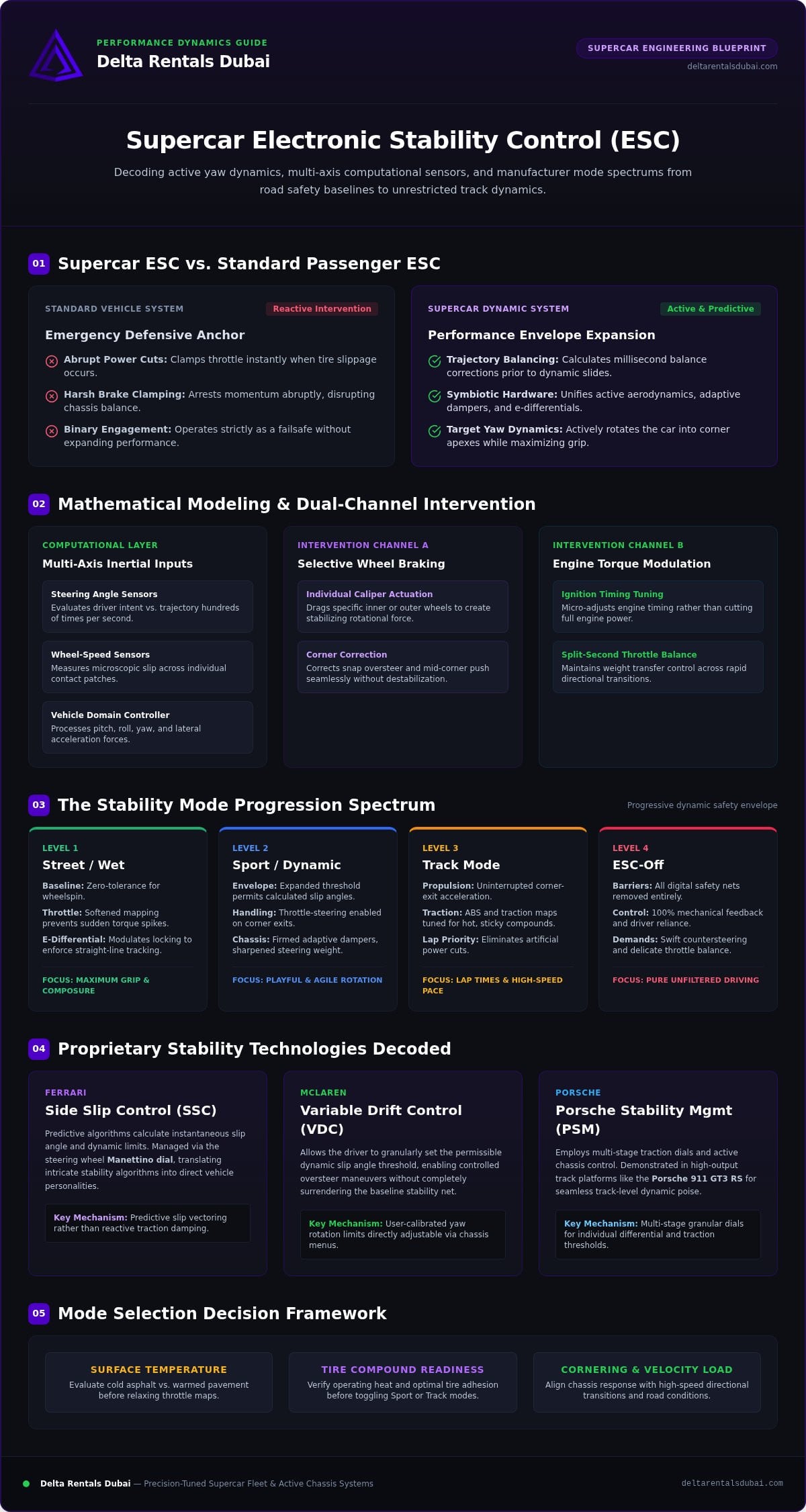
Standard passenger car stability systems function like an emergency anchor. They cut engine power abruptly and clamp down on the brakes the second a tire slips. Supercar stabilization operates on an entirely different plane of engineering. Rather than suffocating forward momentum, modern supercar electronic stability control modes actively balance vehicle trajectory with millisecond precision, predicting balance disruptions before a minor slide degrades into dynamic instability.
Every system builds on the fundamentals of automotive Electronic Stability Control, utilizing selective braking to counter lateral skids. In an exotic platform, however, this architecture works symbiotically with active aerodynamics, adaptive suspension dampers, and electronically controlled limited-slip differentials. The hardware doesn’t just catch errors. It constantly computes the target yaw rate and slip angle, actively rotating the car into corner apexes while optimizing available tire traction.
Sensors and Mathematical Modeling Behind High-Performance Stability
Precision dynamics require immense computational speed. Steering angle sensors analyze driver intent against the car’s actual physical trajectory hundreds of times per second. Concurrently, wheel-speed sensors compute microscopic tire slip across individual contact patches. Central vehicle domain controllers crunch multi-axis inertial data, measuring pitch, roll, yaw, and lateral forces against complex digital models. The software anticipates chassis behavior before the driver even registers a loss of adhesion.
Active Intervention: Independent Braking Versus Engine Torque Management
Intervention occurs through two harmonized mechanical channels. To correct mid-corner push or snap oversteer, individual caliper actuation gently drags specific inner or outer wheels, creating stabilizing rotational force. At the same time, central computers fine-tune engine output via ignition timing adjustments and split-second throttle modulation rather than harsh power cuts. This fluid interplay ensures that exploring different supercar electronic stability control modes sharpens vehicle balance without upsetting rapid weight transfer during aggressive directional transitions.
The Spectrum of Supercar Stability Modes: From Road Safety to Track Agility
High-performance driving is no longer a binary choice between robotic intervention and terrifying instability. Modern exotics divide chassis behavior into distinct, progressive tiers. By cycling through modern supercar electronic stability control modes, you adjust how far the chassis allows the rear axle to rotate before digital safeguards intervene. Steering wheel hardware like Ferrari’s Manettino dial illustrates this progression clearly, translating complex stability algorithms into distinct driving personalities.
Street and Wet Settings: Maximizing Mechanical Grip in Sub-Optimal Conditions
Street and wet configurations establish a zero-tolerance baseline for wheelspin. Throttle mapping deliberately softens to prevent sudden torque spikes from overwhelming cold tires. Concurrently, active electronic differentials modulate locking percentages to enforce straight-line tracking. These modes prioritize predictable road holding above all else, ensuring smooth gear changes and absolute composure over slick asphalt.
Dynamic and Sport Calibrations: Controlled Slip Angles and Playful Handling
Sport settings shift chassis programming from strict prevention to measured rotation. Here, the electronic safety envelope widens. The computer permits calculated slip angles, allowing you to throttle-steer through corner exits with genuine fluidity. Adaptive dampers firm up to control body roll, steering weight increases for sharper road feel, and individual braking thresholds retreat into the background, engaging only if yaw velocity spikes dangerously.
Track and ESC-Off Modes: Engineering Realities When Driving Unfiltered
Track configurations prioritize lap times and uninterrupted corner-exit propulsion over defensive safety nets. They recalibrate anti-lock braking and traction maps specifically for hot, sticky tire compounds, allowing aggressive driving without artificial power cuts. ESC-Off removes every electronic barrier entirely. Driving unfiltered demands swift countersteering, delicate throttle balance, and total chassis respect. To experience track-level dynamic poise behind the wheel of a factory-maintained Porsche 911 GT3 RS, simply reserve your precision driving experience to feel these engineered dynamic thresholds firsthand.
Proprietary ESC Technologies: How Porsche, Ferrari, and McLaren Engineer Control
Every tier-one supercar manufacturer develops proprietary software architectures that translate raw vehicle telemetry into distinct driving philosophies. Rather than relying on off-the-shelf control units, Stuttgart, Maranello, and Woking build bespoke dynamic equations. These variations illustrate why navigating supercar electronic stability control modes feels radically different across brands, turning each chassis into a unique dynamic classroom.
Porsche Stability Management: Multi-Dial Precision on Track-Focused Machinery
Porsche Stability Management (PSM) emphasizes surgical consistency and transparent feedback. On flagship machinery like the Porsche 911 GT3 RS, PSM moves beyond simple console buttons into dedicated rotary steering-wheel dials. Drivers gain granular, multi-stage control over traction thresholds and dynamic stability independently. The system integrates real-time active aerodynamic flap adjustments with electronically controlled differential locking and multi-stage suspension damping, providing unwavering high-speed stability.
Ferrari Manettino and Side Slip Control (SSC) Architecture
Ferrari approaches dynamic vehicle management through mathematical prediction rather than reactive containment. Controlled via the steering-wheel Manettino, Maranello’s proprietary Side Slip Control calculates the vehicle’s dynamic attitude hundreds of times per second. By comparing instantaneous tire slip angles against algorithmic targets, SSC coordinates the electronic differential, magnetorheological dampers, and carbon-ceramic brakes. Selecting CT-Off disables traditional traction interference while maintaining dynamic stability during extreme yaw.
McLaren Active Dynamics and Variable Drift Control
McLaren engineers chassis balance around independent physical adaptability. Woking deliberately separates powertrain and handling controls into distinct toggle switches. This lets drivers pair compliant road damping with aggressive track throttle maps, or vice versa. Additionally, Variable Drift Control (VDC) empowers the driver to set precise drift angles via the central infotainment screen. It seamlessly meters allowable slip without completely severing electronic intervention.
Modern hybrid engineering takes this integration a step further. Platforms like the McLaren Artura utilize instantaneous electric motor torque to counter micro-skids far quicker than conventional combustion engines can manage. Exploring these distinct engineering approaches provides unmatched insight into how modern supercar electronic stability control modes redefine the relationship between machine computation and driver engagement.
How to Choose the Correct Stability Mode: A Practical Decision Framework
Selecting the optimal chassis setup isn’t about ego. It’s an engineering calculation that matches mechanical grip to real-time road conditions. Before rotating your drive selector, assess the physical variables that dictate tire adhesion. Deciding between various supercar electronic stability control modes requires evaluating pavement heat, compound readiness, and your actual familiarity with high-output torque delivery.
Assessing Ambient Temperature, Tire Pressure, and Road Surfaces
Track-bred performance tires offer remarkably low lateral grip when cold, regardless of aerodynamic downforce. Always inspect your tire temperature gauges on the digital instrument cluster before applying aggressive throttle. Warm highway asphalt generates immense mechanical traction once compounds reach operating heat, permitting dynamic calibrations. If unexpected rain or surface debris compromises traction, switch immediately to dedicated Wet configurations to maximize safety margins.
The Myth of Disabling ESC: Why Electronic Modes Often Produce Faster Driving
Turning off electronic aids doesn’t make you faster. Modern high-performance stability algorithms process wheel slip and individual torque distribution far quicker than human reflexes. Dynamic sport calibrations maintain forward drive out of corners without inducing tire scrub or thermal degradation from excessive wheelspin. Understanding these nuanced supercar electronic stability control modes allows you to balance explosive pace with calculated mechanical control.
Step-by-Step Mode Selection for Everyday Grand Touring
Follow a disciplined progression every time you drive:
- Phase 1: Default Baseline. Begin every journey in standard road settings until engine oil, gearbox fluids, and tires reach optimal operating temperatures.
- Phase 2: Dynamic Engagement. Transition into intermediate sport modes only on open, sweeping stretches with dry pavement and unobstructed sightlines.
- Phase 3: Track Protocol. Reserve complete system deactivation exclusively for closed circuits under professional instruction.
Respecting these mechanical boundaries lets you experience breathtaking velocity without unnecessary risk. When you’re ready to command a world-class fleet maintained to pristine factory standards, connect directly with our team on WhatsApp to arrange your tailored high-performance reservation.
Experience the Pinnacle of High-Performance Engineering Across the Country
Automotive theory only takes you so far. True dynamic mastery requires firsthand seat time behind the wheel of impeccably engineered machinery. Modern high-output platforms pair explosive acceleration with multi-layered stability architectures, turning extreme velocity into a composed, confidence-inspiring experience. Exploring various supercar electronic stability control modes across real-world asphalt reveals precisely how active aerodynamics, adaptive damping, and electronic differentials communicate under load.
Unfiltered Precision: Selecting Track-Bred Versus Grand Touring Machinery
Different driving environments require distinct chassis calibrations. Purpose-built track cars deliver laser-sharp steering response and granular traction adjustment designed to dissect apexes with zero wasted motion. Flagship grand tourers provide effortless stability, compliant damper settings, and serene long-distance composure during high-speed cruising. Choosing the right platform lets you match active chassis dynamics to your exact driving goals. Explore the diverse performance options in our national luxury fleet to select the ideal machine for your driving itinerary.
The Value of Flawless Maintenance in High-Output Dynamic Driving
Precision stability software relies entirely on flawless mechanical running gear. A fraction of a millimeter variance in tire tread depth or minor suspension misalignment distorts the predictive algorithms that govern high-speed yaw control. Factory-certified maintenance ensures sensors, active aero actuators, and braking hardware execute dynamic commands flawlessly.
Before every journey, a professional vehicle handover clarifies each steering-wheel switch, dynamic setting, and safety threshold. This seamless onboarding eliminates uncertainty, allowing you to pilot multi-hundred-horsepower machines with clarity. Unlocking the true capability of modern supercar electronic stability control modes begins with factory-grade preparation, direct vehicle delivery, and pristine mechanical readiness.
Command the Next Level of Precision Performance
Mastering modern supercar electronic stability control modes transforms immense horsepower from an intimidating challenge into an exhilarating, exact science. Advanced digital algorithms don’t dilute driver involvement. Instead, they elevate your precision by actively managing slip angles, yaw rates, and rapid weight transfer. With disciplined tire awareness and calculated mode progression, you command peak vehicle dynamics with unwavering authority.
Direct access to world-class engineering is closer than you think. Delta Rentals offers nationwide vehicle delivery paired with a comprehensive vehicle orientation at handover, ensuring you understand every chassis setting before starting the engine. Discover our pristine, factory-maintained fleet featuring benchmarks like the Porsche 911 GT3 RS and McLaren Artura. Backed by over 300 five-star verified customer reviews highlighting transparent elite service, we deliver an unforgettable automotive experience. Take the driver’s seat with complete confidence. Explore our elite national supercar fleet and reserve your drive today.
Frequently Asked Questions
What happens when you turn stability control completely off in a modern supercar?
Disabling stability control completely removes digital torque cuts and individual wheel brake intervention. The car relies entirely on your steering angle, pedal finesse, and physical tire grip. If you enter a corner too fast or apply throttle abruptly, the vehicle will not correct the resulting slide. You assume total mechanical responsibility for managing chassis weight transfer and snap oversteer.
Can you drift a modern supercar while leaving electronic stability control enabled?
Yes, intermediate supercar electronic stability control modes are specifically calibrated to allow controlled power slides. Systems like Ferrari’s Side Slip Control and McLaren’s Variable Drift Control calculate acceptable yaw angles in real time. They let you hold an extended drift on corner exit, intervening with subtle brake pressure only if the rotation exceeds your preset angle threshold.
Is track mode safe to use during spirited driving on regular public highways?
Track mode is unsuitable for regular highways because it assumes warm, ultra-sticky competition rubber and pristine asphalt. It relaxes the safety envelope, stiffens dampers aggressively, and permits excessive wheel slip before stepping in. On unpredictable public roads with surface seams, localized gravel, or unexpected traffic, intermediate sport settings provide far better real-world protection.
How does wet mode stabilize high-horsepower rear-wheel drive supercars?
Wet mode maximizes mechanical traction by softening throttle response and preemptively deadening abrupt torque surges. The system increases sensor sensitivity to detect microscopic tire slip instantly, engaging the brakes and locking the active differential early to prevent loss of lateral grip. It transforms high-strung, rear-wheel-drive platforms into docile, predictable machines over damp, low-friction tarmac.
Why do modern supercars have multiple traction control settings instead of just one?
A single setting cannot bridge the massive performance gap between slick highway commuting and aggressive closed-circuit driving. Multi-stage supercar electronic stability control modes let drivers dial in exact levels of allowable tire slip to match changing ambient heat, tire wear, and individual experience. This modular approach delivers tailored chassis dynamics without forcing drivers to choose between full interference and zero assistance.
Does leaving stability control in sport mode wear out the rear brake pads faster?
Aggressive driving in dynamic sport settings can increase rear brake pad wear noticeably. The stability control computer frequently applies light, targeted braking pressure to individual inner rear wheels to neutralize understeer and stabilize yaw rotations. While this torque vectoring sharpens cornering precision, the rapid micro-interventions generate additional friction and thermal load on the rear brake assemblies.
What is the difference between traction control and electronic stability control?
Traction control prevents longitudinal wheelspin during straight-line acceleration by trimming engine output or tapping the drive-wheel brakes. Electronic stability control is a broader, multi-dimensional safety architecture that manages lateral vehicle trajectory. It continuously monitors yaw, roll, and steering angle, actuating individual brakes across all four wheels to prevent the chassis from spinning out during directional changes.