

A traditional air conditioning compressor can siphon three to five horsepower straight from the crankshaft, creating an immediate performance penalty. If you have ever tackled a spirited driving session on a hot afternoon, you know the frustration. You shouldn’t have to endure a sweltering cabin just to protect your throttle response, nor should you accept parasitic drag when chasing peak speed. Fortunately, climate control efficiency in high performance cars has moved far beyond trade-offs. Modern supercars now isolate cooling demands from the powertrain, delivering crisp cabin air without bleeding engine output.
In this 2026 engineering guide, discover how modern supercars balance cabin cooling and thermal comfort without sacrificing track-level horsepower or aerodynamic efficiency. You will learn how decoupled electric compressors and heat pumps protect engine output, how smart airflow management prevents excess drag, and what advanced thermal systems to look for when experiencing elite performance machinery.
Key Takeaways
- Mastering climate control efficiency in high performance cars requires advanced thermal isolation techniques engineered to neutralize mid-engine and rear-engine cockpit heat soak.
- Discover how modern Wide-Open Throttle disengagement and decoupled electric compressors preserve maximum horsepower during aggressive acceleration.
- Explore the lightweight composite ducting and active aerodynamic packaging that cool modern cockpits without increasing drag.
- Implement a driver-tested cabin pre-cooling and recirculation protocol to protect cooling cores before demanding drives.
- Identify the critical multi-point thermal standards that ensure elite performance machinery delivers sustained cabin comfort under extreme operating conditions.
Understanding Climate Control Efficiency in High Performance Cars
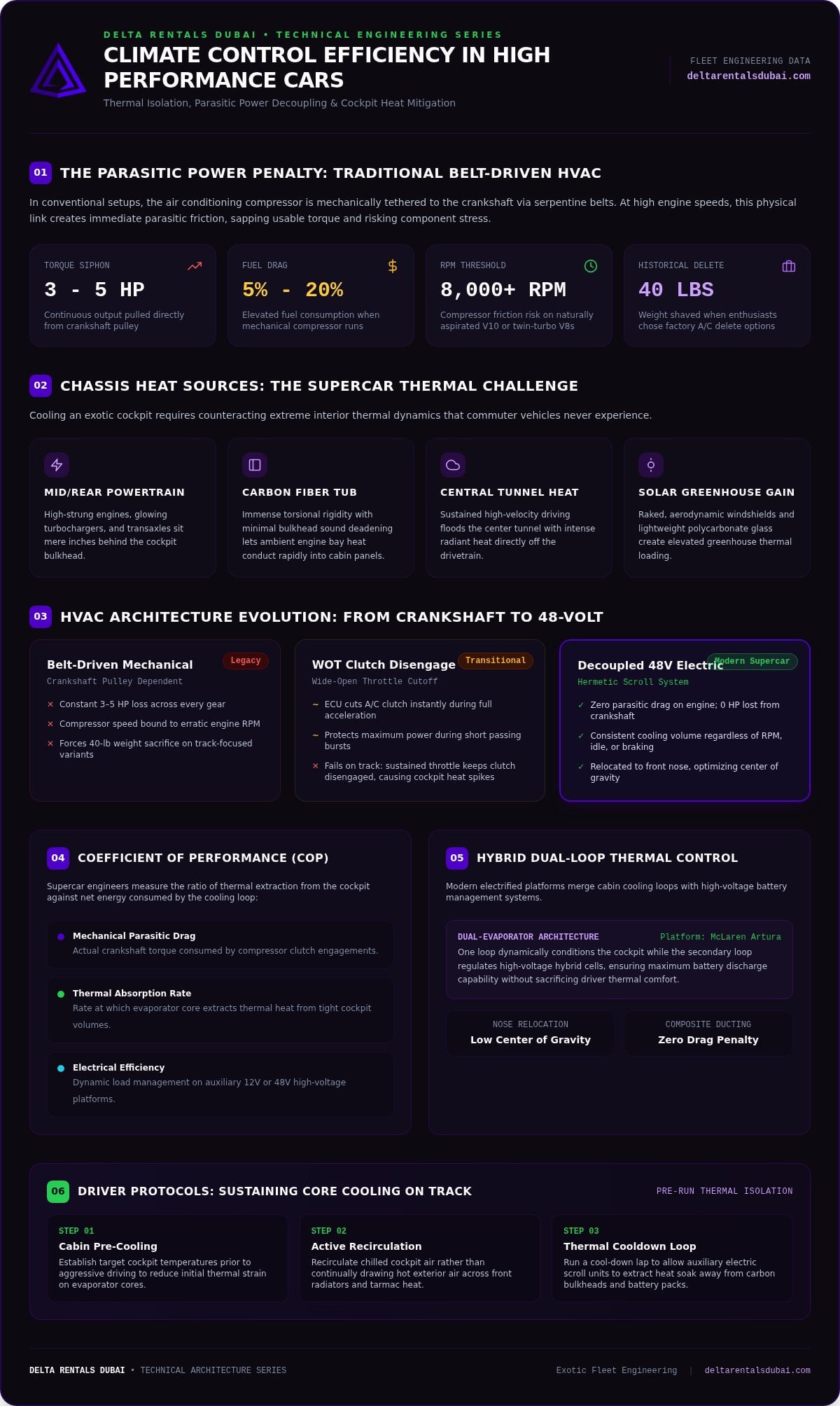
In standard commuter vehicles, HVAC systems simply blow chilled air into an insulated passenger box. In an exotic platform, climate control efficiency in high performance cars represents something far more demanding: the precise ratio of thermal extraction against horsepower loss, chassis ballast, and aerodynamic drag. For decades, manufacturers treated luxury and track capability as mutually exclusive, prompting track enthusiasts to select factory air conditioning delete options to shave forty pounds. Today, intelligent digital thermal management has replaced mechanical sacrifice. While traditional automobile air conditioning systems produced unoptimized, continuous drag against the crankshaft, modern supercar architectures dynamically regulate thermal transfer without choking the powertrain.
The Unique Thermal Challenges of Performance Cockpits
Exotic layouts generate immense internal thermal loads. In mid-engine and rear-engine configurations, high-strung powertrains, glowing turbochargers, and transaxles sit inches from the driver’s back. Carbon fiber tubs provide immense rigidity, but minimal bulkhead insulation allows ambient heat to conduct rapidly across chassis panels. Simultaneously, high-speed driving floods the central tunnel with radiant transmission heat, while steep windscreens and lightweight polycarbonate glass create massive greenhouse solar gain. Cooling these cockpits demands active heat rejection far beyond ordinary automotive baselines.
Defining Efficiency: Coefficient of Performance vs Horsepower Drain
Evaluating supercar climate hardware requires looking beyond vent temperatures to the Coefficient of Performance (COP). In performance engineering, COP tracks the volume of heat extracted from the cabin relative to the net work required to operate the loop:
- Mechanical Parasitic Drag: The actual crankshaft torque consumed by running compressor clutches.
- Thermal Absorption Rate: How rapidly the evaporator core pulls thermal energy from tight cockpit volumes.
- Electrical Efficiency: The current demand placed on auxiliary 12V or 48V architectures.
Engineers evaluate climate control efficiency in high performance cars by measuring cooling rate per unit of consumed engine energy. The standard is absolute: instantaneous driver cooling without forfeiting throttle response or top-end speed.
Parasitic Power Draw: Balancing Horsepower and Cockpit Cooling
Traditional automotive engineering tied cabin comfort directly to engine speed. In conventional setups, a belt-driven compressor runs off the crankshaft pulley, siphoning between 3 to 5 horsepower and increasing fuel consumption by 5% to 20%. Spin a naturally aspirated V10 or twin-turbo V8 past 8,000 RPM, and that physical link creates serious problems. Excessive rotational velocity forces severe internal compressor friction, risking mechanical failure while stealing usable torque at the top end. To solve this, early performance systems introduced Wide-Open Throttle (WOT) electromagnetic clutch disengagement. Stomp the accelerator, and an engine control unit cuts compressor power instantly. Lift off, and the clutch snaps shut again.
While WOT cutoffs protect peak horsepower during short passing maneuvers, they fail during sustained track driving. Frequent full-throttle bursts keep the clutch disengaged, allowing cockpit temperatures to spike rapidly. Modern engineering solves this problem by moving toward an integrated cooling and HVAC design that replaces mechanical belts with independent electrical circuits.
Traditional Belt-Driven Compressors vs Modern 48V Electric Units
Decoupling the air conditioning compressor from the engine transforms climate control efficiency in high performance cars. Dedicated 48-volt auxiliary electrical architectures run hermetically sealed electric scroll compressors completely independent of engine RPM. Whether idling in heavy traffic or braking into a chicane, cabin cooling volume remains entirely constant. Freeing the compressor from the serpentine belt also unlocks packaging freedom. Designers can relocate the unit to the front nose away from scorching exhaust manifolds, lowering the center of gravity while eliminating parasitic engine drag entirely.
Hybrid Integration and High-Voltage Thermal Management
Modern hybrid supercars take this decoupling a step further by merging interior climate loops with high-voltage battery management. Vehicles like the McLaren Artura use dual-evaporator architectures where the climate compressor chills both passenger air and the high-voltage traction pack. Intricate valve networks distribute refrigerant dynamically: prioritizing battery stability during hard acceleration, then directing cooling back to the driver under cruising conditions. Regenerative braking systems harvest kinetic energy into the hybrid battery, effectively running the climate compressor on captured stopping power rather than combusted fuel.
This level of integrated thermal balance ensures maximum output remains available at all times. If you want to feel this technology firsthand, consider reserving an engineered machine through an elite McLaren Artura rental that proves extreme thermal efficiency and high horsepower can easily coexist.
Aerodynamic Packaging and Lightweight HVAC Architecture
Packaging a cooling system within a razor-thin supercar profile presents a brutal aerodynamic dilemma. Every heat exchanger placed directly against the oncoming airflow creates form drag, disrupting the clean wake essential for high-speed stability. In high-output vehicles, climate control efficiency in high performance cars requires balancing thermal exchange against aerodynamic drag. Rather than relying on blunt, frontal air dams that degrade top speed, engineers deploy advanced thermal management technologies, pairing active ducting with composite heat exchangers that maximize airflow without creating aerodynamic wake turbulence.
Condenser Placement and Airflow Aerodynamics
High-downforce designs route airflow through carefully sculpted paths. For example, the track-focused Porsche 911 GT3 RS replaces traditional luggage space with a large, angled center radiator, exhausting scorching air over the hood and roof rather than beneath the chassis. Nose-mounted climate condensers work alongside active aerodynamic flaps that open during low-speed thermal soak and seal during high-speed runs. Ingesting air from clean boundary layers feeds sufficient volume to the condenser, ensuring the cabin stays cold without disrupting critical downforce balance.
Lightweighting the Climate Control Assembly
Trimming chassis weight requires reimagining every component in the HVAC loop. Traditional thick rubber hoses and cast brackets have yielded to featherweight composite plumbing and precision-engineered alloy assemblies:
- Titanium and Thin-Wall Tubing: High-pressure refrigerant lines made from thin-wall aluminum and titanium drop system mass by up to 35%.
- Micro-Channel Evaporators: Compact aluminum matrix cores maximize refrigerant surface area, extracting cockpit heat within tight, stripped-back dash layouts.
- Brushless Variable Blowers: Compact blower assemblies reduce electrical current while cycling cabin air volume in seconds.
Multi-Zone Grand Touring Luxury vs Track Minimalism
Different driving philosophies approach thermal comfort from opposing directions. While hardcore track specials favor compact, weight-saving blowers, an ultra-luxury vehicle like the Rolls Royce Cullinan Black Badge employs a lavish four-zone climate architecture designed for whisper-quiet operation. These grand touring systems rely on double-glazed acoustic glass, infrared-reflective windshield films, and micro-diffuse vents that prevent direct airflow draft against occupants. By reflecting solar thermal radiation before it penetrates the glass, these vehicles minimize climate system workload, keeping the cabin serene while the powertrain effortlessly glides forward.
Optimizing Climate Control Efficiency: Best Practices for Drivers
Hardware accounts for only half of the performance thermal equation. How you operate the controls inside the cockpit determines whether the system cools seamlessly or struggles under load. Maximizing climate control efficiency in high performance cars requires calculated driver habits that shield cooling cores from extreme thermal spikes, particularly during intense track outings or high-speed touring.
Pre-Drive Cabin Thermal Management
Thermal mitigation begins well before starting the engine. Follow this proven five-step protocol to purge cockpit heat soak:
- Park Strategically: Always utilize covered structures or custom-fitted solar-reflective windshield shades to block radiant greenhouse buildup.
- Pre-Condition Remotely: Activate connected smartphone pre-cooling while the vehicle is idling or plugged in, using auxiliary power rather than drawing from dynamic reserves.
- Execute a Dynamic Window Drop: Roll both windows down for the first sixty seconds of driving above 30 mph to flush trapped superheated air instantly.
- Engage Automatic Recirculation: Close external flaps once stagnant heat exits, lowering the enthalpy differential across the cooling core.
- Lock Baseline Cabin Temperature: Set the system to 70°F (21°C) on automatic rather than dialing it to maximum low, allowing the sensors to meter airflow smoothly.
Dynamic In-Cabin Settings During Performance Driving
When preparing for dynamic launch runs or sustained high-RPM sessions, avoid setting manual blower speeds to maximum. Cranking the fan to full speed creates excessive electrical draw on alternators and high-voltage converters while pulling warm cockpit air across the evaporator core faster than it can effectively chill. Instead, leave the system in automated climate mode with interior recirculation active. Recirculating already chilled cockpit air cuts compressor load substantially. In vehicles equipped with multi-zone systems, disable unoccupied passenger zones to direct concentrated cooling flow solely onto the driver.
Preventative Inspection and Maintenance Essentials
Maintaining peak heat extraction requires vigilant hardware inspection. Check these critical areas regularly:
- Clear Condenser Inlets: Inspect front intake nostrils after aggressive drives, clearing away rubber tire marbles, leaves, and road grit that restrict cooling fins.
- Verify Refrigerant Charge: Ensure factory-spec refrigerant levels to prevent compressor cavitation during sustained high lateral-G cornering.
- Swap High-Flow Microfilters: Replace restrictive cabin pollen filters annually to maintain uninterrupted static pressure across the blower motor.
If you want to experience flawless high-speed thermal stability without worrying about maintenance overhead, book an elite supercar rental from an expertly maintained luxury fleet ready to perform in any climate.
Experience Uncompromised Performance and Thermal Luxury
Modern supercar engineering proves that extreme speed and cabin comfort no longer exist in opposition. By isolating high-voltage compressors, streamlining micro-channel heat exchangers, and executing active aerodynamic ducting, elite manufacturers ensure drivers remain sharp behind the wheel. Mastering climate control efficiency in high performance cars allows exotic machinery to deliver blistering acceleration runs repeatedly, keeping the cockpit calm while mechanical temperatures surge outside.
The Standard of a Meticulously Maintained Supercar Fleet
Factory engineering relies entirely on rigorous physical upkeep to perform at its peak. When high-performance cars operate in demanding national climates, cooling loops face severe thermal stress. Specialized automotive technicians run comprehensive diagnostic checks before every handoff, pressure-testing auxiliary circuits and verifying pristine condenser airflow. This uncompromising inspection standard preserves baseline climate control efficiency in high performance cars across every platform:
- Thermal Loop Pressure Testing: Precision manifold checks verify proper refrigerant mass, preventing compressor starvation during aggressive maneuvers.
- Heat Exchanger Decontamination: Micro-channel fins undergo ultrasonic cleaning to strip microscopic grit that impedes thermal transfer.
- Electronic Actuator Calibration: Digital scan tools verify active aerodynamic flaps open and seal with millisecond accuracy.
Whether commanding a pure track weapon or enjoying refined VIP chauffeuring, verified thermal integrity guarantees instant, refreshing climate control from the moment you fire the ignition.
Selecting Your Performance Machine for Maximum Driving Comfort
Your driving goals dictate the ideal thermal package. If your focus centers on sharp cornering and high-downforce dynamics, track-bred machines like the Porsche 911 GT3 RS channel air with surgical precision. If you crave instant hybrid torque paired with an isolated electric cooling loop, hybrid supercars like the McLaren Artura provide seamless cabin climate without sapping powertrain response. For cross-country travel wrapped in silent opulence, ultra-luxury flagships like the Rolls Royce Cullinan Black Badge offer multi-zone thermal serenity that completely shuts out ambient heat.
Experiencing these automotive masterworks in pristine mechanical condition is straightforward. Connect with Delta Rentals to access an elite national fleet of meticulously prepared exotic vehicles. From personalized vehicle handovers to dedicated concierge support, you can step behind the wheel of world-class automotive engineering and enjoy uncompromising performance in total comfort.
Command Peak Horsepower in Total Cockpit Serenity
The days of sacrificing comfort for raw speed are officially behind us. Modern thermal packaging proves that advanced decoupling, 48-volt electric scroll compressors, and intelligent active aerodynamics preserve maximum horsepower while maintaining an ice-cold cabin. True climate control efficiency in high performance cars lets you push the limits on demanding roads so you don’t have to battle engine drag or cockpit heat soak.
Every vehicle in an elite lineup should honor this balance. Whether you want the track-honed precision of the Porsche 911 GT3 RS, the hybrid innovation of the McLaren Artura, or the multi-zone sanctuary of the Rolls Royce Cullinan, pristine condition is non-negotiable. Rigorous multi-point thermal and mechanical inspections prior to every client delivery guarantee peak cooling performance across every single mile. Backed by dedicated national concierge support, stepping into a world-class exotic vehicle has never been easier. Experience track performance and effortless luxury with Delta Rentals and discover what uncompromised automotive engineering feels like today.
Frequently Asked Questions
Does running the air conditioning reduce horsepower in modern high performance cars?
Not in platforms equipped with decoupled 48-volt or high-voltage electric compressors. While traditional belt setups sap three to five horsepower directly from the crankshaft, modern architectures isolate cooling from engine rotation completely. Furthermore, vehicles running legacy belt-driven compressors use wide-open throttle cutoffs that disengage the clutch automatically during full acceleration, ensuring you never lose usable horsepower when demanding peak performance.
Why do some track cars still offer air conditioning delete options?
Manufacturers offer air conditioning deletes primarily to strip physical vehicle weight rather than conserve horsepower. Removing the compressor, condenser, lines, and evaporator core sheds between thirty and forty-five pounds of chassis ballast. For purists chasing absolute lap times, shedding front-end weight sharpens turn-in dynamics, though modern climate control efficiency in high performance cars has made this sacrifice largely unnecessary for spirited driving.
How do hybrid supercars power their climate control systems?
Hybrid supercars energize their climate systems using dedicated high-voltage traction batteries paired with kinetic energy recovery. Instead of drawing mechanical power from the engine, an electric scroll compressor runs on stored electrical reserves. Regenerative braking captures thermal energy during deceleration and channels it into the battery. This system maintains crisp cabin cooling and battery thermal stability even when the combustion engine shuts down completely.
Can high cockpit heat damage electronic instrumentation in performance vehicles?
Yes, excessive cockpit temperatures can trigger electronic throttling and display distortion in digital instrument clusters. Modern performance machines house complex telemetry computers, touchscreens, and digital driver displays behind carbon fiber dash structures. Cabin temperatures exceeding 140°F (60°C) cause liquid crystal displays to dim, glitch, or enter safety reboot cycles. Sustained cabin climate control protects delicate electronic hardware from permanent thermal degradation.
What is the ideal climate control setting for track driving?
The optimal track setting is automatic climate mode set to 70°F (21°C) with interior air recirculation engaged. Recirculating cockpit air lowers the thermal load on the cooling core by chilling already-conditioned air rather than blistering outdoor intake. Avoid setting manual fan speeds to maximum, which strains auxiliary electrical circuits. Direct airflow toward your chest to keep your core body temperature stable under high lateral forces.
How does active aerodynamics impact the cooling efficiency of an air conditioning condenser?
Active aerodynamics optimizes condenser heat exchange by balancing incoming airflow against aerodynamic drag. Electronically controlled front flaps open during low-speed cornering or thermal soak to flood the condenser fins with cooling air. At higher track speeds, the flaps close partially to streamline underbody airflow and reduce drag. This dynamic modulation stabilizes climate control efficiency in high performance cars without disturbing balance or top-speed stability.
How often should performance car climate control systems undergo professional servicing?
Performance car climate systems should undergo professional inspection at least once every twelve months or before dedicated track outings. High lateral Gs, intense engine compartment heat, and track debris put significant strain on micro-channel condensers, seals, and fluid lines. Routine servicing verifies factory-spec refrigerant pressure, clears rubber marbles from air ducts, and checks electronic actuators to ensure peak cooling reliability.