

A panoramic glass roof is no longer a mere design flourish; it’s an exacting engineering discipline that balances expansive greenhouse geometry with advanced thermal shielding. If you appreciate high-end automotive craftsmanship, you already know that panoramic sunroof visibility in luxury SUVs delivers an unmatched sense of airy freedom, dramatically opening sightlines and elevating every passenger mile. Yet it’s completely natural to question the practical trade-offs. You might wonder whether that vast expanse of overhead glass invites blinding glare, traps unbearable cabin heat, or cuts into vital rear headroom.
Modern flagship engineering has completely rewritten those rules. You’ll discover how state-of-the-art panoramic architectures transform cabin openness, driver sightlines, and passenger comfort without sacrificing structural rigidity or whisper-quiet composure. We break down the realities of acoustic lamination, electrochromic smart glass, and thermal barrier coatings. By the end of this 2026 guide, you’ll have an actionable framework to choose between panoramic glass and solid headliners with total confidence.
Key Takeaways
- Understand how panoramic sunroof visibility in luxury SUVs surpasses traditional moonroofs through uninterrupted glass canopies that dramatically expand sightlines.
- Discover how strategic overhead daylighting alters spatial perception, eliminating the cavernous atmosphere common in expansive three-row cabins.
- Learn how advanced acoustic lamination and electrochromic smart glass reflect solar heat and seal out road noise without mechanical shade intrusion.
- Compare real-world greenhouse architectures, pillar placement, and glass clarity across flagship platforms like the Range Rover Sport V8 and Cadillac Escalade.
- Master a practical framework to audit glass tint levels and structural openness, ensuring effortless comfort for executive touring.
What Defines Panoramic Sunroof Visibility in Luxury SUVs?
True luxury engineering treats natural light as an architectural material. Panoramic sunroof visibility in luxury SUVs represents far more than an oversized window cut into a metal roof stamping. It is the calculated integration of uninterrupted overhead glazing and elevated sightlines. While a standard moonroof merely punches a modest opening above the front seats, modern prestige canopy systems stretch daylight across multiple seating tiers. Understanding the mechanical evolution across historic types of sunroofs clarifies why modern monolithic glass panels deliver an entirely different sensory experience. By bathing the cabin in balanced daylight, premium manufacturers actively reduce passenger fatigue during extended journeys.
When paired with the command seating position typical of flagship SUVs, this glazing fundamentally changes the driving environment. It transforms high-riding cockpits into open observation lounges.
Anatomy of Modern Panoramic Glass Roofs
Structural glass roofs generally fall into two categories: fixed monolithic canopies and dual-pane operational tilt-and-slide assemblies. Fixed glass delivers maximum visual clarity and unbroken surface area. Operational dual-pane systems add ventilation versatility using motorized tracks. Both setups rely on precision perimeter sealing, water-channel drainage rails, and ultra-high-strength steel reinforcement rings. Engineered to satisfy stringent ANSI Z26.1 strength standards, these surrounding structural cages preserve vehicle torsional rigidity while allowing panoramic sunroof visibility in luxury SUVs to remain completely unhindered.
The Geometry of Driver and Passenger Sightlines
Cabin geometry dictates how occupants perceive outward space. High roof arches and lowered beltlines amplify peripheral vision, creating distinct spatial advantages across every row:
- Enhanced Driver Spatial Awareness: Tall greenhouse glass reduces blind spots above and around the vehicle, giving drivers immediate environmental context in crowded traffic or tight maneuvers.
- Uncompromised Rear Sightlines: Slimmed B-pillars and full-length overhead glass prevent rear passengers from feeling boxed in by heavy seatbacks and thick roof pillars.
- Vertical Field of View: Expansive overhead glass allows occupants to take in towering coastal cliffs, mountain passes, and urban skylines without hunching forward.
Elevated sightlines turn standard transit into an engaging, dynamic tour for everyone on board.
How Overhead Glass Transforms Spatial Perception and Interior Light
Natural light reshapes how human psychology interprets interior volume. In full-size prestige vehicles, vast cabins can quickly feel cavernous and isolating when enclosed beneath dark, solid headliners. Overhead daylight completely counters this effect. By illuminating the center aisle and cabin ceiling, it visually expands shoulder and head space, making enclosed cabins feel as expansive as private lounges. Expansive vertical vision also realigns the vestibular system. Passengers prone to motion fatigue gain continuous visual contact with the horizon and open sky, stabilizing sensory balance through winding mountain roads and sweeping turns.
Illumination Engineering and Cabin Ambience
Bespoke automotive interiors rely on accurate light transmission to highlight fine craftsmanship. Natural light brings out the authentic depth of semi-aniline leathers, contrast stitching, and open-pore wood veneers that directional interior lamps often wash out. Premium glass panels manage this illumination with precision. Neutral density tints prevent harsh midday glare while allowing pleasant ambient light to fill the cabin. As daylight fades, this overhead illumination blends seamlessly into customizable ambient LED lighting. Safety remains just as vital as luxury aesthetics. While ongoing NHTSA sunroof safety analysis monitors automotive glazing durability across high-volume platforms, Tier-1 luxury manufacturers utilize advanced multi-layer lamination to ensure these light-filled sanctuaries stay quiet, secure, and structurally sound.
Rear-Seat Passenger Experience and Headroom Geometry
Second- and third-row occupants often endure the most confined seating positions in conventional vehicles. Optimizing panoramic sunroof visibility in luxury SUVs redefines that rear-seat executive travel experience. Instead of staring at thick front headrests and opaque headliners, passengers enjoy an uninterrupted panoramic sweep across towering mountain passes and open horizons.
Automakers protect precious passenger clearance through scalloped, contoured headliners. Rather than dropping ceiling heights across the entire cabin, modern cassettes route motorized tracks along the vehicle’s structural perimeter. The result is generous vertical headroom paired with an airy, elevated perspective. If you want to evaluate these spatial differences firsthand, you can connect with a prestige fleet specialist to explore flagship platforms configured with class-leading canopy designs.
Thermal Management and Acoustic Engineering Behind Luxury Glass Canopies
Skeptics often worry that spanning an SUV cabin with glass turns the interior into a rolling greenhouse. In premium automotive engineering, thermal defense is built directly into the glass matrix. Multi-zone climate systems work in tandem with rooftop solar load sensors. These sensors detect direct infrared intensity and sun angles in real time, automatically adjusting blower speeds and zone temperatures before occupants feel an ounce of radiant heat. The result is total cabin composure under direct midday sun.
Infrared Shielding and Smart Tinting Technologies
Modern glass roofs rely on advanced low-emissivity (Low-E) coatings and nano-ceramic layers. These micro-thin metal oxide deposits reflect thermal energy without degrading navigation, satellite radio, or cellular connectivity. High-performance formulations block over 90% of infrared heat and 99% of damaging ultraviolet radiation while keeping glass crystal clear.
For maximum control, electrochromic and Polymer Dispersed Liquid Crystal (PDLC) technologies change the game. By running a faint electric current through an internal conductive layer, the glass shifts from transparent to opaque in seconds. Drivers control overhead sunlight via touchscreen or voice prompt, eliminating the bulk of mechanical fabric shades. This keeps panoramic sunroof visibility in luxury SUVs bright yet cool without sacrificing an inch of ceiling clearance.
Sound Attenuation and Structural Quietness
Quiet cabins demand exceptional acoustic isolation. Unprotected glass typically reflects high-frequency road rumble and wind roar. Flagship automakers counter this by embedding specialized acoustic and solar control interlayers between dual panes of tempered or heat-strengthened glass. These polyvinyl butyral (PVB) acoustic films absorb structural vibrations and deaden external turbulence, maintaining executive-level quietness at sustained highway speeds.
- Wind Deflector Aerodynamics: Integrated mesh or composite air deflectors automatically deploy when sliding roofs retract, smoothing turbulent airflow over the cabin opening and preventing low-frequency ear-buffeting.
- Acoustic PVB Barriers: Specialized inner films break sound waves across the 1,000 to 4,000 Hz frequency spectrum, keeping conversational voices crisp and clear.
- Dynamic Weather Sealing: Multi-lip perimeter gaskets press tightly against structural roof channels to stop wind whistles at elevated speeds.
Mastering thermal coatings and structural damping ensures panoramic sunroof visibility in luxury SUVs delivers breathtaking sights alongside first-class sanctuary.
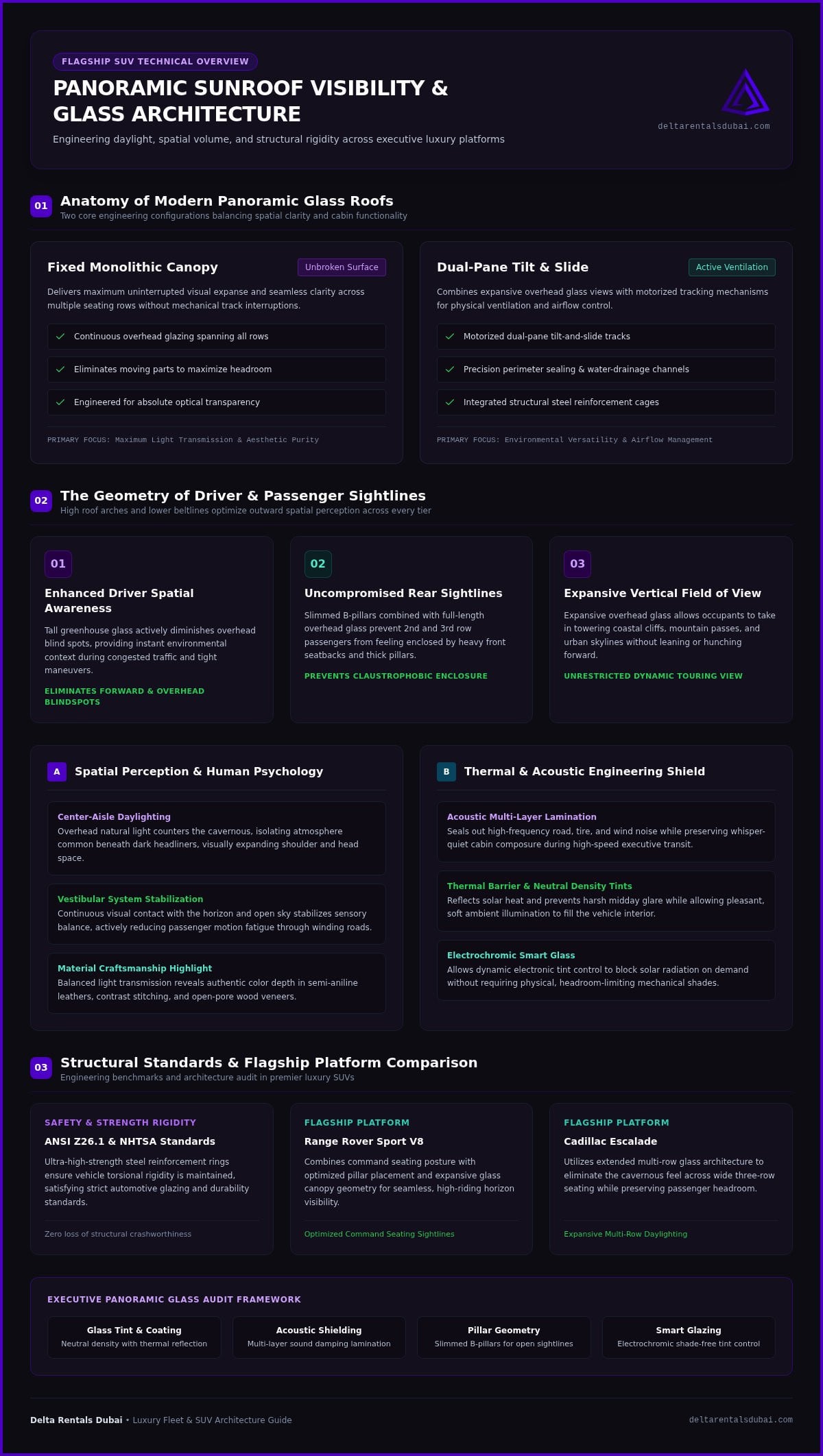
Evaluating Panoramic Visibility Across Flagship Luxury SUVs
Flagship SUVs interpret overhead transparency differently based on their chassis layout and design priorities. A performance-engineered model places the driver low against a sleek, sloping windshield, whereas full-size executive platforms position occupants upright beneath expansive glass ceilings. Evaluating panoramic sunroof visibility in luxury SUVs requires looking closely at how roof pillars, seating geometry, and glass dimensions interact across different vehicle tiers.
Sport-Oriented Flagship SUV Roof Architecture
High-performance models masterfully balance rapid road focus with airy passenger sightlines. In the Range Rover Sport V8, the steeply raked windshield transitions cleanly into a floating-roof glass canopy. Slim A-pillars ensure unobstructed cornering vision for the driver, while the continuous glass roof keeps the cockpit feeling fast, low, and open. For those comparing dynamic platforms across our nationwide fleet, review our comprehensive analysis of ultra luxury suv rental options to see how performance chassis balance greenhouse openness.
Ultra-Luxury and Full-Size Presidential Glass Cabins
Extended-wheelbase platforms deliver the ultimate showcase of overhead scale. The Cadillac Escalade utilizes an expansive panoramic sunroof spanning the first two rows, pairing a high beltline with tall side glass to fill the cabin with ambient daylight. Second-row executive seats benefit directly from this layout, enjoying unhindered upward views of urban skylines and sweeping open highways.
The pinnacle of bespoke canopy design appears in the Rolls Royce Cullinan. Utilizing elevated pavilion seating, rear occupants sit noticeably higher than the front row. This theater-style elevation aligns passenger eye levels directly with the lower edge of the panoramic roof glass, delivering magnificent skyward vistas framed by handcrafted leather trim. Learn more about these bespoke cabin appointments in our Rolls Royce Cullinan Black Badge guide.
Experiencing these distinct sightlines firsthand clarifies the clear advantage of panoramic sunroof visibility in luxury SUVs. When you are ready to command the open road in supreme comfort, reserve your prestige SUV experience with our dedicated concierge team today.
Selecting the Ideal Luxury SUV for Panoramic Touring and Executive Travel
Choosing the right flagship vehicle requires testing how its greenhouse performs under direct sunlight. Spec sheets tell only part of the story. You must assess how the overhead glass balances optical purity, glare suppression, and cabin thermal balance during real-world travel. Securing a prestige rental offers the most intelligent way to test panoramic sunroof visibility in luxury SUVs across long highway stretches before committing to a permanent purchase.
A rigorous walkaround inspection helps you confirm whether a vehicle meets high executive touring standards.
Pre-Travel Panoramic Roof Evaluation Checklist
Before departing on high-end touring or client transport, inspect the canopy setup thoroughly:
- Optical Distortion Audit: Look through the perimeter edges where curved glass meets the roof frame. Inferior tooling creates visual warping that strains eyes during upward sightseeing.
- Mechanical Retraction Smoothness: Cycle the shade system completely. It should glide quietly on its track, operating with minimal motor whine and taking under ten seconds to fully deploy or retract.
- Control Interface Responsiveness: Test the overhead console. Capacitive touch sliders and gesture sensors should respond instantly to light inputs without requiring repetitive tapping.
Conducting these simple checks guarantees flawless cabin comfort under changing daylight conditions.
Experience Flawless Luxury Cabin Vistas with Delta Rentals
Delta Rentals provides immediate, direct access to a national fleet of tier-one prestige SUVs. Every vehicle, from the commanding Cadillac Escalade to the refined Range Rover Sport V8, is maintained in pristine optical and mechanical condition. This dedication guarantees maximum clarity through every glass canopy, free from haze, track hesitation, or acoustic rattles.
Whether you require a performance-focused SUV for personal driving or an extended-wheelbase model for executive travel, our concierge team delivers seamless service nationwide. Pair class-leading panoramic roof engineering with professional drivers by exploring our comprehensive luxury chauffeur service guide. You gain the elevated sightlines, serene acoustic isolation, and bespoke prestige expected from modern flagship touring without compromise.
Command the Open Horizon in Flagship Comfort
Modern automotive architecture proves that natural daylight and uncompromising cabin serenity coexist effortlessly. Advanced infrared coatings, acoustic laminates, and sculpted headliners protect interior headroom while transforming enclosed cabins into luminous observation lounges. Prioritizing panoramic sunroof visibility in luxury SUVs guarantees that every drive delivers superior spatial comfort, reduced travel fatigue, and commanding sightlines across changing landscapes.
Delta Rentals puts this elite engineering directly at your command. Our hand-selected national fleet features industry-leading luxury SUV models, each impeccably detailed to ensure crystal-clear glass optics and whisper-quiet cabin composure. Supported by five-star reviewed concierge service and frictionless nationwide delivery, your transition into prestige travel is completely seamless. Elevate your perspective and explore our elite luxury SUV fleet at Delta Rentals today.
Frequently Asked Questions
Does a panoramic sunroof in a luxury SUV make the cabin excessively hot?
No, modern luxury SUVs don’t suffer from excessive solar heat gain. Multi-layer infrared-reflective coatings and nano-ceramic interlayers reject over 90% of solar thermal energy before it penetrates the interior. When paired with smart rooftop solar sensors, automatic climate control dynamically balances cabin temperature. This technology preserves optimal panoramic sunroof visibility in luxury SUVs without placing heavy demands on air conditioning systems or creating uncomfortable hotspots.
How does a panoramic glass roof impact structural safety during a rollover?
A panoramic glass roof does not compromise vehicle structural safety during a rollover incident. Vehicle architectures integrate high-tensile boron steel roll cages and reinforced ring frames around the ceiling perimeter to absorb impact forces. Glazing must satisfy rigorous ANSI Z26.1 structural standards. In modern chassis engineering, the reinforced frame transfers kinetic energy away from occupants, ensuring roof strength meets or exceeds federal crashworthiness benchmarks.
Do panoramic sunroofs reduce passenger headroom in full-size luxury SUVs?
Minimal headroom reduction occurs, but flagship engineering largely prevents noticeable loss for passengers. Traditional mechanical cassettes previously shaved several inches, but contemporary luxury designs route tracks along exterior roof rails. Scalloped headliners carve out generous vertical clearance directly above the seats. In fixed glass designs, the ultra-thin laminated panel actually offers slightly more vertical headspace than thick, fabric-padded conventional headliners.
What is the difference between laminated and tempered glass in panoramic roofs?
The difference lies in construction and failure behavior. Tempered glass undergoes rapid heating and cooling to create surface tension, shattering into small granules upon heavy impact. Laminated glass bonds two glass sheets around a polyvinyl butyral (PVB) interlayer. If cracked, laminated glass retains its structural shape without falling into the passenger compartment, while also delivering superior acoustic insulation and blocking ninety-nine percent of ultraviolet rays.
How do electrochromic smart glass sunroofs work in modern luxury vehicles?
Electrochromic smart roofs work by passing a low-voltage electrical current through a conductive film embedded inside the glass. When activated via touchscreen or voice controls, microscopic ions or liquid crystals align to alter light transmission. The glass shifts seamlessly from crystal clear to dark opaque in seconds. This eliminates the need for bulky motorized fabric blinds, delivering instantaneous glare control while maximizing panoramic sunroof visibility in luxury SUVs on demand.
Are panoramic sunroofs noisier at highway speeds than conventional solid roofs?
No, premium panoramic glass roofs are engineered to match the quietness of solid ceilings. Manufacturers integrate acoustic PVB interlayers directly between glass panes, specifically dampening high-frequency road rumble and wind turbulence. Precision aerodynamic exterior channeling and multi-lip perimeter rubber gaskets seal out air leaks. At sustained national highway cruising speeds, the decibel level inside a flagship glass-roof SUV remains completely serene and whisper quiet.
Can you open all panoramic sunroofs or are some completely fixed?
Not all panoramic roofs open; automotive manufacturers implement both fixed and operational designs. Operational systems feature front panes that tilt or slide rearward over fixed rear sections, offering open-air ventilation. Fixed glass canopies remain permanently sealed, prioritizing monolithic structural simplicity, weight reduction, and continuous panoramic visibility. Fixed roofs eliminate mechanical tracks entirely, which maximizes overhead viewing angles and preserves exceptional interior headroom for all rows.