

The finest automotive ride doesn’t simply react to broken pavement; it predicts and erases it. Modern adaptive air suspension systems in luxury vehicles have evolved far beyond the basic pneumatic bags of the past, transforming chassis control from reactive mechanical damping into anticipatory road management. If you’ve ever questioned whether air suspension truly justifies the hype over traditional steel springs, or worried about compressor wear and long-term reliability, your skepticism is completely natural.
The engineering reality, however, changes everything. Discover how adaptive air suspension transforms luxury vehicle dynamics, isolates road imperfections, and delivers unprecedented ride comfort. We’ll unpack the digital sensors and multi-chamber hardware driving today’s intelligent chassis, examine how flagship icons like Rolls-Royce, Range Rover, and Porsche tune their active setups, and reveal what to inspect when you test drive or rent an air-equipped prestige model.
Key Takeaways
- Master the mechanics behind adaptive air suspension systems in luxury vehicles, discovering how multi-chamber pneumatic springs instantly modulate stiffness and ride height.
- See how predictive forward-facing sensors and intelligent software scan road topography in real time to neutralize imperfections before tires make contact.
- Understand the vital engineering trade-offs between progressive pneumatic bladders and traditional steel springs across compliance, dynamic stability, and long-term durability.
- Compare how premier engineering houses like Rolls-Royce, Range Rover, and Porsche tune their flagship chassis systems for distinct driving personalities.
- Learn the exact tactile cues to monitor during a test drive or luxury rental to accurately evaluate float, body control, and high-speed composure.
What Are Adaptive Air Suspension Systems in Luxury Vehicles?
Uncompromising ride refinement requires total authority over road impact forces. Rather than relying on fixed steel coils, modern adaptive air suspension systems in luxury vehicles replace rigid metal springs with pressurized, vulcanized rubber-composite air bladders. These pneumatic chambers adjust both ride height and effective spring stiffness on demand. When integrated with advanced active suspension systems, high-speed microprocessors recalibrate shock damping in fractions of a second. This mechanical versatility eliminates the traditional compromise between sharp handling and supple road isolation, providing the foundational serenity expected in flagship automobiles.
The Core Mechanical Architecture: Compressors, Reservoirs, and Air Springs
Pneumatic ride control relies on high-precision mechanical hardware engineered to handle extreme dynamic forces:
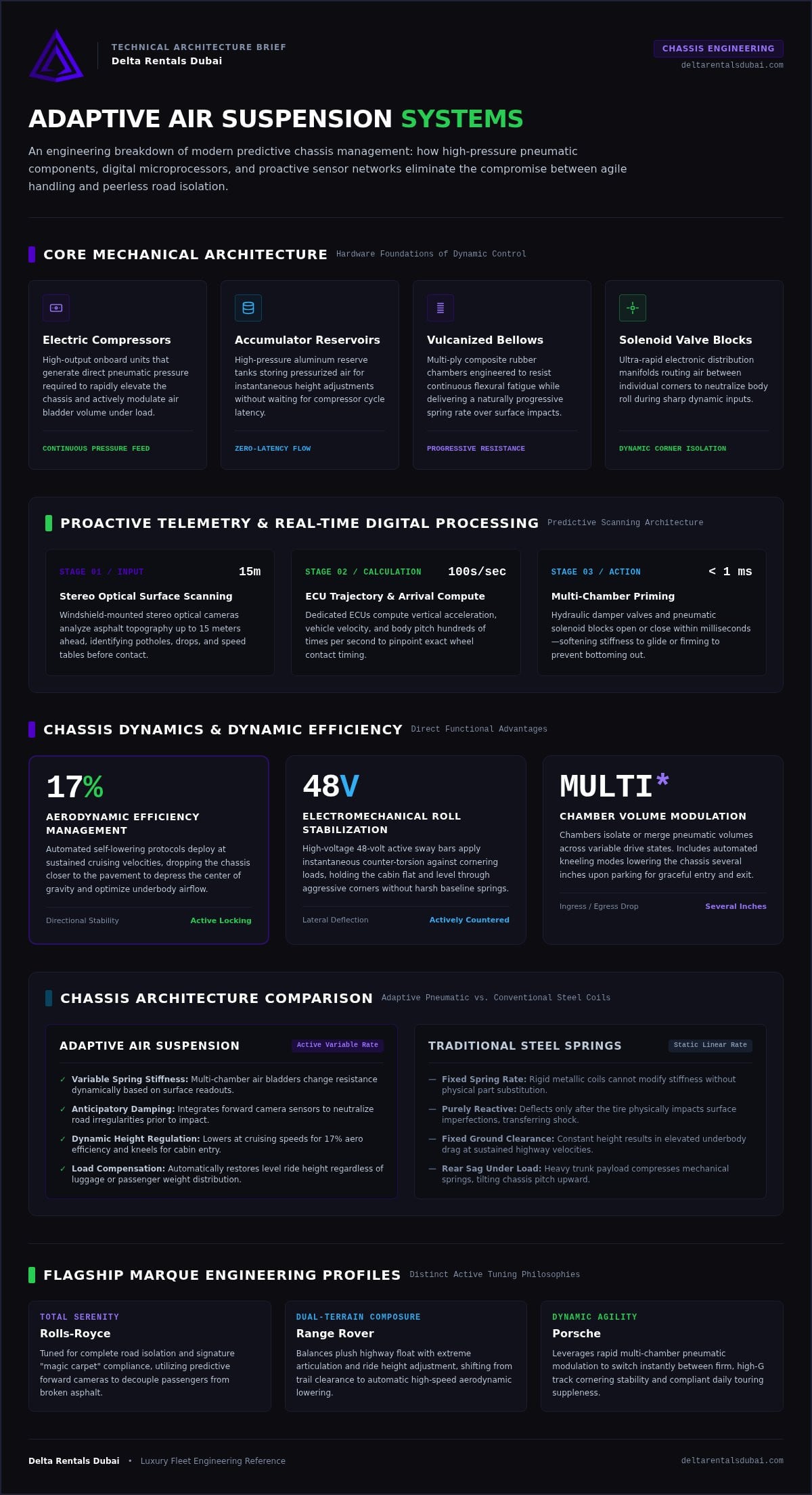
- Electric Compressors: Onboard high-output compressors generate the pneumatic pressure required to raise the chassis and adjust air bladder volume.
- Accumulator Reservoirs: High-pressure aluminum tanks store reserve air, enabling near-instantaneous ride-height alterations without waiting for compressor cycling.
- Vulcanized Air Bellows: Multi-ply composite rubber chambers contain pressurized air, resisting continuous flexural fatigue while delivering a naturally progressive spring rate under load.
- Solenoid Valve Blocks: High-speed electronic manifolds route air between corners, actively counteracting body roll during aggressive cornering and high-speed maneuvers.
Digital Integration: Electronic Control Units and Multi-Sensor Feedback
The pneumatic hardware only functions as well as the software directing it. Dedicated electronic control units (ECUs) calculate vertical acceleration, body pitch, and vehicle velocity hundreds of times per second. Ride-height sensors and accelerometers mounted to the chassis track wheel deflection continuously, relaying surface irregularities to the central computer in real time.
The ECU instantly commands continuously variable damping valves housed inside each shock absorber. By opening or restricting internal hydraulic fluid pathways within milliseconds, the system alters damper resistance to match current surface conditions. The combination delivers immediate composure, absorbing harsh expansion joints while maintaining absolute control at highway speeds.
How Predictive Chassis Technology Delivers the Ultimate Luxury Ride
Predictive chassis engineering represents the ultimate evolution of ride comfort. Rather than waiting for a wheel to strike an imperfection, modern adaptive air suspension systems in luxury vehicles read the asphalt ahead and prime the suspension before impact. An in-depth engineering comparison of modern chassis setups reveals that proactive dampening fundamentally separates prestige transportation from conventional vehicles.
Camera-Assisted Road Scanning and Proactive Height Regulation
Windshield-mounted stereo optical cameras and forward sensors scan surface topography up to 15 meters ahead. When the system detects an elevation drop or broken pavement, the central processor calculates the exact wheel arrival time. Multi-chamber air springs instantly isolate or combine internal air volumes through electronic solenoid valves. By opening or closing chambers, the suspension softens its spring rate to glide across a speed table or firms up to prevent bottoming out, functioning flawlessly across both dense urban routes and open highways.
Active Roll Stabilization and High-Speed Aerodynamic Adjustments
True composure requires managing lateral forces alongside vertical impacts. High-voltage 48-volt electromechanical sway bars twist against cornering loads, keeping the passenger cabin completely level through sharp curves without requiring stiff, jarring baseline springs.
At sustained cruising speeds, automated self-lowering protocols drop the chassis closer to the ground. This lowering action drops the vehicle’s center of gravity and optimizes airflow underneath the body, improving aerodynamic efficiency management by up to 17% while locking in directional stability. Upon parking, automated kneeling modes drop the chassis several inches for graceful passenger entry and exit. Discerning drivers can reserve a flagship luxury rental to experience this effortless high-speed poise firsthand.
The Engineering Behind Cabin Isolation and Vibration Damping
Cabin serenity requires filtering secondary vibrations. Heavy subframe bushed isolation mounts absorb micro-chatter from coarse asphalt, while high-volume composite air bladders eliminate the resonant vibrations common to metallic springs. The result isn’t a vague, floating sensation that induces motion sickness. Modern adaptive air suspension systems in luxury vehicles deliver genuine isolation, absorbing abrupt impacts while maintaining poised, confidence-inspiring body control.
Adaptive Air Suspension vs. Traditional Steel Springs: Engineering Comparison
Choosing between steel coils and pneumatic chambers comes down to dynamic versatility versus mechanical simplicity. Traditional steel springs operate on fixed physics. They use a linear spring rate where twice the load produces twice the deflection. In contrast, adaptive air suspension systems in luxury vehicles rely on progressive pneumatic resistance. Air compresses exponentially, which keeps tiny surface ripples imperceptible while preventing deep chassis bottoming on severe impacts.
Ride Compliance, Variable Spring Rates, and Dynamic Control
Steel coils demand a permanent compromise between comfort and agility. Tune them soft for highway plushness, and the car leans excessively through quick lane changes. Stiffen them for tight handling, and road expansion joints shudder straight into the cabin.
Pneumatic springs bypass this trade-off completely. Operating alongside continuously variable damping, modern multi-chamber units switch personalities in milliseconds. They deliver supple compliance while cruising, then instantly stiffen their air volume under hard braking to eliminate front-end dive and maintain laser-sharp steering response.
Automated Load Leveling and Variable Ground Clearance
Steel springs inevitably sag under the weight of luggage and passengers, degrading steering geometry and headlight alignment. Air systems eliminate this issue through automated self-leveling:
- Constant Suspension Travel: Height sensors detect passenger loads and command the compressor to add pressure, keeping full damper travel available regardless of payload.
- Variable Clearance: Drivers can toggle clearance modes, raising the vehicle to clear obstacles or steep ramps. Check our comprehensive luxury SUV guide to explore how ride clearance impacts everyday usability.
- High-Speed Aerodynamics: Highway lowering reduces air turbulence beneath the vehicle floor, enhancing high-speed stability and extending driving range.
Mechanical Reliability, Component Wear, and Maintenance Complexities
Steel springs excel in structural simplicity. They feature no pneumatic seals, no air lines, and practically zero electronics. Pneumatics, however, introduce multiple wear points that require deliberate inspection as mileage climbs.
Rubber desiccators inside the air dryer saturate over years of thermal cycling, letting moisture enter the aluminum valve block. Repeated inflation cycles can stress the compressor motor, while road grit can abrade the flexible rubber bladders. When evaluating higher-mileage adaptive air suspension systems in luxury vehicles, listen for prolonged compressor run times after startup, watch for corner sagging after overnight parking, and verify seamless transitions across all ride heights.
Flagship Implementations: How Leading Luxury Marques Engineer Air Ride
Every elite manufacturer configures pneumatic damping to express distinct brand philosophy. While hardware foundations remain similar, proprietary software calibration creates radically different road manners. Mastering adaptive air suspension systems in luxury vehicles requires understanding how each marque blends pneumatic hardware with digital chassis intelligence.
The Rolls-Royce Planar Suspension System and Flagbearer Technology
Rolls-Royce prioritizes absolute isolation above all else. The brand’s Planar Suspension System incorporates a bespoke upper wishbone damper mounted directly above the front suspension assemblies, neutralizing micro-vibrations that bypass conventional dampers.
Optical cameras scan the road while satellite navigation tracks geographic elevation profiles miles ahead. The vehicle pre-conditions its pneumatic volume and transmission gearing before corners arrive. Explore our in-depth Rolls-Royce Cullinan guide to discover how this technology creates the marque’s signature magic carpet ride.
Range Rover Electronic Air Suspension and Dynamic Response Pro
Range Rover engineers pneumatic chassis setups for extreme dual-purpose capability. Its five-stage height architecture lowers the body for aerodynamic efficiency at cruising speeds, yet extends drastically when maximum clearance is required.
To keep high-riding luxury SUVs level, 48-volt electronic active roll control counters lateral cornering forces with immense torque. Off-road, electronic cross-link valves open between opposing air springs, simulating solid-axle wheel articulation across broken terrain while maintaining whisper-quiet composure inside.
Porsche Active Suspension Management (PASM) and Adaptive Air Systems
Porsche applies pneumatic damping through a performance lens. Using multi-chamber air springs, PASM can switch between three distinct volume stages within milliseconds. In comfort settings, full air volume absorbs highway joints; in performance modes, internal valves seal off chambers to create rigid spring rates suitable for high-G lateral cornering.
While models like the Panamera and Cayenne rely on air bladders for split-personality versatility, pure track-focused machines like the GT3 RS utilize specialized mechanical coilovers for unfiltered feedback. Contrast these engineering choices in our Porsche 911 GT3 RS review.
To evaluate these distinct chassis philosophies firsthand, connect with our prestige fleet specialists for tailored access to the world’s most advanced luxury vehicles.
Evaluating Air Suspension Performance: What to Experience Behind the Wheel
A standard test drive around the block won’t reveal how a chassis handles real dynamic stress. Accurately judging adaptive air suspension systems in luxury vehicles demands deliberate evaluation across distinct road surfaces. Use this targeted assessment strategy to measure chassis isolation, rebound damping, and transient roll stability.
Chassis Dynamics Checklist: Assessing Isolation, Rebound, and Roll
Put the vehicle through specific mechanical challenges to evaluate its composure:
- Single-Stroke Rebound Control: Drive through a sudden compression dip or across a raised speed table. A properly calibrated air chassis compresses, rebounds, and settles in one fluid, controlled stroke without secondary bouncing or floating sensations.
- Impact Isolation Over Harsh Transverse Joints: Cross angled railway tracks or highway expansion joints at speed. Impact harshness should dissipate completely within the suspension bushings and air bladders, never vibrating into the steering wheel or windshield frame.
- Transient Roll and Mode Variance: Toggle the chassis mode from Comfort to Sport during brisk lane transitions. You should feel the pneumatic bladders firm up instantly, tightening body control and eliminating lateral lean.
- Acoustic Isolation: Monitor ambient interior noise at sustained highway speeds. Quality air bladders eliminate resonant tire hum on coarse asphalt, preserving absolute cabin serenity.
Selecting the Right Adaptive Luxury Vehicle for Your Travel Needs
Chassis calibration varies drastically across vehicle segments. Ultra-luxury sedans and high-stature flagship cruisers prioritize total bump absorption and rear-cabin stillness. These vehicles excel when paired with professional chauffeur travel, giving passengers a peaceful environment to conduct business or relax without disturbance.
Performance SUVs and grand tourers configure their air systems with broader stiffness spectrums. These platforms cater to self-drive enthusiasts who demand athletic cornering on winding routes along with relaxed touring comfort on the interstate. Experiencing these engineering philosophies firsthand provides clear clarity before making your next acquisition. Discover an unrivaled fleet of active air suspension vehicles through Delta Rentals, offering meticulously maintained flagship models with transparent, deposit-free rental access.
Elevate Your Standard of Ride Refinement
Predictive road scanning, progressive pneumatic springs, and millisecond damper modulation have rendered traditional static chassis setups obsolete. Modern adaptive air suspension systems in luxury vehicles eliminate the historical compromise between velvet-smooth cruising and disciplined body control. Instead of merely enduring uneven pavement, these intelligent platforms actively command the road, preserving serene stillness inside the cabin.
Understanding the physics behind pneumatic dampening is informative, but the ultimate appreciation comes from experiencing it on the open road. Delta Rentals delivers effortless access to an exceptional national fleet featuring factory-calibrated adaptive pneumatic suspension systems. With transparent terms backed by hundreds of verified 5-star reviews, complimentary nationwide delivery, and seamless no-deposit options, unlocking an extraordinary driving experience has never been simpler. Reserve your luxury vehicle with Delta Rentals today and discover how effortless prestige feels from the driver’s seat.
Frequently Asked Questions
How long do adaptive air suspension systems typically last before needing maintenance?
Factory air suspension components typically last between 80,000 and 120,000 miles or roughly six to ten years before requiring service. Rubber air bladders naturally degrade from road debris exposure and continuous heat cycles. Valve blocks, sensors, and electric compressors often endure the vehicle’s entire lifespan if air leaks are addressed promptly. Regular visual inspections during routine servicing ensure minor seal weeping doesn’t evolve into major compressor strain.
Can an adaptive air suspension system function if an air spring develops a leak?
An air suspension system cannot function normally with a leaking air spring. The onboard compressor attempts to pump continuous air into the punctured corner to maintain vehicle ride height. Over time, this constant duty cycle causes the compressor motor to overheat and shut down automatically to protect its circuitry. Once the compressor cuts out, the affected corner collapses onto its internal bump stops, requiring immediate flatbed towing to prevent chassis damage.
What is the primary difference between adaptive dampers and full air suspension?
Adaptive dampers regulate hydraulic rebound stiffness, whereas full adaptive air suspension systems in luxury vehicles replace traditional steel coil springs with pressurized pneumatic bladders. Systems that rely solely on adaptive dampers cannot alter vehicle ride height or self-level under heavy payloads. True air setups control both damping resistance and physical ride height simultaneously. This dual control creates a much broader dynamic spectrum between cloud-like cruising and firm, athletic cornering.
Do adaptive air suspension systems compromise high-performance sports car handling?
Modern pneumatic setups enhance performance rather than compromising it. Multi-chamber air springs allow the electronic control unit to isolate chambers during aggressive steering inputs, instantly creating an ultra-stiff spring rate that eliminates body lean. Combined with active 48-volt anti-roll bars, air suspension lets a vehicle transition effortlessly from a track-capable corner carver into a supple daily driver at the press of a button. Pure track specials only favor steel springs for slight weight savings.
How does ambient climate and high heat affect vehicle pneumatic air suspension bladders?
Extreme ambient heat accelerates the oxidation and vulcanization breakdown of synthetic rubber bladders. High surface temperatures dry out flexible seals, potentially leading to microscopic cracks and slow pressure leaks. In arid environments, airborne dust and grit can also adhere to external bladder folds, causing abrasive friction as the suspension compresses. Elite fleet operators combat this by conducting frequent underbody washes and preventative inspections to preserve pneumatic integrity.
What happens if the suspension compressor overheats or fails while driving?
If the air compressor overheats, the central control unit logs a diagnostic fault and temporarily suspends dynamic ride-height adjustments. The system relies on its reserve accumulator tank and closed solenoid valves to maintain current pressure levels at each corner. You won’t drop to the asphalt immediately if the air springs are intact. The vehicle typically enters a restricted comfort mode, alerting the driver to schedule maintenance before shutting off completely.
Is adaptive air suspension worth the extra investment compared to standard steel springs?
Adaptive air suspension systems in luxury vehicles deliver a measurable upgrade in ride refinement, cargo utility, and high-speed stability that steel springs simply can’t match. The capability to lower for enhanced aerodynamics, raise for steep ramps, and automatically level under varying passenger counts provides unmatched daily luxury. For discerning drivers prioritizing cabin quietness and effortless travel, the tangible comfort benefits easily outweigh the added mechanical complexity.