
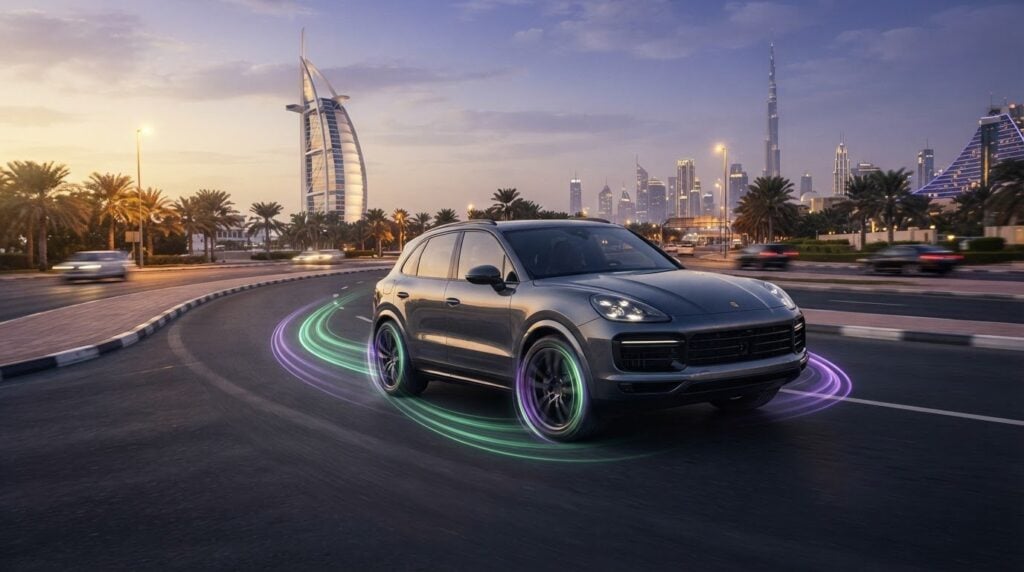
A tall, 2.5-ton luxury machine has no physical right to carve a corner like a mid-engine exotic. Yet modern torque vectoring systems in performance SUVs are systematically dismantling traditional physics. If you are skeptical that an elevated vehicle can conquer inertia rather than simply fight it, your hesitation makes sense. Many drivers confuse basic all-wheel-drive traction with active lateral force distribution, questioning whether complex differential hardware genuinely improves everyday high-speed highway stability.
You are about to discover how advanced torque vectoring systems conquer inertia and elevate high-performance SUVs to genuine supercar handling dynamics. We break down the precise mechanics governing yaw rate and cornering grip, compare leading engineering solutions across world-class manufacturers, and preview how to experience these transformative dynamics firsthand behind the wheel.
Key Takeaways
- Understand how torque vectoring systems in performance SUVs actively govern yaw rate to conquer high-mass inertia, replacing reactive wheel slip with genuine corner-carving precision.
- Discover the critical engineering differences between mechanical active differentials, electronic multi-plate clutches, and brake-based systems, including why thermal limits impact sustained hard driving.
- Master the physics behind corner entry and apex tracking, learning how targeted power delivery pulls heavy platforms through bends without steering lag or mid-corner understeer.
- Compare benchmark chassis architectures across premier marques like Porsche, Range Rover, and Ferrari to identify how leading platforms balance grand touring luxury with sharp agility.
- Identify the dynamic behaviors and high-speed stability traits you must evaluate during an extended performance drive to assess true chassis capability.
What Is Torque Vectoring in Modern Performance SUVs?
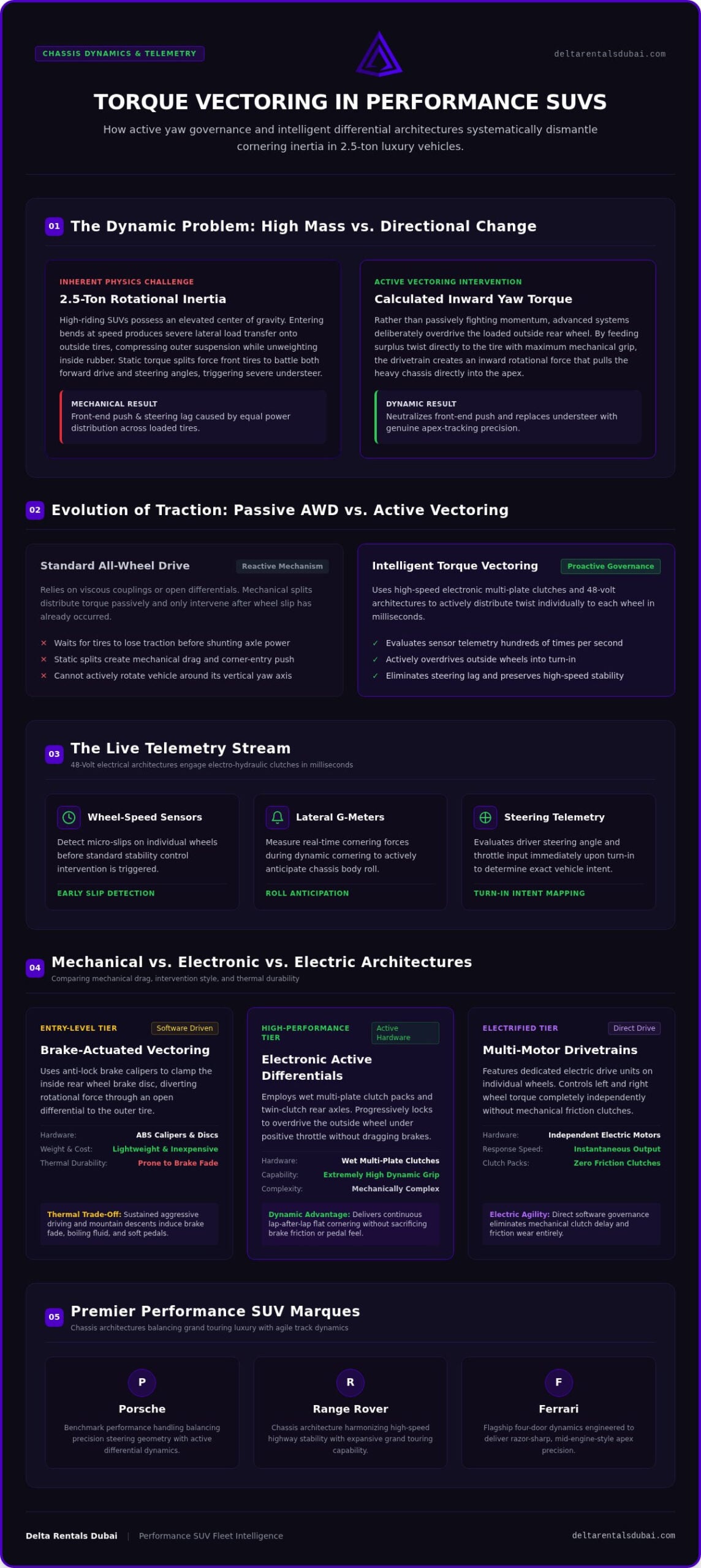
Torque vectoring represents a fundamental leap beyond basic traction control. Standard all-wheel-drive systems merely react to wheel slippage, shunting power between front and rear axles after tires lose grip. In contrast, advanced torque vectoring systems in performance SUVs actively govern how much twist reaches each individual wheel during dynamic cornering. Rather than passively managing momentum, the drivetrain creates a deliberate yaw moment that rotates a 2.5-ton platform cleanly into an apex.
High-mass vehicles naturally resist directional changes. When pushing into a bend at speed, static mechanical splits send equal torque across an axle, forcing the front tires to fight both steering angles and forward drive. This scenario triggers frustrating push, commonly known as understeer. Active vectoring solves this mechanical limitation. Electronic control units evaluate steering angle, throttle position, and yaw rate hundreds of times per second, overdriving the outside wheels to pull the vehicle into the turn rather than sliding off line.
The Physics of Cornering High-Riding Performance Vehicles
Tall ride heights dramatically increase rotational inertia. As an SUV enters a bend, its elevated center of gravity produces severe lateral load transfer onto the outside tires. This uneven loading compresses the outer suspension and unweights the inside rubber. A calculated yaw torque counteracts this natural inertia. By feeding surplus power directly to the loaded outside rear wheel, the chassis generates an inward rotational force that completely neutralizes front-end push.
From Passive All-Wheel Drive to Intelligent Torque Distribution
Yesterday’s performance drivetrains relied on viscous couplings or open differentials. Today’s flagship machines utilize intelligent torque distribution powered by high-speed electronic multi-plate clutch packs. Modern 48-volt electrical architectures allow these clutches to engage in milliseconds. The system processes an immense stream of live data to keep the vehicle completely composed:
- Wheel-speed sensors: Detect micro-slips before standard stability control intervenes.
- Lateral G-meters: Measure real-time cornering forces to anticipate chassis roll.
- Steering angle telemetry: Determines driver intent instantly upon turn-in.
The result is a driving sensation that defies physical scale. Modern torque vectoring systems in performance SUVs transform heavy luxury haulers into razor-sharp, predictable performance machines on demanding tarmac.
Mechanical vs. Electronic vs. Electric: Types of Torque Vectoring
Not all vectoring architectures deliver equal results on the road. Automotive manufacturers employ three distinct methods to govern wheel output, ranging from lightweight software interventions to dedicated multi-motor hardware. Understanding What Is Torque Vectoring across these tiers clarifies why some systems maintain flat cornering lap after lap while others surrender to thermal exhaustion.
Every configuration alters mechanical drag, vehicle weight, and durability under hard driving:
- Brake-based vectoring: Uses anti-lock brake calipers to clamp inside wheels. Lightweight and inexpensive, but prone to rapid pad wear.
- Mechanical/electronic active differentials: Employs electro-hydraulic clutch packs to push drive outward. Extremely capable, though mechanically complex.
- Multi-motor electric drivetrains: Dedicated drive units control left and right wheels independently without physical friction clutches.
Brake-Actuated Vectoring: Principles and Thermal Trade-Offs
Brake-actuated systems represent an entry-level software solution. When tackling a bend, stability software applies calibrated hydraulic pressure to the inside rear brake disc. This action diverts rotational force through an open differential to the outer tire. While effective for moderate maneuvers, aggressive driving generates intense friction. Sustained mountain descents quickly induce brake fade, boiling fluid, softening the pedal, and reducing overall system intervention.
Active Limited-Slip Differentials and Twin-Clutch Rear Axles
True mechanical hardware avoids dragging the brakes entirely. High-tier engineering incorporates an electronically controlled rear differential with wet multi-plate clutch packs. Rather than choking speed, these units progressively lock to overdrive the outside wheel under positive throttle. Twin-clutch rear drive units take this further by discarding conventional differential gears, channeling genuine additive torque exactly where traction demands it.
Multi-Motor Electric Vehicle Dynamics and Future Systems
Direct electric propulsion offers the quickest vectoring response available. Dual or quad electric setups bypass clutches altogether, adjusting individual wheel output in fractions of a millisecond. Systems can apply regenerative drag on an inside hub while feeding positive kilowatts to the outside, rotating the SUV instantly while recovering kinetic energy.
Evaluating these engineering approaches reveals why premier torque vectoring systems in performance SUVs deliver such distinct driving sensations. Drivers planning to experience these dynamic systems in action can arrange an elite performance SUV hire to test chassis response firsthand across open highways.
How Torque Vectoring Eliminates Understeer and Transforms Handling
Eliminating understeer in heavy platforms requires rewriting how lateral grip develops across an axle. When negotiating technical bends, torque vectoring systems in performance SUVs systematically manipulate tire slip angles at every cornering phase. Instead of waiting for front tires to wash wide, the driveline generates instantaneous rotational force around the vehicle’s vertical axis, matching steering input with surgical precision.
Recent technical research into the engineering performance of torque vectoring controllers demonstrates how predictive electronic logic maximizes tire contact patches. By actively distributing drive before slip occurs, torque vectoring systems in performance SUVs ensure heavy luxury platforms carve lines previously reserved for lightweight sports coupes.
Deconstructing Corner Turn-In, Mid-Corner Balance, and Exit Drive
The handling transformation occurs across three distinct phases of every bend:
- Phase 1: Turn-In. The system trims initial understeer by applying yaw-inducing differential splits the moment you turn the wheel, avoiding upfront steering lag.
- Phase 2: Mid-Corner Balance. Active micro-adjustments shift torque across both axles, maintaining neutral balance and resisting centrifugal forces that unsettle tall bodies.
- Phase 3: Exit Drive. Overdriving the loaded outside rear wheel allows drivers to apply full throttle significantly earlier, slingshotting the vehicle out of the apex without pushing wide.
High-Speed Stability and Crosswind Compensation
Torque vectoring delivers benefits far beyond aggressive mountain switchbacks. On open multi-lane motorways, rapid overtaking maneuvers produce aerodynamic turbulence and crosswind buffeting. Active yaw damping calculates lateral displacement in real time, feeding minute torque corrections to opposing wheels to keep tracking laser-straight. If an SUV encounters loose gravel or sudden lane shifts at speed, the differential acts as an active stabilizer, checking snap-oversteer before safety interventions cut engine power.
Integration with Adaptive Air Suspension and Rear-Wheel Steering
Peak dynamic performance relies on unified chassis networks. Active 48-volt anti-roll bars counteract body lean, keeping the tire tread flat against the pavement. Meanwhile, rear-axle steering angles artificially shorten the vehicle’s wheelbase at lower speeds and lengthen it during high-speed transitions. When coupled with an electronically governed rear differential, these integrated subsystems isolate cabin occupants from centrifugal forces entirely. Discover how modern chassis integration redefines grand touring dynamics in our detailed guide to luxury SUV rentals.
Leading Torque Vectoring Systems Across Premier Performance SUVs
Proprietary software calibration dictates how mechanical components express themselves on the tarmac. Elite manufacturers utilize distinct hardware configurations to shape chassis personality, defining whether torque vectoring systems in performance SUVs feel like composed cross-country cruisers or razor-sharp track instruments. Examining the industry’s benchmark platforms highlights how premier engineering teams conquer high-mass inertia.
Every marque approaches active yaw control with a unique dynamic philosophy:
- Land Rover: Combines electronic active rear differentials with targeted brake vectoring for imperceptible all-terrain balance.
- Ferrari: Leverages independent four-wheel steering and dual-axle electronic distribution for mid-engine agility.
- Porsche & Mercedes-AMG: Employ fully variable electro-mechanical differential locks tuned for pure rear-wheel-drive dynamics.
The Range Rover Sport V8: All-Terrain Dynamic Vectoring
Land Rover pairs an electronic active rear differential with graduated torque vectoring by braking. Integrated with twin-speed transfer cases and active roll control, the system pre-emptively locks during high-speed transitions, tucking the front end into fast sweepers while maintaining supreme poise across diverse road surfaces. Explore this effortless power delivery by checking our Range Rover Sport V8 review.
Italian Thoroughbred Engineering: Ferrari Purosangue Dynamics
Ferrari rewrote the segment rulebook with the Purosangue. Its 4RM-S evo architecture pairs a front-mid naturally aspirated V12 with independent four-wheel steering and an active front power transfer unit. Working alongside 48-volt active spool-valve dampers, the system feeds instantaneous torque across all four corners, virtually eliminating body roll and handling like a genuine sports prototype.
German Precision: Porsche PTV+ and Mercedes-AMG Performance 4MATIC+
Porsche Torque Vectoring Plus (PTV+) remains an engineering benchmark across the Cayenne and Macan lineups. It integrates an electronically controlled rear differential lock that varies torque seamlessly from open to 100% locked. Meanwhile, Mercedes-AMG Performance 4MATIC+ continuously adjusts front-to-rear distribution, transitioning from a secure 50:50 split to 100% rear-wheel drive to reward assertive corner exits.
These benchmark chassis architectures prove that tall curb weight is no longer an obstacle to supercar performance. Discerning drivers ready to evaluate dynamic vectoring firsthand can reserve a high-performance luxury SUV to test genuine yaw control across open national highways.
Experiencing Advanced SUV Dynamics Firsthand: The Enthusiast Roadmap
A brief dealership test drive around low-speed city blocks never reveals true chassis character. You cannot evaluate how torque vectoring systems in performance SUVs conquer aggressive lateral forces while stuck in congested traffic with a salesperson monitoring the speedometer. Appreciating genuine active differential response requires wide-open highways, varied pavement textures, and uninterrupted seat time.
What to Look for When Testing a Performance SUV
Conducting an extended evaluation of an advanced performance chassis demands attention to subtle tactile behaviors:
- Steering feedback and front-end bite: Feel whether steering resistance builds naturally as the outside wheels dig in, or if electronic damping numbs front tire feedback during sudden off-camber transitions.
- Mid-corner throttle adjustability: Feed power smoothly at the apex. A finely tuned active driveline will actively tighten your driving line rather than pushing wide.
- High-speed settle time: Execute rapid lane transitions along open motorways. The body should settle instantly without secondary lateral oscillations.
Tailored Luxury Vehicle Hire for Automotive Connoisseurs
Securing an extended private drive provides the ultimate real-world evaluation of cutting-edge automotive engineering. Rather than navigating restrictive dealership policies, discerning drivers can put flagship platforms through their paces across open national highways. Select dynamic benchmarks like the Range Rover Sport V8 or the Mercedes G63 directly from our premier performance fleet. Backed by transparent operations, verified zero-deposit luxury rental options, and white-glove vehicle delivery across the country, testing world-class engineering is completely effortless.
Reserve Your Elite Performance SUV Experience Today
Evaluating modern torque vectoring systems in performance SUVs requires real asphalt and open road ahead of you. Connect with our dedicated concierge team via instant messaging to schedule customized delivery to your private residence, luxury resort, or international airport terminal. Step behind the wheel and experience true supercar dynamics in a versatile luxury format. Reserve your high-performance luxury SUV today.
Command Supercar Agility Behind the Wheel
Modern torque vectoring systems in performance SUVs have permanently rewritten high-mass automotive physics. By neutralizing understeer across the entry, apex, and exit of every corner, these sophisticated drivetrains deliver genuine sports car agility alongside unflinching high-speed highway stability. You no longer need to sacrifice razor-sharp handling to enjoy commanding road presence and grand touring luxury.
Experiencing this dynamic precision requires the open road. Backed by over 300 five-star verified client reviews commending transparent service and pristine vehicle condition, our elite fleet features industry benchmarks like the Range Rover Sport V8 and Ferrari Purosangue. Take advantage of transparent zero-deposit luxury car hire options paired with seamless national delivery wherever you reside. Elevate your driving standards and connect with our concierge to reserve your elite performance SUV today.
Frequently Asked Questions
How does torque vectoring improve handling in heavy performance SUVs?
Torque vectoring improves handling by generating an active yaw moment that physically rotates the vehicle into turns. By directing more drive torque to the outside wheels, the system counteracts the high center of gravity and outward momentum inherent in heavy platforms. This keeps the chassis flat, sharpens steering response, and prevents the front tires from pushing wide under aggressive cornering loads.
What is the main difference between brake-based and mechanical torque vectoring?
The primary difference lies in how power is transferred across the axle. Brake-based vectoring applies friction to the inner wheel to divert existing power outward, which bleeds forward momentum and generates thermal heat. Mechanical vectoring utilizes electronically controlled wet clutch packs inside the differential to actively push surplus torque to the outside wheel, delivering additive drive without dragging the brakes or inducing thermal fade.
Does torque vectoring in performance SUVs increase tire and brake pad wear?
Brake-based systems certainly accelerate rear brake pad wear because calipers constantly drag inside rotors to assist turning. True mechanical active differentials, however, protect brake components entirely. While aggressive cornering in any heavy platform naturally loads outer tire shoulders, modern torque vectoring systems in performance SUVs actually reduce scrub by aligning wheel speeds with the vehicle’s turning radius, promoting more even tread wear across the tire face.
Can torque vectoring systems completely eliminate SUV understeer at high speeds?
They cannot override the fundamental laws of friction, but they dramatically raise the threshold where understeer occurs. If entry speed exceeds the maximum physical grip of the tire contact patch, the vehicle will inevitably push wide. However, active vectoring delays this breakaway point significantly by optimizing lateral load distribution and stabilizing the chassis during fast transitions, giving the driver immense cornering precision.
How does an active rear differential work with all-wheel drive systems?
An active rear differential functions as a dynamic partner to the central transfer case. While the central all-wheel drive unit splits torque longitudinally between front and rear axles, the active differential distributes rear torque laterally between left and right wheels. By varying clutch pack lockup from zero to 100 percent in milliseconds, it shapes vehicle rotation precisely according to steering input and throttle demand.
Is torque vectoring active all the time or only during aggressive driving modes?
Torque vectoring operates continuously in the background, even during routine daily driving. In comfort settings, calibrations focus on straight-line highway tracking, crosswind compensation, and low-speed parking maneuverability. Engaging dynamic or track modes reconfigures the electronic control algorithms, commanding aggressive outside-wheel overdrive and sharper yaw response to transform torque vectoring systems in performance SUVs into track-focused cornering weapons.
Why do electric performance SUVs offer faster torque vectoring than gasoline models?
Electric powertrains adjust torque output through software commands directly to individual wheel motors, bypassing mechanical clutches, driveshafts, and hydraulic actuators entirely. Dual- or quad-motor electric drivelines alter power distribution in fractions of a millisecond. They can simultaneously apply positive drive to an outside tire and regenerative drag to an inside hub, achieving instantaneous yaw response that mechanical internal combustion drivetrains cannot match.