

Few sounds induce as much immediate dread as hand-laid carbon fibre grinding against concrete right in front of waiting hotel valets. You shouldn’t have to hold your breath every time you enter a subterranean parking facility, anxious that a steep grade will claim your front splitter, aerodynamic diffuser, or exhaust tips. Executing a proactive air suspension ride height adjustment for underground hotel ramps is the single best way to protect low-slung bodywork and preserve an effortless arrival.
You can master underground hotel ramp clearance by coordinating factory pneumatic air suspension and hydraulic front-axle lifts with precise transition geometry. In this 2026 guide, we examine approach, departure, and breakover angles on multi-level basement car park ramps, outline exact lift activation timing to eliminate system latency, and give you the mechanical insight needed to park any high-performance vehicle or ultra-luxury transport with complete composure.
Key Takeaways
- Master the critical geometry of approach, breakover, and departure angles to anticipate aggressive basement slope transitions before entry.
- Discover why executing an air suspension ride height adjustment for underground hotel ramps before reaching the downward slope prevents costly undercarriage contact.
- Compare multi-chamber pneumatic air suspension against rapid hydraulic axle lifts to manage system latency and operational speed thresholds.
- Implement a step-by-step approach protocol that guarantees maximum chassis clearance without disrupting the flow of arrival.
- Select the ideal vehicle architecture for your destination and utilize comprehensive controls familiarization to eliminate parking anxiety.
The Physics of Underground Hotel Ramps: Why Low Ground Clearance Demands Ride Height Adjustment
Subterranean car parks prioritize spatial efficiency over vehicular geometry. To pack multi-level parking beneath expansive hospitality complexes, architects frequently construct short, steep access ramps featuring aggressive transition slopes. Standard municipal driveways typically cap grades between 12% and 15%, but basement drop-offs frequently introduce sharp compound inclines. When a low-slung performance car approaches these sudden knuckles of unyielding concrete, static ride height simply cannot guarantee survival. Proactive air suspension ride height adjustment for underground hotel ramps bridges the mechanical gap between extreme low-drag engineering and unforgiving urban architecture.
Understanding Approach, Breakover, and Departure Angles on Steep Inclines
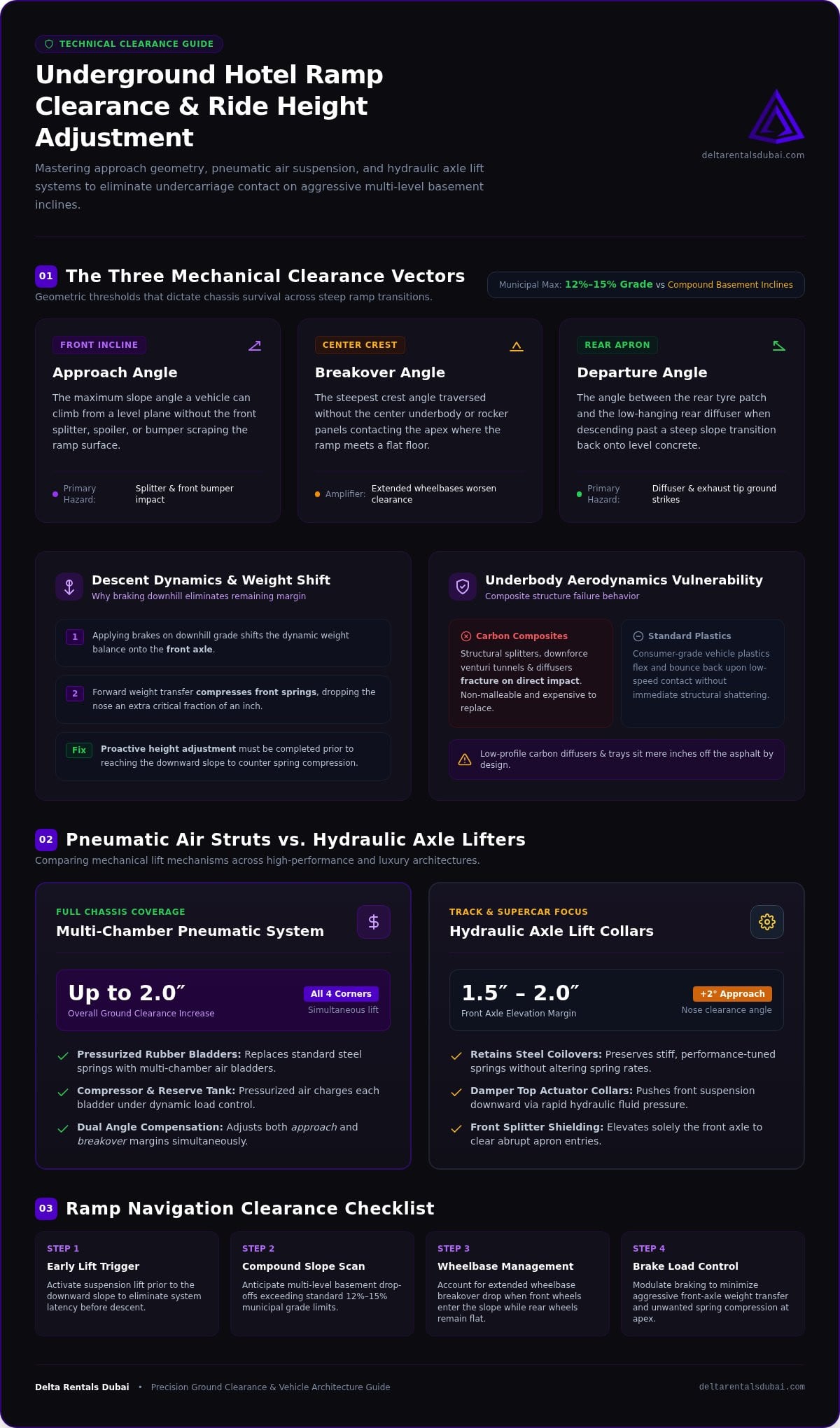
Three mechanical vectors dictate whether your chassis clears a subterranean ramp transition without contact:
- Approach Angle: The maximum slope angle a vehicle can climb from a level plane without the front splitter, spoiler, or bumper scraping the ramp surface.
- Breakover Angle: The steepest crest angle a vehicle can traverse without the center underbody or rocker panels contacting the apex where the ramp meets a flat parking floor.
- Departure Angle: The angle between the rear tyre patch and the low-hanging rear diffuser, vital when descending past a steep slope transition back onto level concrete.
Extended wheelbases amplify ground-clearance hazards. A long, elegant grand tourer often possesses sufficient static ground clearance in a straight line, but its elongated distance between front and rear axles severely degrades its breakover threshold. When the front wheels roll onto the downhill grade while the rear wheels remain on the flat upper floor, the chassis center drops drastically toward the concrete apex.
The Vulnerability of Precision Underbody Aerodynamics and Carbon Fiber
Performance chassis rely on smooth carbon-fibre underbody trays, downforce-inducing venturi tunnels, and low-profile front splitters to maintain stability at speed. These hand-finished components sit mere inches off the asphalt. Unlike flexible consumer plastics that bend and bounce back, structural composite splitters and delicate rear diffusers fracture upon direct contact with an unyielding driveway apron.
Descent dynamics make the situation worse. Applying the brakes as you point downhill shifts the vehicle’s dynamic weight balance onto the front axle. That forward weight transfer compresses the front springs, dropping the nose an extra critical fraction of an inch right as the splitter approaches the bottom apex. Without executing an air suspension ride height adjustment for underground hotel ramps prior to descent, this dynamic suspension compression instantly eliminates your remaining clearance margin.
How Air Suspension and Front-Axle Lift Systems Work Under Practical Conditions
Consumer car platforms and performance supercars handle variable clearance through distinct mechanical approaches. While delivery vans or recreational vehicles rely on simple manual helper springs, luxury vehicles integrate precision active hardware. Understanding how these components generate clearance under load ensures you execute an effective air suspension ride height adjustment for underground hotel ramps without pausing vehicle momentum or risking low-speed scrape events.
Pneumatic Air Struts Versus Hydraulic Coilover Lifters
Two primary mechanical architectures dominate modern height-adjustable performance vehicles:
- Full Multi-Chamber Pneumatic Systems: Found in full-size luxury transport, these systems replace standard steel springs with pressurized rubber bladders. An onboard compressor and pressurized reserve tank inflate each corner simultaneously. They raise overall ground clearance by up to two inches, adjusting both approach and breakover margins across the entire chassis.
- Hydraulic Axle Lift Collars: Common on track-focused supercars, these systems retain stiff, performance-tuned steel coilover springs. Hydraulic actuator collars sitting on top of the front dampers push the suspension downward via fluid pressure. This design elevates solely the front axle by 1.5 to 2 inches, typically adding around two degrees to the car’s approach angle in roughly four to eight seconds.
Foundational engineering principles of automotive suspension design emphasize high-pressure fluid reservoirs to minimize cycle latency. While a purely pneumatic air spring takes several seconds to fill from an onboard accumulator tank, a dedicated hydraulic pump actuates almost instantaneously, raising the nose before an oncoming drop-off catches your front splitter.
Integrated Cabin Controls and Automated Smart Lift Features
Engaging these systems depends entirely on vehicle architecture. Dedicated sports cars often feature a physical toggle switch on the center console or steering wheel hub. In contrast, modern luxury GTs frequently embed ride height commands within digital touchscreen sub-menus. Once activated, electronic height sensors monitor each control arm, leveling the body even if you are carrying multiple passengers and heavy luggage.
Every system enforces a rigid velocity threshold. Factory computers automatically lower raised front ends once the speedometer registers between 35 and 50 km/h. Exceeding that threshold mid-ramp can drop your splitter directly onto descending transitions. Several modern manufacturers bypass manual activation entirely using GPS-linked memory, prompting the car to rise automatically whenever satellite coordinates match an aggressive driveway.
Navigating these complex setups shouldn’t feel intimidating. If you want seamless access to a fleet prepared for every architectural hurdle, you can easily reserve an elite lift-equipped model backed by a complete handover walkthrough.
Comparing Suspension Capabilities Across Supercars, Grand Tourers, and Luxury SUVs
Every automotive segment negotiates underground architecture differently. While low-profile sports cars require surgical precision to preserve aerodynamic ground effects, full-size luxury SUVs conquer aggressive drop-offs with absolute ease. Choosing the right vehicle architecture for your destination, paired with an understanding of air suspension ride height adjustment for underground hotel ramps, ensures you arrive without underbody stress.
Dedicated Performance Coupes and Front-End Lift Architecture
Extreme track machinery prioritizes road-hugging downforce over everyday practicality. Cars such as the Porsche 911 GT3 RS feature specialized front-axle hydraulic lift assemblies engineered directly into their motorsport-derived dampers. Activating this system raises the nose by approximately 40 millimeters, preserving the prominent front splitter and delicate underfloor strakes from steep grade changes without compromising high-speed track stiffness.
Prestige SUVs and Adaptive Air Suspension Travel
Full-size luxury platforms eliminate transition anxiety entirely. Vehicles like the Rolls Royce Cullinan Black Badge utilize self-leveling, multi-chamber pneumatic air suspension setups that offer expansive wheel articulation and substantial ground clearance. Active anti-roll stabilization continuously counteracts torsional twist as individual wheels traverse abrupt subterranean ramps, keeping the structural underfloor safely horizontal and completely isolated from sudden pavement edges.
Luxury High-Performance Sedans and Hybrid Supercars
Extended grand tourers and electrified supercars demand deliberate clearance management. Long-wheelbase luxury sedans boast ample bumper height, yet their elongated chassis creates vulnerability at the breakover crest. Modern mid-engine hybrid supercars present a different technical challenge altogether.
- Underfloor Protection: High-performance hybrids like the McLaren Artura house structural battery enclosures and intricate cooling channels directly beneath the monocoque, demanding total protection from ramp friction.
- Rapid Deployment: Advanced hydraulic front lifts on modern mid-engine platforms deploy in under four seconds, granting immediate approach clearance before you cross the downward apron.
- Automatic Posture Balancing: Sophisticated electronic controllers regulate ride height across both axles, maintaining aerodynamic equilibrium as drive angles shift.
Matching your itinerary to appropriate engineering guarantees a seamless arrival. Whether you desire the track-bred poise of an agile coupe or the effortless height clearance of an imposing prestige SUV, mastering air suspension ride height adjustment for underground hotel ramps keeps your vehicle immaculate across every basement level.
Step-by-Step Procedure: How to Navigate Underground Hotel Ramps Without Undercarriage Damage
Negotiating subterranean garage entries without scraping requires clear technique rather than luck. Follow this proven tactical sequence to preserve delicate composite bodywork and achieve complete composure during basement arrivals.
Pre-Ramp Assessment and Timely Lift Engagement
Executing an air suspension ride height adjustment for underground hotel ramps begins well before your tyres touch the slope:
- Halt on Level Pavement: Come to a complete stop on the flat apron roughly five meters ahead of the downward break. Actuating the lift while stationary prevents pressure surges in the lines.
- Engage the Lift Control: Press the dedicated console switch or select the chassis lift tile within the infotainment display.
- Verify Instrument Confirmation: Wait for the dashboard graphic or audible chime to confirm maximum ride height. Rolling forward before full extension risks immediate splitter contact.
Steering Angles, Crest Crossing, and Throttle Modulation
Trajectory dictates clearance. When ramp width permits, approach the decline at a 30-degree to 45-degree angle. Entering diagonally staggers wheel contact; one front tyre rolls onto the slope first, lifting the front lip upward before the second tyre leaves the flat surface. This diagonal path substantially broadens your effective approach angle.
Hold a steady crawl below 15 km/h. Exceeding velocity limits triggers the vehicle’s automatic lowering safety program, dropping the chassis back down mid-ramp. Avoid sudden throttle jabs or hard braking pulses while crossing the crest, as pitch motions compress dampers and erode precious center breakover margin.
Transitioning to Flat Surfaces and System Reset
The descent ends only when the rear wheels settle completely onto the horizontal parking floor. Clearing the front bumper does not protect an elongated rear diffuser. Continue straight until all four tyres rest on level concrete before deactivating the system.
Allow the pneumatic compressor or hydraulic valve block a brief moment to cycle smoothly before engaging reverse or tucking into a tight valet lane. Taking these precautions protects your journey from disruptive scrapes and preserves vehicle integrity. For personalized guidance before your arrival, connect directly with expert fleet concierges via WhatsApp for personalized vehicle walkthroughs.
Selecting the Ideal High-Clearance Luxury Rental for Effortless Hotel and Valet Access
Strategic vehicle selection transforms challenging basement architecture into an effortless afterthought. If your travel plans center on high-end hotels with steep subterranean entries, aligning your rental choice with vehicle-specific suspension characteristics eliminates scraping hazards before you even depart. Knowing how to leverage air suspension ride height adjustment for underground hotel ramps gives you the freedom to choose between uncompromising performance and commanding luxury poise.
Choosing Between Track Supercars and Commanding Luxury SUVs
Your itinerary should drive your vehicle architecture:
- Extreme Performance with Lift Assurance: When high-speed precision is your priority, rent a Porsche 911 GT3 RS Rental or McLaren Artura Rental. Both feature factory-engineered front lifts that preserve low-profile aerodynamic splitters across steep urban transitions.
- Dynamic Grand Touring Versatility: A Range Rover Rental such as the Range Rover Sport V8 combines an assertive aesthetic with multi-mode air suspension. It lets you conquer multi-story spiral ramps with generous breakover margins.
- Supreme High-Clearance Prestige: Opting for a Rolls Royce Cullinan Black Badge Rental delivers unmatched ease. Its high static floor clearance and automatic self-leveling bladders roll over aggressive transitions without requiring manual driver intervention.
The Premium Advantage: Seamless Handover and Dedicated Support
Uncertainty behind the wheel ruins the luxury experience. To ensure total confidence, every handover from an elite fleet provider includes a thorough controls familiarization session. Handover specialists demonstrate the exact location of physical lift switches, explain infotainment sub-menus, and outline system activation cycle times before you set off.
This hands-on briefing removes all guesswork surrounding speed cut-off thresholds. You know precisely how your vehicle behaves when transitioning from level valet forecourts to descending parking decks. With pristine underbodies inspected prior to delivery, you enjoy flawless presentation and mechanical peace of mind throughout your stay. To tailor your selection or review lift-equipped options, message our vehicle support team on WhatsApp to arrange your next luxury vehicle.
Master Every Subterranean Arrival with Total Composure
Aggressive underground garage slopes don’t have to compromise your journey or risk your vehicle’s undercarriage. By anticipating transition geometry and understanding approach thresholds, you can navigate challenging architecture effortlessly. Executing a proactive air suspension ride height adjustment for underground hotel ramps before entering the decline ensures your front splitters, diffusers, and carbon-fibre trays remain in showroom condition.
Every journey deserves complete peace of mind. Whether you reserve the track-honed Porsche 911 GT3 RS, the agile McLaren Artura, or the commanding Rolls Royce Cullinan, our pristine fleet delivers superior engineering for every architectural setting. Each vehicle handover includes a comprehensive front-axle lift and suspension orientation so you feel completely in command from the moment you drive away. If you encounter unfamiliar terrain, our dedicated team is always on hand via instant messaging to assist. Chat with our luxury fleet specialists on WhatsApp today to select the perfect lift-equipped model for your next destination.
Frequently Asked Questions
How much extra ground clearance does a front-axle lift system typically provide?
Most dedicated performance systems deliver between 30 and 50 millimeters (roughly 1.2 to 2 inches) of additional elevation at the front spoiler. On track-focused models like the Porsche 911 GT3 RS, a factory lift adds approximately 40 millimeters. This compact elevation expands the vehicle’s approach angle by about two degrees, which is often enough to clear steep underground driveway transitions cleanly.
Can I activate air suspension ride height adjustment while driving down a ramp?
You shouldn’t attempt to engage height adjustments while traversing an incline. Active descent shifts vehicular weight onto the front dampers, straining hydraulic actuators or pneumatic compressors. Performing your air suspension ride height adjustment for underground hotel ramps while stopped on the flat surface above ensures optimal line pressure and gives mechanical components sufficient time to fully extend before your tyres meet the slope.
What happens if I exceed the speed limit while my vehicle is lifted?
Onboard chassis control modules monitor vehicle velocity and automatically vent or lower the raised suspension once you pass a preset threshold. This safety cut-off usually engages between 35 and 50 km/h. If you accelerate past this limit while descending, the nose lowers automatically mid-transition, leaving delicate front diffusers vulnerable to sudden concrete apex contact.
Do all high-performance rental supercars come equipped with front-axle lift systems?
Not every high-performance car includes an axle lift as standard equipment, because some track variants omit it to save weight. Elite fleets resolve this issue by selectively acquiring lift-equipped models like the McLaren Artura and Porsche 911 GT3 RS. Handover specialists verify these features during vehicle delivery to ensure clients navigate challenging architecture without mechanical uncertainty.
Why do long-wheelbase luxury sedans scrape on ramp transitions even with standard ride height?
Extended distances between front and rear axles severely reduce a vehicle’s center breakover angle. While bumper clearance might appear adequate on flat pavement, crossing a pronounced crest causes the middle undercarriage to bottom out as the front wheels descend and the rear wheels remain elevated. Vehicles with long wheelbases require active height elevation across all four corners to traverse these apexes safely.
Can diagonal driving angles help prevent undercarriage scraping on narrow garage ramps?
Entering an incline at a slight diagonal angle significantly lowers the risk of scraping by staggering tyre contact. Allowing one wheel to meet the slope before the other lifts the front overhang incrementally, preventing the entire lower splitter edge from hitting simultaneously. When ramp width permits, combining a shallow approach angle with active height management provides maximum underbody clearance.
Is front-axle lift operated by hydraulics or pneumatic air compression?
Both technologies are common across the automotive sector, depending on the chassis configuration. Track-oriented supercars favor hydraulic lifter collars mounted directly onto stiff coilover springs for rapid, four-second deployment. Larger luxury platforms generally utilize multi-chamber pneumatic air bladders fed by pressurized reservoirs to adjust entire body height smoothly across both axles.