

Dropping the roof on a high-performance machine shouldn’t force you to trade elite comfort for an intolerable, deafening roar. Too many drivers discover that high-speed cruising turns an aspirational journey into an exhausting ordeal, dominated by violent low-frequency buffeting and wind rush that makes ordinary conversation impossible. If you want to eliminate that acoustic chaos, implementing proven wind noise reduction tips for open top high speed convertible driving will immediately restore poise to your cockpit.
Open-air acoustic refinement is fundamentally an aerodynamic discipline of pressure redirection, not passive insulation. You don’t have to tolerate ear fatigue to enjoy the sky above. In this guide, you will master the exact deflector setups, window height alignments, and airflow management strategies needed to cut turbulence by up to 75%. Here is how to achieve conversational cabin serenity while preserving the raw, unfiltered thrill of your engine note on every open highway.
Key Takeaways
- Master essential wind noise reduction tips for open top high speed convertible driving by neutralizing low-pressure cockpit vacuums with rear deflectors and strategic window indexing.
- Eliminate painful Helmholtz buffeting and cabin thrumming by understanding how high-velocity air shears over the windshield header rail.
- Discover how exotic mid-engine spiders and grand tourers handle turbulent wake patterns differently through specialized flying buttresses and rear glass management.
- Optimize speed-sensitive audio settings and in-cabin acoustic technology to maintain clear, effortless sound clarity at highway speeds.
- Prevent irritating high-speed air leaks and whistles by preserving A-pillar rubber seals with specialized conditioning treatments.
Understanding Cabin Buffeting and Wind Turbulence in High-Speed Convertibles
Traditional automotive soundproofing focuses entirely on passive isolation. Enclosed car guides often recommend lining door panels with mass-loaded vinyl or butyl damping mats to suppress structure-borne tire vibration and chassis hum. In a droptop, that advice falls completely flat. The moment you lower the roof, cabin acoustics cease to be an insulation challenge and become a fluid dynamics problem. Mastering effective wind noise reduction tips for open top high speed convertible driving requires looking beyond panel deadening to control the airborne shear forces entering the cabin directly from above.
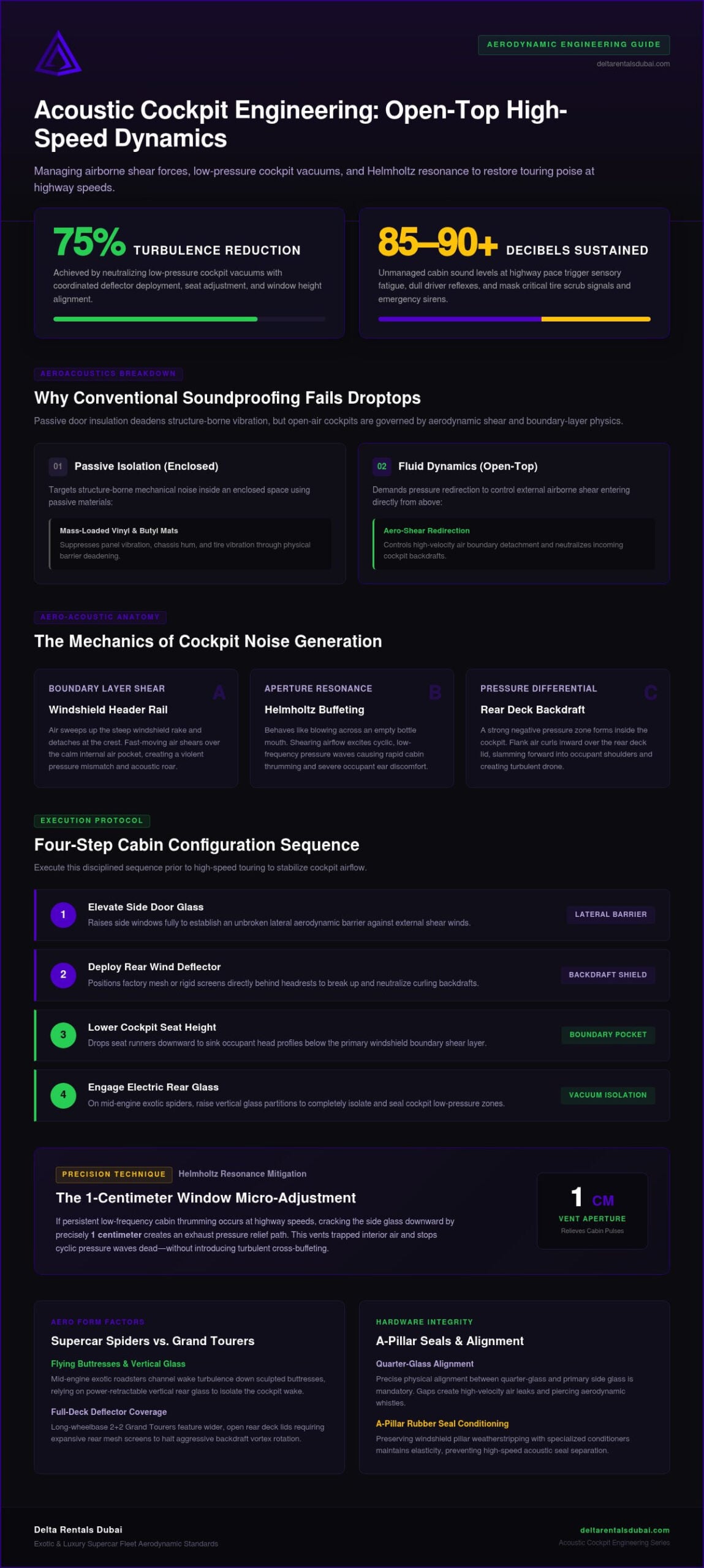
At high speeds, air splits sharply against the front bumper, sweeping up the steep rake of the windshield. Once this airstream crests the windshield header rail, it detaches from the vehicle’s surface. This boundary layer separation creates violent air shear. Rather than flowing smoothly over the car, fast-moving air shears past the calm air pocket within the interior. The resulting pressure mismatch turns an unmanaged cabin into an acoustic echo chamber, replacing the mechanical symphony of your engine with an abrasive rush of sound.
When studying principles of automotive aerodynamics, engineers pay close attention to aperture resonance. At open highway speeds, air shearing across the cabin behaves exactly like blowing across the mouth of an empty glass bottle. This phenomenon, known as Helmholtz resonance, creates cyclic low-frequency pressure waves. These vibrating vortices generate a rapid, rhythmic cabin thrumming that causes physical ear discomfort and quickly drains driving pleasure.
The Physics of Cockpit Low-Pressure Vortices
As velocity rises, high-speed airflow over the windshield header establishes a powerful negative pressure zone inside the cockpit. Ambient air rushing along the exterior flanks curls aggressively inward over the rear deck lid, rushing forward to fill this sudden vacuum. This turbulent backdraft slams into the back of occupant headrests and shoulders. Without proper intervention, these low-pressure vortices turn clean engine induction sound into a muddied, turbulent drone.
Decibel Exposure and Driver Hearing Fatigue
Unmanaged open-cockpit driving easily pushes sound levels past 85 to 90 decibels at sustained highway pace. Continuous exposure to this acoustic intensity triggers severe sensory fatigue, dulling driver reflexes on long journeys. The sheer roar of turbulent air masks ambient situational awareness, drowning out tire scrub signals and distant emergency sirens. Applying targeted wind noise reduction tips for open top high speed convertible driving re-establishes atmospheric calm, letting you hold a normal conversation and stay razor-sharp behind the wheel.
Step-by-Step Cabin Setup: Active Wind Deflectors and Window Indexing
To turn high-speed turbulence into quiet, stable airflow, execute a disciplined cabin configuration before pinning the throttle. Applying methodical wind noise reduction tips for open top high speed convertible driving transforms your cockpit from a chaotic wind tunnel into a serene touring environment.
Execute this four-step sequence for immediate acoustic control:
- Elevate side windows: Raise door glass to establish an unbroken lateral aerodynamic barrier against shear winds.
- Deploy the rear wind deflector: Position factory mesh or rigid screens directly behind the headrests to neutralize curling backdrafts.
- Lower the seat height: Drop seat runners to sink occupant profiles beneath the primary windshield boundary layer.
- Engage electric rear glass: On modern mid-engine exotic spiders, raise the vertical rear glass partition to seal off low-pressure cockpit vortices.
Mastering the Window Height Micro-Adjustment Technique
Raising both side windows fully prevents lateral crosswinds from wrapping around your shoulders. If you encounter slight interior thrumming at high cruising speeds, crack the glass downward by a single centimeter. This tiny gap vents trapped cockpit air and eliminates pressure pulses without introducing turbulence. Always confirm that quarter-glass seals align precisely against the main glass to prevent high-pitched aerodynamic whistles.
Deploying Mesh vs. Polycarbonate Wind Deflectors
Rear wind deflectors neutralize the vacuum created behind occupant seats. Groundbreaking aeroacoustics research reveals how breaking up vortex shedding dramatically lowers turbulent sound generation. Fabric mesh screens diffuse returning wake currents while maintaining unobstructed rearward visibility. Rigid polycarbonate panels physically divert high-velocity air upward over the rear deck lid. Both configurations disrupt cabin vacuum formation, cutting cabin noise and wind blast by up to 75%.
Optimizing Seating Position and Headrest Aerodynamics
Cockpit geometry dictates airflow interaction. Drop your seat runners to their lowest setting to tuck your head securely below the windshield slipstream. Recline the backrest slightly backward to minimize trailing air currents grazing the nape of your neck. Integrating these physical adjustments with factory aero cowls channels high-velocity air cleanly over the cockpit.
If you want to experience effortless high-speed touring in an aerodynamically honed droptop like an Audi R8 V10 Spyder or Lamborghini Evo Spyder, connect with our luxury concierge to arrange an elite convertible rental today.
Acoustic Cockpit Engineering: Audio Systems, Attire, and In-Cabin Tech
Aerodynamic airflow management shields the cabin from exterior pressure, but achieving true acoustic refinement requires optimizing the cockpit itself. Standard audio advice often centers on static foam rings and mass dampers. That guidance fails completely once ambient road speed takes over. Pairing high-fidelity digital signal processing with personal apparel forms an indispensable pillar of advanced wind noise reduction tips for open top high speed convertible driving.
Acoustic management inside a performance roadster divides into active cockpit technology and passive physical interventions. Modern exotics overcome rushing air by utilizing headrest-integrated micro-speakers. By positioning drivers directly behind your ears, these dedicated arrays isolate navigational prompts and phone calls from buffeting crosswinds. You enjoy pristine acoustic clarity without having to crank dashboard speakers to ear-splitting volumes.
Calibrating Speed-Sensitive Audio and Equalizer Presets
Speed-sensitive volume compensation automatically raises audio gain as velocity climbs. However, factory equalization presets rarely account for open-air frequency loss. Heavy sub-bass notes quickly blur into low-frequency road rumble, muddying the entire soundstage. Open your infotainment sound settings and recalibrate your equalizer bands for open-air touring:
- Cut sub-bass frequencies: Roll back lower bass registers to prevent low-end acoustic clipping and interior resonance.
- Boost mid-range vocals: Elevate frequencies between 1 kHz and 4 kHz to keep vocals and instrumentation crisp over wind rush.
- Shift balance forward: Bias the audio fader slightly toward dashboard tweeters and headrest modules to focus sound directionally.
Protective Driver Gear for High-Speed Open Cruising
Passive gear provides an immediate physical shield against persistent acoustic stress. Purpose-built acoustic earplugs featuring precision attenuating filters reduce destructive decibel exposure while preserving the mechanical melody of the exhaust note. Unfiltered air turbulence also causes involuntary squinting and physical tension; close-fitting wrap-around driving glasses deflect turbulent updrafts cleanly away from your eyes. Round out your gear with a structured, low-profile cap that stays locked in place, ensuring an effortless, high-speed open-top journey.
Vehicle-Specific Aero Solutions: Mid-Engine Supercars vs. Grand Tourers
Universal soundproofing kits fail because open-top cabin aerodynamics vary drastically across vehicle architectures. A mid-engine exotic does not manage wake turbulence the same way a front-engine 2+2 grand tourer does. Tailoring your wind noise reduction tips for open top high speed convertible driving to your specific chassis layout is the secret to neutralizing buffeting while preserving dynamic engine acoustic character.
Cockpit layout dictates the trajectory of separated boundary layers. In front-engine grand tourers, airflow travels over a broad cabin opening before meeting a flat rear deck. In mid-engine machines, aerodynamic channels, raised engine cowls, and rear glass partitions fundamentally reshape incoming air before it can collapse inward.
Taming Airflow in Exotic Mid-Engine Spyders
Modern exotics utilize aerodynamic flying buttresses that frame the rear deck. These sculpted pillars channel high-velocity air directly into engine cooling intakes while routing lateral vortices away from occupant ears. Many mid-engine platforms also integrate an independent, electrically powered vertical rear window between the roll hoops. Raising this tiny glass panel with the roof down seals off the central low-pressure vacuum, eliminating cockpit backdraft entirely without blocking the glorious mechanical induction soundtrack.
You can experience this level of integrated aerodynamic precision firsthand across the Lamborghini Evo Spyder and Audi R8 V10 Spyder fleets, where active spoilers automatically shift angles at speed to prevent rear cabin suction.
Managing Turbulence in Luxury 2+2 Grand Tourers
Spacious four-seat luxury convertibles present a much larger cabin volume. This expanded void creates a massive low-pressure cavern that invites aggressive turbulence over rear seats. Managing this footprint requires specific hardware solutions:
- Full-width tonneau deflectors: Clip a horizontal folding deflector over the rear footwells to physically shrink the open cabin aperture.
- Active header air deflectors: Deploy motorized deflector vanes mounted directly along the upper windshield rail to throw oncoming airflow high over the passenger zone.
- Acoustic soft tops: When cruising speeds push past triple digits on cross-country runs, deploying modern multi-layer canvas roofs yields coupe-grade decibel isolation in seconds.
To reserve an exotic droptop maintained to pristine mechanical and acoustic standards, book your premier supercar rental experience with our concierge team today.
Maintaining Weather Seals and Aerodynamic Integrity for Flawless Touring
Even the most advanced wind deflector setup cannot compensate for degraded weatherstripping or misaligned latch hardware. At high cruising velocity, oncoming air exerts enormous lifting force against your windshield frame. If rubber seals are dry, cracked, or out of position, pressurized air forces its way through microscopic gaps. The result is a piercing, high-frequency whistle that cuts straight through engine sound and conversation. Integrating mechanical seal maintenance into your wind noise reduction tips for open top high speed convertible driving guarantees that your droptop retains factory-grade acoustic sealing on every spirited sprint.
Preventative Seal Care and Latch Alignment
Convertible weatherstripping faces severe thermal cycling and direct exposure to debris. When rubber loses elasticity, it flattens permanently, breaking the airtight seal against window glass and top frames. Restore and preserve these critical contact points through a focused maintenance routine:
- Clean channels with pure water: Wipe down rubber grooves with lint-free microfiber towels and water-based cleaners to strip away embedded road sand and grit.
- Condition with perfluoropolyether lubricants: Apply specialized conditioning grease such as Krytox or high-viscosity silicone emulsion quarterly to keep seals pliant and eliminate dry-contact creaking.
- Recalibrate automatic window indexing: Reset door glass sensors so windows cycle upward the full additional centimeter into rubber channels every time the door shuts.
- Inspect roof latch tolerances: Verify that convertible header latches lock down with uniform tension, ensuring zero millimeter elevation differences across the front windshield header rail.
Experience Flawless Open-Air Precision with Delta Rentals
Maintaining an exotic droptop’s delicate aerodynamic balance requires absolute technical diligence. At Delta Rentals, every high-performance convertible in our national fleet undergoes rigorous multi-point aerodynamic and acoustic inspections. From factory-calibrated window indexing to flawless rubber seals and spotless active deflectors, our cars are primed for quiet, high-speed stability.
Whether you choose an Audi R8 V10 Spyder or a Lamborghini Evo Spyder, you step into a meticulously prepared machine designed to deliver exhilarating performance without acoustic chaos. Experience the pinnacle of refined open-air touring with our 5-star concierge service on roads across the country.
Master Cockpit Serenity on the Open Road
High-speed droptop touring shouldn’t mean choosing between open skies and acoustic comfort. Applying targeted wind noise reduction tips for open top high speed convertible driving ensures you actively redirect turbulent shear, neutralize cockpit low-pressure vortices, and preserve pristine audio clarity. By pairing rear deflectors and micro-indexed side windows with disciplined weather seal maintenance, you transform violent buffeting into effortless, high-speed composure.
When you want to experience factory-engineered aerodynamics at their absolute peak, step into our meticulously maintained fleet featuring iconic roadsters like the Audi R8 V10 Spyder and Lamborghini Evo Spyder. Recognized as an elite, transparent concierge vehicle hire trusted across the entire country, we prepare every droptop to the highest mechanical and aerodynamic standards. Connect with our concierge team to reserve your premier convertible and command the highway in complete comfort today.
Frequently Asked Questions
Why does my convertible create a loud thumping noise at high speeds with the top down?
That rhythmic thumping is caused by Helmholtz resonance, which happens when high-velocity air shears over the windshield header rail and creates oscillating pressure waves across the open cabin. This acts like air blowing over an empty bottle, setting up low-frequency pulses. You can stop this buffeting immediately by cracking your side windows slightly or deploying a rear wind deflector to break up internal cockpit vacuum pockets.
Do wind deflectors actually make a noticeable difference in convertible cabin noise?
Yes, installing a quality rear mesh screen or polycarbonate wind deflector reduces interior wind turbulence and roar by up to 75%. Deflectors work by disrupting the powerful low-pressure vacuum that forms behind front occupants, preventing ambient air from curling inward over the rear deck. Following proven wind noise reduction tips for open top high speed convertible driving ensures you block backdrafts while preserving your car’s exterior lines.
Is it better to drive with windows up or down when cruising in a convertible at speed?
Driving with the side windows elevated provides superior aerodynamic isolation and cabin composure at highway velocity. Raised glass creates an unbroken lateral shield that forces rushing crosswinds around the chassis rather than directly into the cockpit. If you experience minor cabin pressure pulsing, crack the windows down about a centimeter to equalize interior air pressure without introducing turbulent drafts around your shoulders.
Can open-top wind noise cause permanent hearing damage during long road trips?
Sustained open-top driving frequently exceeds 85 to 90 decibels at highway speeds, which causes genuine auditory fatigue and potential hearing strain over extended periods. High-speed wind rush masks emergency sirens and critical tire feedback. Wearing filtered acoustic driving earplugs protects your ears from harmful low-frequency roar while keeping navigational prompts, passenger conversations, and mechanical exhaust notes perfectly clear.
What is the best way to clean and condition convertible rubber window seals?
Clean your weatherstripping using lint-free microfiber towels and warm water to remove abrasive sand, road grit, and dust particles from the contact channels. Once completely dry, treat the rubber quarterly with a specialized perfluoropolyether lubricant or pure silicone emulsion like Krytox. This conditioning treatment prevents dry rot, eliminates squeaks, and ensures an airtight, whistle-free window glass fitment at high cruising speeds.
How do mid-engine supercar convertibles manage cabin turbulence compared to standard roadsters?
Mid-engine exotic spiders utilize sculpted flying buttresses, aerodynamically routed intake tunnels, and vertical power rear windows to control turbulent airflow. Rather than letting air collapse back into the cockpit, these channels direct airstreams smoothly over the engine deck. Understanding these vehicle-specific designs gives you essential wind noise reduction tips for open top high speed convertible driving, ensuring stable acoustics in high-performance exotics.