
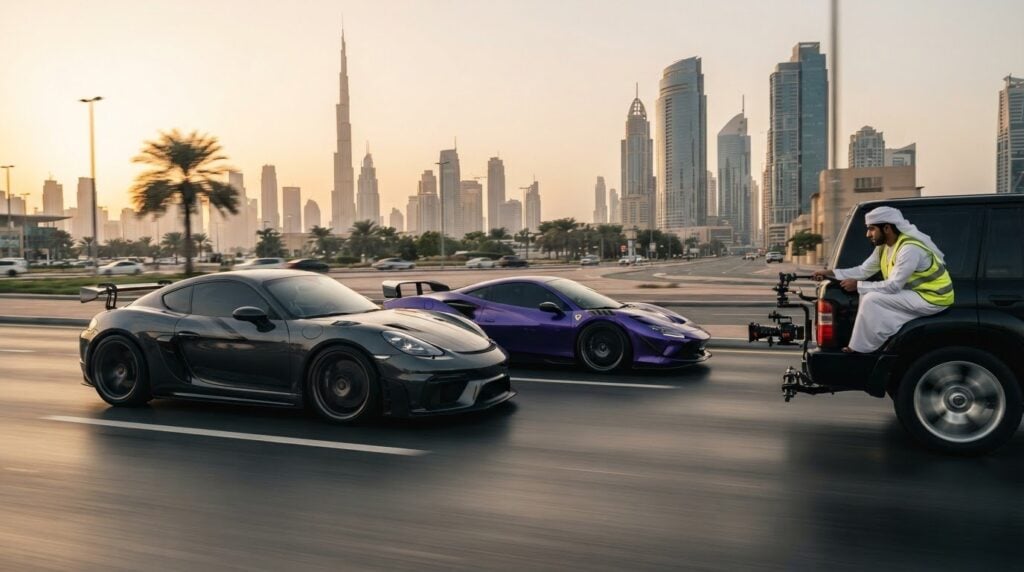
Elite automotive photography is 40% technical skill and 60% logistical orchestration of the subject and environment. You’ve likely felt the sting of a perfect sunset ruined by unwanted reflections on a high-gloss Porsche 911 GT3 RS or the disappointment of a static shot that lacks the soul of motion. It’s a high-stakes world where every second of golden hour is a luxury you can’t afford to waste.
This masterclass delivers the professional supercar photoshoot production tips you need to bridge the gap between amateur snapshots and portfolio-ready art. You’ll learn to master the technical orchestration and logistical secrets required to produce world-class imagery using elite high-performance vehicles. We’re removing the traditional friction of sourcing rare models like the McLaren Artura by highlighting streamlined partners like Delta Rentals Dubai, who provide no-deposit access to an exclusive fleet.
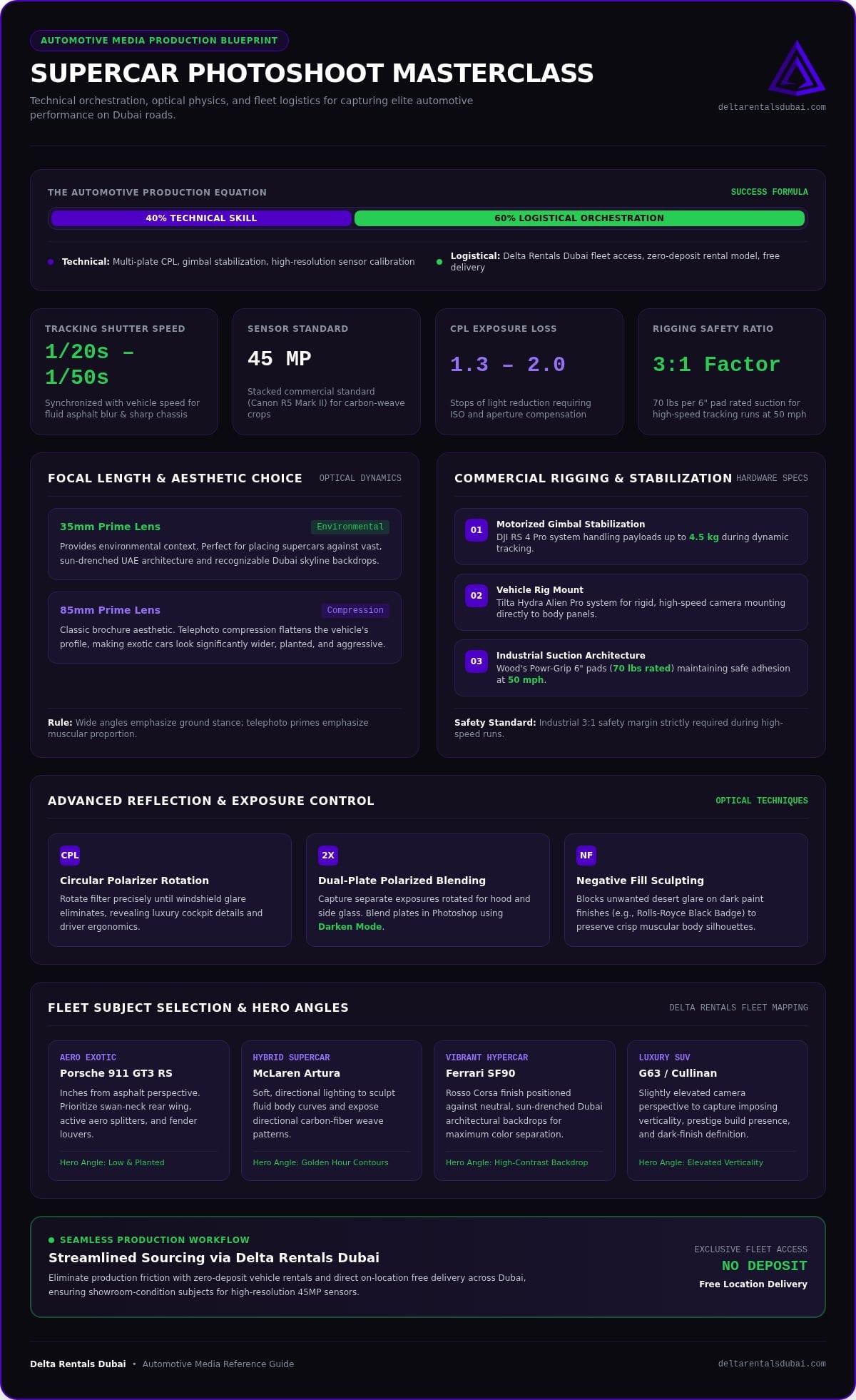
We’ll dive into the precise gear settings for 2026, including why professional tracking shots require shutter speeds between 1/20s and 1/50s to nail that fluid asphalt blur. From managing complex body curves with multi-plate CPL stacking to optimizing your production workflow, this is your roadmap to effortless prestige in automotive media.
Key Takeaways
- Identify and exploit “hero angles” that accentuate the specific aerodynamic design language of elite models like the Porsche 911 GT3 RS.
- Master reflection control using Circular Polarizers and negative fill to prevent high-gloss paint from acting like a distracting mirror.
- Execute high-impact “roller” shots by synchronizing shutter speed with vehicle velocity for perfect wheel blur and sharp chassis detail.
- Apply professional supercar photoshoot production tips to streamline logistics, utilizing no-deposit rentals and free delivery to maximize on-location efficiency.
- Leverage the UAE’s golden hour and advanced lighting techniques to sculpt the contours of performance subjects like the McLaren Artura.
The Fundamentals of Supercar Aesthetics and Subject Selection
A supercar is a masterclass in functional sculpture. Unlike a standard vehicle, every curve on a Porsche 911 GT3 RS or a McLaren Artura exists to manipulate air. Mastering these professional supercar photoshoot production tips starts with recognizing that you aren’t just shooting a car; you’re documenting performance. A hero angle for a low-slung exotic typically requires getting the lens inches from the asphalt to emphasize the aggressive, wide stance. Compare this to a luxury SUV like the Mercedes G63, where a slightly higher perspective better captures the imposing verticality and prestige of the build.
Identifying the “soul” of the car means hunting for specific design cues that define its character. Look for the light signatures, the massive rear wings, and the functional vents that signal raw power. Modern 2026 models often feature intricate carbon fiber accents that require precise lighting to reveal the directional weave. If you’re sourcing these subjects, partnering with an elite fleet provider like Delta Rentals Dubai ensures you have access to showroom-condition models that stand up to the scrutiny of high-resolution sensors.
Aerodynamics as Art: Capturing Form and Function
High-performance design is dictated by downforce. When shooting the Porsche 911 GT3 RS, your composition should prioritize the swan-neck rear wing and active aero components. Use low, wide-angle perspectives to make the car look planted and powerful. This approach highlights the aggressive front splitters and fender louvers that differentiate a true supercar from a standard sports car. Capturing the texture of carbon fiber requires soft, directional light to prevent the weave from disappearing into a flat black void during the edit.
Color Theory in Automotive Production
The UAE offers a neutral, high-contrast backdrop that makes vibrant Italian exotics stand out. If you’re shooting a Ferrari SF90 in Rosso Corsa, the sun-drenched architecture provides a perfect aesthetic counterpoint. However, the “Black Badge” aesthetic found on a Rolls Royce Cullinan requires specific exposure compensation. Dark, high-gloss finishes act as mirrors, so you’ll need to manage reflections carefully to maintain the car’s shape. Use negative fill to add definition to the body lines, ensuring the vehicle doesn’t look like a simple silhouette against the bright national landscape.
Essential Gear for Professional Automotive Production
High-resolution sensors are no longer optional for commercial automotive work. The 2026 industry standard, led by bodies like the Canon EOS R5 Mark II, utilizes 45MP stacked sensors to capture every microscopic detail for luxury prints. This level of resolution allows you to crop into a headlight assembly or a carbon fiber weave without losing the premium feel. These professional supercar photoshoot production tips prioritize gear that removes technical barriers, allowing you to focus on the art of the frame.
The Role of Polarizing Filters
A Circular Polarizer (CPL) is your most vital tool. It’s the only way to “dial out” distracting glare from a curved hood or a windscreen. Start by rotating the filter until the reflection on the glass disappears, revealing the interior detail. For complex body panels, use the dual-polarization technique: take multiple shots at different filter rotations and blend them in Photoshop using Darken mode. Remember that a high-efficiency CPL reduces light by 1.3 to 2 full stops, so you must adjust your ISO or aperture to compensate.
Stabilization is the next pillar of production. For car-to-car tracking, a motorized gimbal like the DJI RS 4 Pro handles payloads up to 4.5 kg, keeping the frame stable during high-speed maneuvers. If you’re rigging to the vehicle itself, utilize a Tilta Hydra Alien Pro system. Always follow industrial standards by using Wood’s Powr-Grip suction cups, which are rated for 70 lbs on a 6-inch pad. Applying these professional supercar photoshoot production tips to your rigging setup ensures a 3:1 safety factor, protecting your camera build during 50 mph tracking runs.
Lens Choice: Compression vs. Context
Your focal length dictates the car’s personality. Use a 35mm lens for environmental shots, placing the supercar within the vast, sun-drenched landscapes of the UAE. If you want that classic brochure look, switch to an 85mm prime. This telephoto compression flattens the car’s profile, making a Lamborghini look wider and more aggressive. An aperture of f/2.8 serves as the ideal sweet spot for automotive work, providing enough depth of field to keep the entire headlight assembly sharp while melting the background into a buttery, non-distracting bokeh.
Precision gear requires a precision subject. While your kit handles the technical side, the aesthetic success of the shoot depends on the vehicle’s condition. If you want to secure a pristine Ferrari or Lamborghini for your next production, choosing a partner with an impeccable fleet is your first step. High-end equipment works best when the subject is flawless.
Lighting and Environment: Mastering Reflection Control
Supercars are essentially high-performance mirrors. Their compound curves and deep paint finishes reflect everything in the vicinity, from nearby buildings to the photographer. One of the most effective professional supercar photoshoot production tips is to leverage the UAE’s “Golden Hour.” The low angle of the sun at dawn or dusk provides soft, directional light that accentuates the vehicle’s silhouette without creating harsh, blown-out specular highlights on the bodywork.
Managing High-Gloss Finishes
The deep, mirror-like finish of a Rolls Royce Cullinan Black Badge presents a unique challenge. Unlike matte finishes, these surfaces reflect the entire environment. Use “Negative Fill” by placing large black flags or scrims on the side of the car facing the light source. This technique adds depth and contour, preventing the car from looking like a flat, washed-out subject. To avoid “hot spots,” use large-format diffusion silks to soften direct sunlight, creating a studio-quality look in any outdoor setting.
Location Scouting for National Production
A world-class shoot requires a clean horizon. Avoid urban clutter like power lines, trash cans, or distracting signage that can ruin a premium frame. Look for long, unobstructed tarmac stretches that allow the car to breathe within the composition. Match the environment to the vehicle’s persona. The futuristic design of the McLaren Artura pairs perfectly with modern, minimalist architecture. Conversely, ensure your location reflects the prestige of the Porsche 911 GT3 RS. Track-inspired backdrops or smooth, sweeping curves better suit its performance-first DNA.
Applying these professional supercar photoshoot production tips during night shoots allows you to move beyond ambient streetlights. Use long-exposure techniques and RGB light wands to “paint” the car’s body lines manually. This highlights the aerodynamic vents and light signatures that define modern exotics. Logistics are key to a successful shoot. Delta Rentals Dubai simplifies this process with free delivery to your chosen location, ensuring the vehicle arrives in showroom condition ready for the lens.
Advanced Motion Techniques: Executing the ‘Roller’
Static photography captures the architecture of a car, but motion captures its purpose. A “roller,” or car-to-car tracking shot, is the gold standard for commercial portfolios. While panning shots from the side of the road are useful, they lack the intimacy and ground-hugging perspective of a dedicated chase vehicle setup. Mastering these professional supercar photoshoot production tips requires a technical pivot. You must move away from high shutter speeds that freeze the action and instead embrace the fluid motion of the road.
Professional results typically require shutter speeds between 1/20s and 1/50s paired with chase speeds of 48 to 80 km/h. This range produces clean circular wheel rotation and a streaking background while keeping the supercar’s body tack-sharp. For a vehicle traveling at 60km/h, a shutter speed of 1/60s provides a safe starting point to ensure the chassis remains sharp while the background begins to streak. Safety is paramount during these maneuvers; always use a closed course or permitted roads to ensure the security of the crew and the high-value assets involved.
The Mechanics of the Tracking Shot
- Alignment: Position the chase vehicle parallel to the subject car to capture perfect profile hero shots.
- Monitoring: Use a tethered monitor or wireless HD feed to check focus and composition in real-time without leaning out of the vehicle.
- Communication: Maintain constant radio contact between the photographer, the chase driver, and the subject driver for micro-adjustments in road positioning.
Wheel Blur and Background Streaks
The goal is a sharp chassis with completely blurred rims. Achieving this requires a steady hand and a low-slung chase car to maintain a dramatic, aggressive perspective. If the road surface is uneven, you can use path blur in post-processing to clean up the motion, though getting it right in-camera is always the priority. To execute these high-speed maneuvers with a world-class subject, book an elite supercar for your production today. Delta Rentals Dubai provides the perfect fleet for content creators who demand visual excellence.
Integrating these professional supercar photoshoot production tips into your workflow transforms a simple drive into a cinematic event. By coordinating your speeds and settings, you create imagery that feels alive, highlighting the performance DNA of vehicles like the Ferrari SF90 or Lamborghini Revuelto. This level of technical orchestration is what separates a casual enthusiast from a master of automotive media.
Production Logistics: Sourcing Elite Vehicles for Content
Sourcing the subject is often the most significant hurdle in automotive media. While technical skill is essential, your portfolio’s ceiling is defined by the quality of the machinery you capture. These professional supercar photoshoot production tips focus on the logistical orchestration that ensures your subject arrives in showroom condition exactly when the light is perfect. Without a reliable vehicle partner, even the best gear can’t save a production from a missing hero car.
The Rental Advantage for Creators
Renting is the secret weapon for building a world-class portfolio without the multi-million dollar overhead of ownership. By leveraging a rotating fleet, you can capture a Ferrari SF90 one week and a Lamborghini Revuelto the next. Using Delta Rentals Dubai provides guaranteed model availability and the ability to book specific colors that align with your client’s brand guidelines. Crucially, their no-deposit service model keeps your production cash flow fluid. It removes the friction of large security holds on commercial credit cards, allowing you to allocate more budget toward crew and equipment.
On-Set Vehicle Management
A “Showroom Ready” standard is mandatory for high-resolution 2026 sensors. Even a thin layer of dust or a single fingerprint on a door handle can require hours of corrective post-processing. Your on-set kit must include premium microfiber cloths, quick-detailer spray, and specialized glass cleaner to maintain a flawless finish between setups. If the production involves moving the car frequently for light adjustments, assign a dedicated handler or driver. This allows the photographer to focus entirely on the frame while the handler manages the vehicle’s road position and safety.
Efficiency defines a successful production. Coordinating delivery and pickup for tight shooting schedules is easier when your logistical partner understands the industry’s pace. For shoots requiring high-capacity support for crew and heavy grip gear, read our guide on Luxury SUV Rental to ensure your team has the space and prestige needed on-site. Applying these professional supercar photoshoot production tips turns a complex logistical puzzle into a seamless, high-status experience. Free delivery options ensure the car arrives on location exactly when needed, ready for the lens.
Elevate Your Automotive Portfolio to Masterclass Standards
Mastering the art of automotive imagery requires more than just a high-resolution sensor. It demands a deep understanding of light manipulation, reflection control, and the precise mechanics of motion. By applying these professional supercar photoshoot production tips, you’ve gained the roadmap to transform complex logistics into a streamlined, high-status creative process. You’re now equipped to handle everything from dual-polarization techniques to the high-speed choreography of a tracking shot.
Success on location ultimately depends on the quality of your subject and the reliability of your partners. Delta Rentals Dubai removes traditional industry friction with over 300 5-star Google reviews and an elite fleet featuring the Porsche 911 GT3 RS and Ferrari SF90. Their no-deposit rentals provide the financial flexibility needed for ambitious production planning, ensuring your focus remains entirely on the frame.
Your next world-class set of images is within reach. Source Your Next Masterpiece Subject at Delta Rentals Dubai and experience a seamless transition from concept to execution. The road is open; it’s time to capture it.
Frequently Asked Questions
What is the best camera lens for supercar photography?
The 35mm prime is the industry standard for environmental shots, allowing you to capture the vehicle’s design alongside the UAE’s architectural backdrops. If you prefer compressed profile shots that look like commercial brochures, an 85mm or 100mm lens is superior. These focal lengths flatten the car’s perspective, emphasizing its aggressive width. Always prioritize lenses with an f/2.8 aperture to achieve professional bokeh that separates the subject from the background.
How do I get rid of reflections on a supercar in a photo?
Use a Circular Polarizer (CPL) to physically dial out glare from the paint and glass. Since supercars possess complex, multi-angled curves, you often can’t remove every reflection in a single frame. Take multiple shots while rotating the filter and blend them using the Darken mode in Photoshop. This technical approach ensures deep paint depth and clear windows, which are essential for professional supercar photoshoot production tips.
Do I need a special permit for a supercar photoshoot in the UAE?
Commercial film and photo shoots on public roads typically require official permits and specific insurance thresholds. You’ll need a Certificate of Insurance that names the relevant national authorities as additional insured parties. If you’re shooting on private property or closed courses, requirements vary, but always verify local regulations before deploying a full production crew. Partnering with a professional fleet provider ensures your documentation aligns with national standards.
What shutter speed should I use for rolling car shots?
Set your shutter speed between 1/20s and 1/50s to create authentic motion blur. This range ensures the wheels appear as fluid circles while the asphalt streaks beneath the chassis. To keep the car body sharp at these speeds, the chase vehicle must perfectly match the subject’s velocity, usually between 48 and 80 km/h. Lower shutter speeds require a stabilized gimbal or a dedicated car mount system to prevent camera shake.
Can I rent a supercar specifically for a photoshoot?
You can easily rent elite models like the Porsche 911 GT3 RS or Ferrari SF90 specifically for production work. Delta Rentals Dubai provides an exclusive fleet for creators, offering no-deposit options that keep your production budget fluid and accessible. They handle the logistics by providing free delivery to your chosen location, ensuring the vehicle arrives in showroom-ready condition. This service is vital when implementing professional supercar photoshoot production tips for high-end clients.
Is it better to shoot supercars at sunrise or sunset?
Sunrise is often superior for automotive production because it offers the same soft, golden light as sunset but with significantly less traffic and urban haze. This allows for cleaner frames and more time to position the vehicle without interference. Both periods provide the low-angle lighting needed to sculpt the car’s body lines and minimize harsh specular highlights. Plan your arrival 45 minutes before the sun hits the horizon for maximum flexibility.
How do I make a car look fast while it’s standing still?
Use low, wide-angle perspectives to emphasize the car’s aggressive stance and aerodynamic splitters. Positioning the wheels at a slight three-quarter turn toward the lens adds a sense of readiness and direction. You can also utilize leading lines in the environment, such as road markings or architectural edges, to draw the eye through the frame. In post-production, adding a subtle path blur to the wheels and background can simulate high-speed motion.
What are the best angles for a Lamborghini vs. a Porsche?
Capture a Lamborghini from a very low, front-three-quarter angle to highlight its sharp, wedge-shaped geometry and aggressive air intakes. For a Porsche 911 GT3 RS, the rear-three-quarter angle is the hero shot, as it accentuates the iconic silhouette and massive swan-neck wing. Focus on the curves of the Porsche versus the geometric planes of the Lamborghini to tell the specific design story of each high-performance machine.