

Did you know the McLaren 720S generates 50 percent more usable downforce than its predecessor without relying on a single permanent, towering wing? It’s a feat of engineering that often leaves enthusiasts questioning where the art ends and the physics begin. You’ve likely stared at those deep body channels and wondered if they’re purely for aesthetic drama or if they serve a higher purpose during a high-speed sprint across the UAE. It’s common to feel uncertain about how air actually moves through a car rather than just over it, especially when the design is this radical.
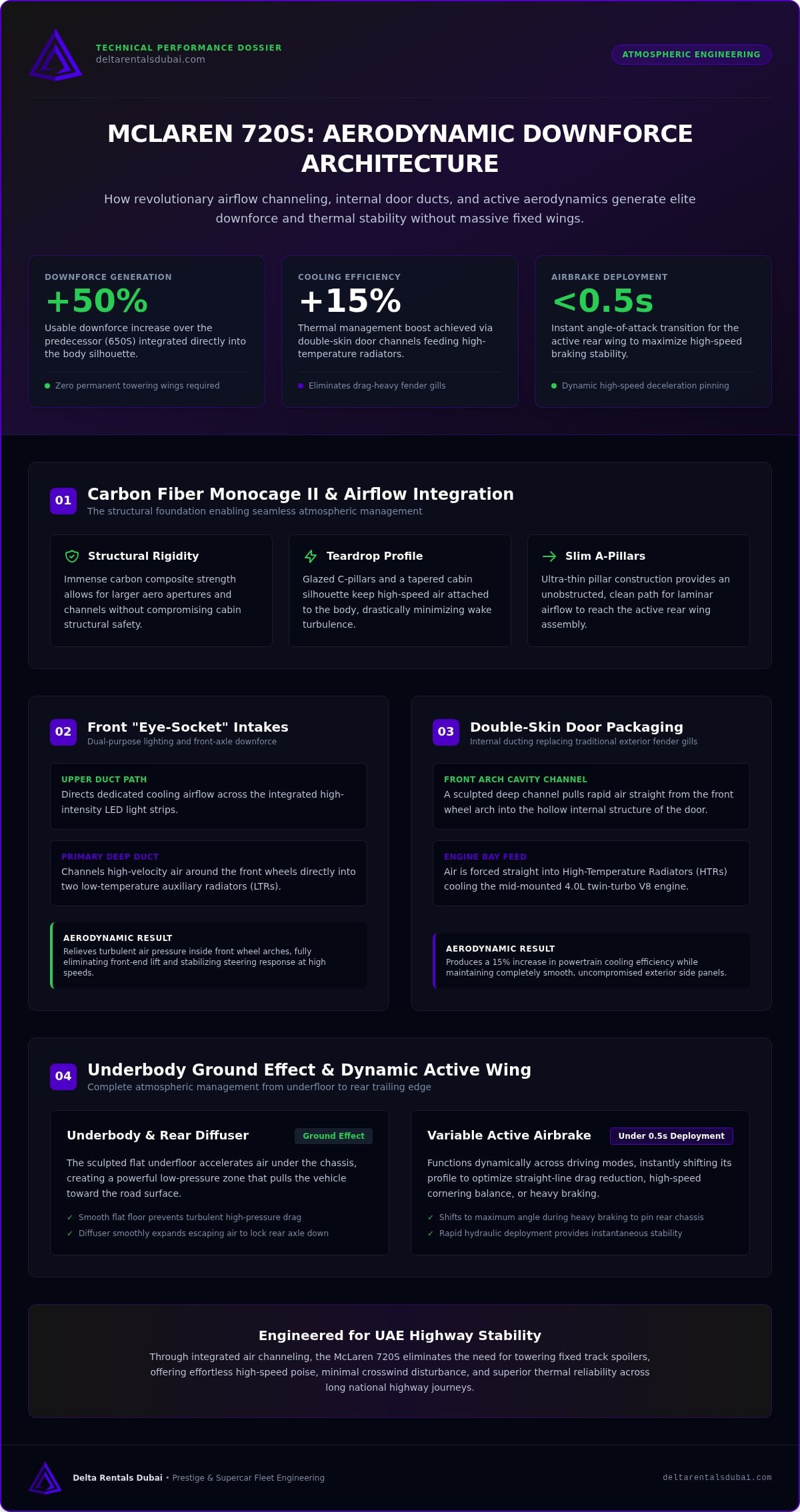
In this article, you’ll discover the secrets behind the McLaren 720S aerodynamic downforce features and how they deliver elite-level stability on national roads. We’re pulling back the curtain on the eye-socket intakes that feed the radiators and the double-skin doors that boost cooling efficiency by 15 percent. You’ll also learn how the active rear wing functions as a powerful airbrake, deploying in less than 0.5 seconds to keep the chassis pinned. By the end, you’ll understand why this isn’t just a supercar; it’s a masterclass in atmospheric management that makes every high-speed journey feel effortless and secure.
Key Takeaways
- Gain a clear understanding of how the carbon fiber Monocage II structure allows for slim pillars that channel air with surgical precision.
- Master the mechanics of the McLaren 720S aerodynamic downforce features, including how eye-socket intakes and double-skin doors optimize cooling without adding drag.
- Learn how the active rear wing functions as a dynamic airbrake, shifting its angle in under 0.5 seconds to provide maximum stability during high-speed deceleration.
- Discover the invisible power of ground effect generated by the flat underbody and rear diffuser to keep the car pinned to the road at any speed.
- See why these track-inspired aerodynamic innovations make the 720S the ultimate choice for safe, high-performance travel across the UAE.
The Philosophy of Air: How the McLaren 720S Redefines Downforce
The McLaren 720S isn’t just a car; it’s a masterclass in how air should behave. While many supercars rely on massive, fixed wings to stay grounded, the 720S takes a more sophisticated route. By integrating McLaren 720S aerodynamic downforce features directly into the body’s silhouette, engineers achieved a 50% increase in downforce compared to the previous 650S. This isn’t just about raw speed. It’s about the confidence that comes from a car that feels surgically attached to the road, even when the winds pick up across the open highways.
We often describe the 720S as “functional jewelry.” Every curve and crease you see serves a specific aerodynamic purpose. The air isn’t simply pushed aside. Instead, it’s invited into the car’s architecture to cool the engine and stabilize the chassis. It’s a premium-yet-practical approach that ensures elite performance doesn’t come at the cost of elegance. At Delta Rentals Dubai, we see this as the pinnacle of technical mastery meeting prestige.
Beyond Aesthetics: The Form Follows Function Mantra
Look at the side of the 720S and you’ll notice something missing. There are no massive radiator intakes on the rear fenders. Most mid-engine cars need these “gills” to breathe, but they create significant drag. McLaren solved this with a revolutionary double-skin door design. Air is channeled through the door itself, keeping the exterior lines incredibly clean. This visual “cleanliness” isn’t just for show. It’s a deliberate strategy to reduce drag while maintaining the high-pressure airflow needed for cooling and stability. It’s much more subtle than the aggressive, aero-heavy look of a dedicated track car, yet it’s just as effective.
The Monocage II and Airflow Integration
The secret to this radical design lies in the chassis. The carbon fiber Monocage II is the structural backbone of McLaren’s aero strategy. Its immense rigidity allows for incredibly slim A-pillars and glazed C-pillars, which do more than just improve your view of the road. They create a teardrop-shaped cabin that allows air to remain “attached” to the body as it flows toward the rear. This reduces turbulence and ensures the McLaren 720S aerodynamic downforce features work in perfect harmony. Consider these benefits of the Monocage II structure:
- Structural strength enables larger apertures for advanced air management without compromising safety.
- The teardrop profile minimizes the wake left behind the car at high speeds, improving overall efficiency.
- Slimmer pillars provide an unobstructed path for air to reach the active rear wing for maximum effect.
This integrated approach turns the entire vehicle into a single, cohesive aerodynamic tool that feels light yet incredibly planted.
Sculpted by the Wind: The Double-Skin Doors and Eye-Socket Intakes
The McLaren 720S is famous for its “eye-socket” headlights. To many, they look like a bold styling choice. Actually, they are a fundamental part of the McLaren 720S aerodynamic downforce features. Each socket is a deeply recessed air intake that serves two critical roles. The upper path cools the LED light strips, while the primary duct channels high-velocity air around the front wheels and into two low-temperature auxiliary radiators. This clever routing reduces air pressure in the wheel arches. It effectively eliminates front-end lift and keeps the nose pinned during high-speed travel.
The Engineering of Eye-Socket Intakes
Traditional headlight clusters create a wall that air must hit and move around. McLaren engineers removed this barrier. By turning the lights into air ducts, they created a path of least resistance. This stabilizes the front axle. It ensures the car responds with surgical precision when you’re navigating the long, sweeping curves of the UAE’s national highways. It’s a premium engineering solution that replaces bulk with efficiency, allowing for a sleeker profile without sacrificing performance.
Double-Skin Doors: A Masterclass in Packaging
Perhaps the most ingenious feature is the “Double-Skin” door architecture. If you look closely at the door profile, you’ll see a deep channel that runs from the front wheel arch toward the rear. Air is sucked into this gap and directed through the door itself. This high-pressure air is then fed directly into the high-temperature radiators (HTRs) that cool the mid-mounted 4.0L twin-turbo V8 engine. By moving these channels inside the bodywork, McLaren achieved a level of aerodynamic purity that few rivals can match.
This design provides several elite performance advantages:
- It achieves a 15% gain in cooling efficiency compared to traditional external setups.
- It eliminates the need for bulky, drag-inducing side radiator scoops common on other mid-engine supercars.
- It maintains a smooth flow of air along the car’s flanks, reducing turbulence that could destabilize the vehicle at high speeds.
This isn’t just about looking fast; it’s about managing heat and air with total authority. The result is a car that remains incredibly stable even in the intense heat of the region. If you’re ready to feel how this technology translates to the road, you can book a McLaren rental with Delta Rentals Dubai and experience this masterclass in packaging for yourself. You’ll quickly see why the absence of side pods makes the 720S one of the most efficient supercars ever built.
Active Dynamics: The Variable Rear Wing and Airbrake System
While the eye-socket intakes and double-skin doors manage air through the body, the rear of the vehicle features a dynamic component that acts as the car’s brain. Active aerodynamics represent the pinnacle of modern supercar engineering. These are components that change their physical shape or angle based on your speed, yaw, and braking force. The full-width active rear wing is the centerpiece of the McLaren 720S aerodynamic downforce features, providing a level of adaptability that fixed wings simply cannot match.
This wing doesn’t just sit there. It’s constantly calculating. By optimizing the vehicle’s center of pressure, it ensures the car remains balanced during high-speed maneuvers. This technical mastery translates into a psychological advantage for the driver. You feel a profound sense of confidence, knowing the car is actively working to keep you stable, whether you’re accelerating on a straight or diving into a corner. It’s a seamless transition into a high-status experience where the car anticipates your next move.
Three Stages of the Variable Rear Wing
The wing operates across three distinct modes, each tailored to a specific driving scenario. It’s an effortless transition that happens behind the scenes, allowing you to focus on the drive. These modes include:
- Driver-Downforce Mode: In this state, the wing tilts to an intermediate angle. It increases grip on the rear axle during cornering, ensuring the car follows your intended line with surgical precision.
- DRS (Drag Reduction System): When you’re chasing maximum straight-line speed, the wing flattens out. This reduces drag and allows the twin-turbo V8 to push the car toward its 341 km/h top speed with minimal atmospheric resistance.
- High-Speed Airbrake: This is the most dramatic deployment. The wing pops up to a near-vertical position, acting as a massive sail to assist the brakes and shift the aerodynamic balance rearward.
The Physics of the Airbrake
Decelerating from high speeds can often cause a car to “nose-dive,” which unweights the rear tires and reduces stability. The 720S solves this with its vertical airbrake. By increasing drag at the rear, the wing pulls the back of the car down, counteracting the forward pitch. This keeps the chassis level and ensures the carbon-ceramic brakes can work with maximum efficiency across all four wheels. It’s a masterclass in stability that makes the McLaren 720S aerodynamic downforce features as much about safety as they are about speed.
The speed of this system is staggering. The 720S airbrake can deploy to a 56-degree angle in 0.5 seconds. This rapid response means that the moment you hit the brake pedal, the car is already transforming to protect your line and your safety. It’s a premium-yet-practical safety feature that makes elite performance accessible on any national road.
The Ground Effect: Underbody Airflow and Rear Diffuser Efficiency
While the eye-socket intakes and active wing command attention, the most potent McLaren 720S aerodynamic downforce features are actually hidden beneath the car. This is the world of ground effect. By creating a vacuum-like seal between the chassis and the asphalt, McLaren engineers turned the entire underbody into a massive suction device. It’s a premium engineering solution that delivers immense stability without the drag penalty of a giant fixed wing. You don’t see it, but you certainly feel it when the car remains perfectly level during high-speed transitions on the E11.
The synergy here is absolute. The front splitter initiates the process by splitting the air, sending a clean, high-velocity stream under the flat floor. This underbody is a single, smooth sheet of carbon fiber designed to accelerate airflow. As the air moves faster, its pressure drops. This creates a low-pressure zone that effectively “sucks” the car toward the road. It’s a frictionless way to achieve elite-level grip, ensuring the 720S feels lighter than its rivals yet more securely planted.
The Venturi Effect and High-Velocity Air
This phenomenon relies on the Venturi effect. By constricting the space between the car and the ground, the air must speed up to pass through. This creates a significant pressure differential between the top of the car and the bottom. To maintain this efficiency, ride height is critical. The 720S features a sophisticated suspension system that keeps the underbody at the optimal distance from the road, preventing air from leaking out the sides and “breaking” the vacuum. It’s a delicate balance that ensures consistent performance across various road surfaces.
Anatomy of the 720S Rear Diffuser
The rear diffuser is the final, critical piece of the aerodynamic puzzle. Its job is to manage the exit of the air that traveled under the car. Large vertical vanes are strategically placed to prevent the air from spinning or becoming turbulent as it leaves. By expanding the air smoothly, the diffuser maintains the low pressure under the car while preventing lift at the rear. Consider these specific functions of the diffuser:
- Vertical Vanes: These prevent “dirty” air from destabilizing the rear axle during high-speed cornering.
- Upward Sweep: This geometry accelerates air exit to maintain the underbody vacuum.
- Thermal Integration: The diffuser works in tandem with the dual-exit exhaust system to draw heat away from the engine bay.
This underbody strategy works in perfect harmony with the active rear wing. While the wing manages the air on top, the diffuser handles the air below. Together, they create a total aero-package that defines the 720S experience. If you want to feel this invisible force for yourself, contact Delta Rentals Dubai today to reserve your McLaren experience. Experience the confidence of a car that is literally pulled to the road by the air it moves through.
Elite Performance in the UAE: Why Aerodynamics Define the Drive
The vast, sun-drenched highways of the UAE demand more than just raw horsepower. They demand stability. The McLaren 720S aerodynamic downforce features we’ve explored are what transform a high-speed journey into a composed, effortless experience. Whether you’re cruising on the E11 or navigating the winding roads of Jebel Hafeet, this car uses the air to its advantage. It doesn’t fight the atmosphere; it masters it with a level of poise that few other vehicles can emulate.
For the enthusiast, this technology translates to “sophisticated speed.” It’s the ability to reach incredible velocities while feeling completely secure. This isn’t just about the numbers on the spec sheet. It’s about the feeling of the steering wheel in your hands and the car’s refusal to wander, even when crosswinds pick up. It’s a masterclass in engineering that makes every drive feel like a high-status event.
McLaren 720S vs. Porsche 911 GT3 RS: Aerodynamic Philosophies
When choosing your elite rental, the choice often comes down to two different schools of thought. The Porsche 911 GT3 RS is a masterpiece of overt aerodynamics. It features massive external wings and aggressive venting that announce its track intentions to everyone. It’s raw, visceral, and unashamedly loud about its performance. In contrast, the 720S hides its most powerful tools within the bodywork. By utilizing integrated channels and active components, it maintains a sleeker, dual-purpose luxury look.
The Porsche relies on physical surface area to create grip. The McLaren uses surgical precision and internal airflow. If your driving style favors a bold, track-focused aesthetic, the Porsche is unmatched. However, if you prefer a car that looks like a piece of modern art while delivering the same level of technical mastery, the 720S is the ultimate choice for a national tour. It’s the difference between a sledgehammer and a scalpel.
Experience Precision with Delta Rentals Dubai
At Delta Rentals Dubai, we understand that a supercar is only as good as its maintenance. Our team ensures that every vehicle in our fleet is kept in peak condition. We preserve the aerodynamic integrity of the 720S so you experience the full benefit of its engineering. We pride ourselves on removing the friction from luxury travel through our no-deposit supercar rental options and free delivery across the UAE.
With over 300 5-star Google reviews, we’ve built a reputation as the most trusted car rental company in the region. We act as your authoritative concierge, offering a seamless transition into a high-status experience. Booking your McLaren 720S is straightforward and transparent. Discover how revolutionary McLaren 720S aerodynamic downforce features redefine what’s possible on the road by securing your rental today. It’s time to stop just reading about the engineering of speed and start living it.
Command the Road with Aerodynamic Mastery
The McLaren 720S is a testament to what happens when engineering removes the barriers between art and physics. You’ve seen how the eye-socket intakes and double-skin doors manage heat and lift with surgical precision. By leveraging the active rear wing and hidden underbody channels, this vehicle delivers a level of stability that makes every high-speed journey feel effortless. These McLaren 720S aerodynamic downforce features aren’t just for the track; they’re designed to give you total authority on the UAE’s national roads.
Experience this technical masterpiece for yourself through a service that values your time and status. Delta Rentals Dubai offers a frictionless transition into the cockpit with our no-deposit luxury car rental options. With 300+ 5-star Google reviews and free national delivery across the UAE, we pride ourselves on being the region’s most trusted partner for elite travel. It’s time to stop observing the engineering of speed and start commanding it.
Rent the McLaren 720S from Delta Rentals Dubai Today and feel the difference that revolutionary aerodynamics make. Your high-status experience is just a message away.
Frequently Asked Questions
How much downforce does the McLaren 720S generate at high speeds?
The McLaren 720S generates 50 percent more usable downforce than its predecessor, the 650S. This massive leap is achieved through a radical rethink of how air moves around and through the vehicle. At its top speed of 341 km/h, the car maintains incredible stability thanks to these aerodynamic gains. It provides a level of grip that makes it one of the most capable supercars on national roads across the UAE today.
What are the eye-socket intakes on the McLaren 720S?
The eye-socket intakes are a dual-purpose aerodynamic feature that replaces traditional headlight housings. Each socket contains LED headlamp strips but primarily acts as a deep duct to channel clean air around the front wheels. This airflow is directed into low-temperature radiators to manage engine heat while simultaneously reducing front-end lift. It’s a key part of the McLaren 720S aerodynamic downforce features that ensure high-speed stability during your drive.
Does the McLaren 720S have a Drag Reduction System (DRS)?
Yes, the 720S features an integrated Drag Reduction System (DRS) as part of its active rear wing technology. When you accelerate at full throttle in a straight line, the wing automatically flattens its angle of attack. This significantly reduces atmospheric drag, allowing the car to reach its maximum velocity with minimal resistance. It’s a sophisticated piece of engineering that balances raw speed with surgical precision for an effortless high-status experience.
How does the McLaren 720S airbrake improve safety?
The active airbrake improves safety by deploying the rear wing to a near-vertical position in less than 0.5 seconds during severe braking. This sudden increase in drag shifts the vehicle’s aerodynamic center of pressure rearward, which counteracts the natural tendency for the nose to dive. By keeping the chassis level, the car maintains maximum contact between the tires and the road. This is one of the essential McLaren 720S aerodynamic downforce features that ensures controlled deceleration.
What is the difference between the aerodynamics of the 720S and the McLaren Artura?
While both cars share McLaren’s “form follows function” philosophy, the 720S focuses on maximizing pure aerodynamic downforce for its Super Series heritage. The McLaren Artura, being a newer hybrid model, emphasizes a blend of cooling efficiency and drag reduction for its electrified powertrain. The 720S features more dramatic body channels and a larger active wing, whereas the Artura utilizes a more streamlined aesthetic to optimize airflow for its specific hybrid requirements.
Why does the McLaren 720S not have side air intakes like other supercars?
The 720S lacks traditional side air intakes because it utilizes revolutionary double-skin door architecture. Instead of using bulky external scoops that create drag, air is channeled through a deep gap within the door itself. This high-pressure air is directed straight into the high-temperature radiators located near the engine. This design allows for a 15 percent gain in cooling efficiency while maintaining a clean, elegant silhouette that reduces overall aerodynamic resistance at high speeds.
Can the active rear wing be controlled manually by the driver?
The active rear wing primarily operates automatically based on speed, yaw, and braking force to ensure optimal performance. However, drivers can influence its behavior through different powertrain and handling modes. By selecting specific settings, you can optimize the wing for maximum downforce during spirited cornering or flatter angles for high-speed cruising. This ensures the car always provides the right balance of grip and speed without requiring constant manual adjustment from the cockpit.
How does the flat underbody contribute to the car’s stability?
The flat underbody is essential for creating “ground effect” downforce. By using a smooth carbon-fiber floor, the car accelerates the air passing beneath it, which creates a zone of low pressure. This low pressure effectively sucks the chassis toward the road surface. When combined with the rear diffuser, this invisible force keeps the car pinned to the asphalt, providing immense stability and confidence during high-speed maneuvers on national highways across the region.