

A luxury yacht charter is a masterpiece of engineering and hospitality, but a single wave of nausea can turn a high-status event into a social disaster. Achieving total seasickness prevention on a yacht isn’t a matter of luck; it’s the result of elite preparation. You’ve invested in the finest vessel and the perfect itinerary, so the anxiety of wasting that premium investment due to physical discomfort is a valid concern. It’s often difficult to distinguish between effective medical remedies and common maritime myths when your reputation as a host is on the line.
We believe your time on the water should be defined by effortless prestige. This guide provides an expert-backed checklist designed to ensure your comfort remains as sophisticated as your surroundings. You’ll gain a clear, proactive plan to stay well, including insights into the latest 2026 pharmaceutical breakthroughs like Tradipitant and advanced neuromodulation wearables. We’ll also explore how selecting specific high-performance hulls can mitigate motion before it starts. Prepare to host with absolute confidence and enjoy a seamless transition into the ultimate offshore lifestyle.
Key Takeaways
- Identify subtle early warning signs like yawning or cold sweats to intercept discomfort before it disrupts your social itinerary.
- Execute a strategic 24-hour preparation plan focused on hydration and dietary choices to ensure a seamless transition to the water.
- Master seasickness prevention on a yacht by utilizing the vessel’s “sweet spot” and maintaining a constant visual reference to the horizon.
- Compare elite pharmaceutical solutions and wearable technology to maintain peak wellness throughout your charter without the burden of drowsiness.
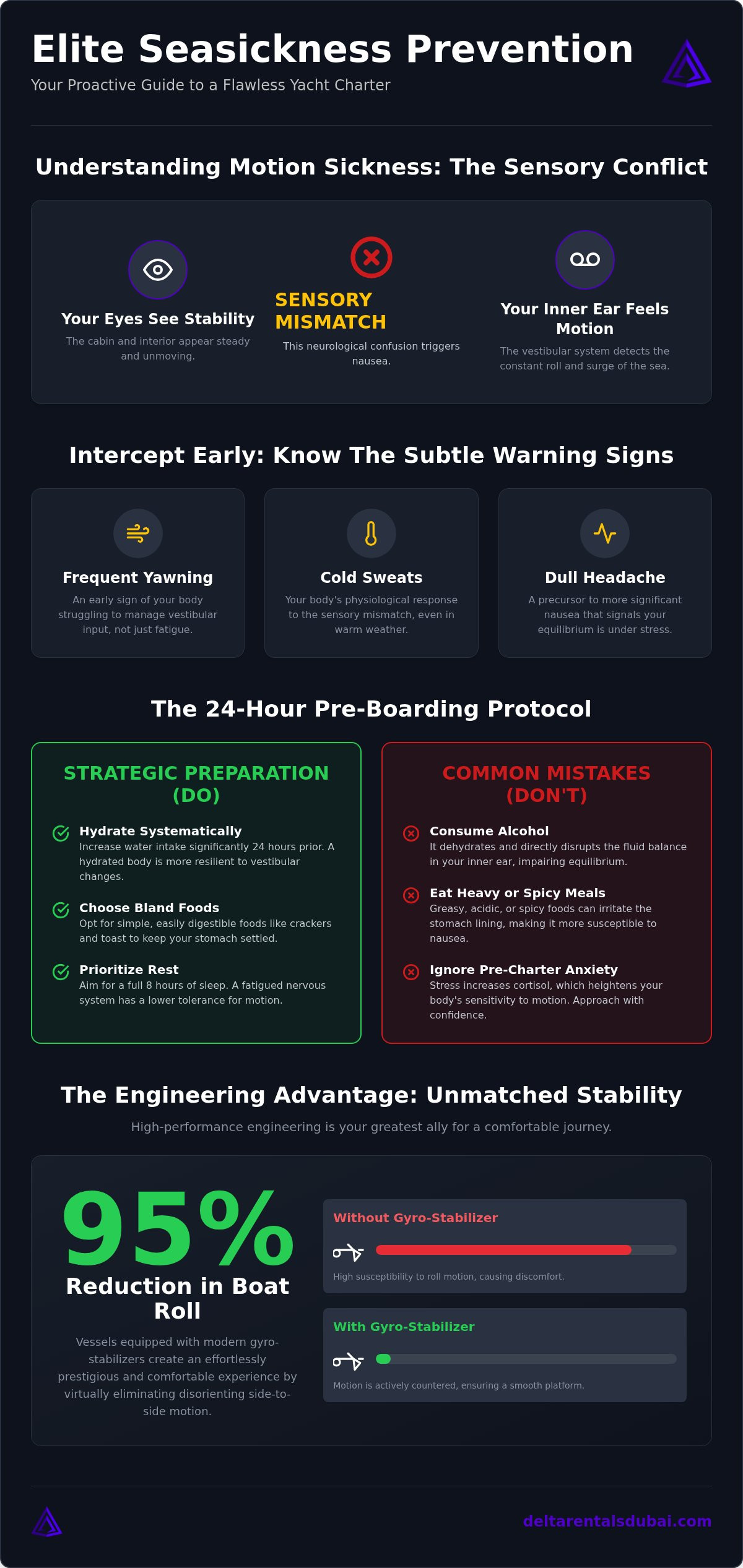
- Evaluate how high-performance engineering like gyro-stabilizers can reduce boat roll by up to 95% for an effortlessly prestigious experience.
The Science of Motion Sickness: Why Even Seasoned Travelers Get Queasy
Motion sickness is the ultimate equalizer on the water. It affects novices and veteran sailors alike because it’s rooted in a fundamental biological error. Effective seasickness prevention on a yacht begins with understanding that your body is simply receiving conflicting data. Your eyes might see the steady interior of a luxury cabin, but your body feels the rhythmic surge of the ocean. This sensory mismatch is the core of The Science of Motion Sickness.
Proactive guests don’t wait for nausea to take hold. Early indicators are often subtle and easily ignored. Watch for frequent yawning, sudden cold sweats, or a dull headache. These are the body’s first signals that the equilibrium is under stress. Catching these early allows for tactical adjustments before the experience is compromised. Many guests mistake these for simple fatigue, but they are the precursors to a more significant vestibular event.
Intimate vessels like luxury yachts offer a more direct connection to the sea, which means they are more susceptible to specific roll motions. Unlike massive cruise ships that use sheer mass to dampen movement, yachts interact directly with the swell. This creates a sharper, more frequent motion that can challenge your balance. High-performance engineering helps, but the physical reality of a smaller hull means the frequency of movement is higher, making seasickness prevention on a yacht a priority for every host.
Psychological factors play a critical role in how your body processes these signals. Approximately 25% to 30% of adults experience motion sickness during common travel, and anticipatory anxiety can actually trigger the condition. When you’re stressed about getting sick, your body releases cortisol, which heightens your sensitivity to motion. A proactive, confident approach is your first line of defense against physical discomfort.
The Role of the Vestibular System
Inner ear mechanics are the primary drivers of your sense of balance. The vestibular system is a complex network of fluid-filled canals that detect every tilt and acceleration. When you’re behind the wheel of a Porsche 911 GT3 RS, your eyes and ears agree on the high-G cornering forces because you can see the road ahead. On a yacht, however, the mismatch theory takes over. Your brain receives signals of movement that your visual field cannot confirm, leading to neurological confusion. This is why looking at a screen or reading while at sea is often the fastest way to trigger nausea.
External Triggers: Heat and Hydration
Local climate conditions often feature high temperatures that accelerate physical stress. Heat exhaustion frequently mimics or intensifies the symptoms of motion sickness. Dehydration is a major culprit; it increases your sensitivity to vestibular changes and slows down your body’s ability to adapt. Gaining your sea legs is a physiological process of habituation, but it requires a well-hydrated system to function efficiently. Prioritize water intake to maintain your internal balance. If your body is fighting the heat, it has fewer resources to manage the motion of the vessel.
Pre-Boarding Checklist: Setting the Stage for a Seamless Voyage
Elite performance requires elite preparation. For effective seasickness prevention on a yacht, your routine should begin exactly 24 hours before you step onto the gangway. This window is critical for stabilizing your internal chemistry. Avoid heavy, acidic, or overly spicy meals that can irritate the stomach lining. Alcohol is particularly disruptive; it affects the inner ear’s fluid balance and impairs the brain’s ability to process motion signals. Skip the pre-charter cocktails to ensure your equilibrium remains sharp.
Hydration is your primary defense. Start increasing your water intake well before you reach the marina. A well-hydrated body is more resilient to the sensory conflicts discussed in the previous section. Sleep is equally vital. A sleep-deprived guest is significantly more susceptible to nausea because the nervous system is already under strain. The science of seasickness suggests that physical fatigue lowers your threshold for motion tolerance. Aim for a full eight hours of rest to prime your body for the offshore environment.
Dietary Do’s and Don’ts
Focus on stability. Stick to bland foods like crackers, plain bread, or ginger-based snacks, which are natural stomach settlers. Limit caffeine and nicotine in the hours leading up to departure. These stimulants heighten sensory awareness and can make you more reactive to the vessel’s movement. Never board on a completely empty stomach. A light, protein-rich breakfast provides the necessary energy without creating the “sloshing” sensation that triggers discomfort.
Setting the Right Mindset
Your mental state dictates your physical response. Practice controlled, rhythmic breathing to calm the autonomic nervous system. Focus on the prestige and luxury of the charter rather than the fear of the waves. Confidence is a powerful tool for wellness. To ensure the transition from your residence to the marina is equally effortless, consult with your luxury chauffeur for a smooth, steady ride. Eliminating the stress of navigation keeps your heart rate low and your mind focused on the upcoming voyage.
Temperature regulation is often overlooked. Wear light, breathable fabrics like linen or high-performance cotton to manage your core body temperature. Overheating is a fast track to nausea and can undermine your efforts at seasickness prevention on a yacht. If you’re planning a full day of prestige, speak with our team to coordinate your arrival in style and comfort.
On-Deck Tactics: Managing Your Environment During the Charter
Once the engines roar and the vessel leaves the berth, your tactical positioning becomes the priority. Effective seasickness prevention on a yacht is about choosing where you stand with the same precision you’d use to choose a racing line. Head for the center of the vessel immediately. The “sweet spot” is located mid-ship, as close to the waterline as possible. This is the point of least rotation. While the bow and stern experience the most dramatic vertical movement, the center remains relatively stable, acting as a pivot point for the entire hull.
Fix your gaze on the horizon. It’s the only truly stable line in your field of vision. By using the horizon as a visual reference point, your brain can synchronize the movement felt by your inner ear with the data from your eyes. This alignment is crucial for maintaining your comfort during a high-status charter. Stay on deck as much as possible. Enclosed cabins, no matter how luxurious, often amplify the sensory conflict. The rush of fresh air helps regulate your body temperature and reduces the claustrophobic triggers that lead to nausea. While you might explore various medication options for motion sickness, on-deck environmental management provides immediate, drug-free relief.
Engage with the voyage to stay ahead of the motion. Taking the helm or focusing on a distant landmark forces your brain to anticipate the boat’s next move. It transforms you from a passive passenger into an active participant. This mental shift significantly reduces your susceptibility to the sea’s rhythm, making seasickness prevention on a yacht a proactive exercise in control rather than a reactive struggle.
Visual Fixation and Activities
Put the phone away. Reading or scrolling through screens while in motion is a guaranteed trigger. Your eyes focus on a static object while your body feels the swell, creating instant neurological friction. Look forward in the direction of travel. Anticipating the waves allows your vestibular system to prepare for the impact. Social interaction is also a powerful psychological distraction. Engaging in conversation keeps your mind from fixating on internal sensations, ensuring your prestigious experience remains uninterrupted.
Cabin Conduct
If you must go below, do it strategically. Lie down in the center of the boat and close your eyes. This removes the visual component of the sensory conflict entirely. Ensure the cabin ventilation is at maximum. Stuffy air or strong odors, such as diesel fumes or heavy perfumes, are aggressive triggers that can quickly override your preparation. A well-ventilated, neutral environment is essential for maintaining your wellness below deck. Move quickly and with purpose when transitioning between levels to minimize the time spent in enclosed spaces.
Pharmaceutical vs. Natural Remedies: What Actually Works?
Mastering seasickness prevention on a yacht requires a sophisticated approach to internal wellness. While on-deck tactics provide immediate relief, pharmaceutical interventions offer a more robust shield for long-duration charters. Scopolamine patches remain the gold standard for elite travelers. These 72-hour patches deliver a consistent dose of medication through the skin, suppressing the vestibular system’s overactive signals. For those seeking the absolute latest in maritime medical technology, the newly FDA-approved Tradipitant, marketed under the brand name Nereus since early 2026, provides a powerful neurokinin-1 receptor antagonist option that avoids many traditional side effects.
Over-the-counter choices like Dramamine (Dimenhydrinate) and Bonine (Meclizine) are effective but come with a performance trade-off. Dramamine is highly potent but frequently induces drowsiness, which can dampen your engagement with the experience. Meclizine is often the preferred choice for daytime charters as it offers similar protection with significantly less sedative impact. If you prefer a drug-free route, the Reliefband is an FDA-cleared wearable device that uses neuromodulation to alleviate nausea. Models like the Reliefband Premier offer a high-tech, adjustable solution that integrates seamlessly into a luxury lifestyle.
Timing Your Medication
The most common failure in seasickness prevention on a yacht is poor timing. Most oral medications require 1 to 2 hours to metabolize and reach peak efficacy. If you wait until you feel queasy to take a pill, the digestive system has already slowed down, rendering the treatment far less effective. The “Patch” protocol is even more demanding; apply your Scopolamine patch at least 4 hours before boarding to ensure full absorption. Always consult with a medical professional to tailor these options to your personal health profile before departure.
Natural Alternatives for the Health-Conscious
Nature provides several high-performance anti-emetics that hold scientific weight. Ginger root is perhaps the most reliable, with numerous studies confirming its ability to settle the stomach without any neurological side effects. Many seasoned sailors also utilize the “P6 point” theory through acupressure bands, which stimulate a specific nerve on the inner wrist to disrupt nausea signals. For immediate sensory soothing, peppermint oil aromatherapy or consuming green apples can provide a refreshing distraction for the senses. These natural methods are excellent supplements to your primary prevention strategy. To ensure your entire journey is managed with this level of detail, contact our concierge team to coordinate your elite travel arrangements.
Choosing the Right Vessel: How Engineering Minimizes Motion
Booking Your Elite Experience
When arranging your charter, be direct with your agent about the vessel’s stability features. Ask specifically if the yacht is equipped with “zero-speed” or “at-rest” stabilizers. This ensures comfort during the most critical parts of your journey, such as lunch breaks in a quiet cove. It’s also vital to match your itinerary to the predicted sea conditions. A professional concierge will suggest routes that utilize the natural protection of the coastline to further minimize motion. To secure your seamless luxury experience, choose a partner like Delta Rentals Dubai that understands the intersection of high-performance engineering and elite hospitality. We handle the technical details so you can focus on the prestige of the voyage.
Secure Your Ultimate Offshore Prestige
Mastering comfort at sea is the final step in curating a world-class lifestyle. By combining a 24-hour dietary protocol with advanced engineering like gyro-stabilizers, you ensure every guest remains focused on the celebration. Your strategy for seasickness prevention on a yacht should be as precise as your choice of a high-performance engine. Utilize the mid-ship sweet spot and time any medical interventions like Tradipitant or Scopolamine at least four hours before the gangway is raised to ensure total efficacy.
Delta Rentals Dubai acts as your high-status partner for elite travel across the UAE. We maintain a 5-star Google reviewed standard, offering a fleet of world-class supercars and yachts that prioritize guest wellness. We remove the traditional friction so you can enjoy the abundance of the open water with absolute confidence. Our national coverage ensures that your transition from land to sea is handled with expert-level efficiency and prestige.
Plan your elite yacht and supercar experience with Delta Rentals Dubai today. The sea is waiting, and with the right preparation, it serves only your pleasure.
Frequently Asked Questions
What is the best thing to eat before going on a yacht?
Stick to high-protein, low-fat options like oatmeal, bananas, or eggs. Avoid citrus and heavy oils which irritate the stomach lining. A light meal provides the energy your body needs to maintain equilibrium without creating a heavy, “sloshing” sensation. Effective seasickness prevention on a yacht starts with a settled digestive system. Ensure you finish your meal at least 45 minutes before departure to allow for initial digestion before the vessel encounters any significant swell.
Can I take seasickness medication if I plan on drinking alcohol?
Mixing motion sickness medication with alcohol is generally discouraged. Most antihistamine-based remedies like Dramamine cause drowsiness, and alcohol significantly intensifies this sedative effect. Alcohol also thins the fluid in your inner ear; this disrupts your natural balance and makes you more susceptible to nausea. For a prestigious and safe experience, prioritize hydration with water or electrolyte-infused beverages until your body has fully habituated to the maritime environment and the medication has cleared.
Do wristbands actually work for motion sickness on a boat?
Acupressure wristbands are a reliable drug-free option for many guests. These bands target the P6 pressure point on the inner wrist, which is believed to disrupt the nausea signals traveling to the brain. While results vary, high-tech neuromodulation devices like the Reliefband offer more consistent relief than simple elastic bands. They are particularly useful for guests who want to avoid the side effects of pharmaceuticals while maintaining their offshore comfort and social engagement.
Where is the best place to sit on a yacht to avoid getting sick?
Position yourself mid-ship on the lower deck to experience the least amount of pitch and roll. This area acts as the vessel’s center of gravity and offers the most stable platform. Always face forward in the direction of travel to help your visual system anticipate the boat’s movement. Avoid the bow, where vertical motion is most extreme, and stay out of enclosed cabins where the lack of a visual horizon can trigger sensory conflict.
How long does it take to get your ‘sea legs’?
Most travelers achieve habituation, commonly known as getting your “sea legs,” within 24 to 48 hours of continuous exposure. During this window, the brain begins to ignore the conflicting signals from the inner ear and eyes. If you are on a day charter, you likely won’t fully habituate, which is why proactive seasickness prevention on a yacht is so critical. Consistent exposure over several days typically eliminates symptoms for the remainder of the voyage.
What should I do if I start feeling sick while we are at sea?
Act immediately if you feel a cold sweat or headache. Move to the center of the yacht, look at the stable horizon, and breathe deeply through your mouth. Do not retreat to a cabin or use a phone, as this will worsen the sensory mismatch. If you must lie down, close your eyes to remove the visual confusion entirely. Sip cold water and apply a cool compress to your neck to help regulate your core temperature.
Are catamarans better than monohulls for preventing seasickness?
Catamarans offer superior stability at anchor and reduced rolling due to their wide twin-hull footprint. This makes them excellent for social events and dining. However, they can have a quicker, more jerky motion in certain sea states compared to the rhythmic roll of a monohull. Monohulls equipped with modern gyro-stabilizers often provide the smoothest experience for those sensitive to motion. Your choice should depend on whether you prioritize stability at rest or during transit.
Does the heat in the UAE make seasickness worse?
High temperatures in the national climate can significantly exacerbate the symptoms of motion sickness. Heat stress causes the heart to work harder and leads to rapid dehydration, both of which lower your physiological threshold for nausea. Staying in shaded, well-ventilated areas of the deck is essential. Combine your hydration strategy with the use of the vessel’s climate-controlled zones during the peak heat of the day to maintain your physical resilience and prestige.