

Most supercars claim racing heritage, but a McLaren is quite literally a Formula 1 car that simply decided to leave the track. You’ve likely heard the marketing buzzwords like “track-inspired” or seen technical acronyms like KERS and DRS that feel more like alphabet soup than actual performance upgrades. It’s natural to be skeptical when every high-end brand promises a podium-worthy experience from a street-legal seat.
This guide cuts through the noise to show you how McLaren’s formula 1 technology in road cars isn’t just a clever sales pitch. It’s the physical architecture and software logic found in machines like the hybrid Artura and the 1,258-horsepower W1 hypercar. We’ll explore the carbon fiber Aerocell structures, hybrid battery systems, and active “Long Tail” aerodynamics that turn every UAE journey into a high-status experience. Get ready to understand why choosing a McLaren means driving the most advanced engineering currently available on the road today.
Key Takeaways
- Learn how the carbon fiber monocoque technology that revolutionized F1 safety now provides the structural rigidity necessary for razor-sharp handling on the road.
- Discover the secrets of active aerodynamics and how moving wings create the “invisible force” that keeps McLaren supercars stable at extreme speeds.
- Understand how McLaren’s formula 1 technology in road cars utilizes electric motors to provide instant torque, effectively eliminating turbo lag in the Artura.
- Find out why McLaren’s commitment to electro-hydraulic steering ensures you maintain a precise, physical connection to the road that fully electric systems can’t match.
- Explore how you can experience this elite racing DNA firsthand through the premium rental fleet available across the UAE.
The Carbon Fiber Revolution: F1’s Safety and Rigidity on the Road
In 1981, the Formula 1 world was skeptical. McLaren introduced the MP4/1, the first racing car to feature a carbon fiber monocoque. Many experts predicted the material would shatter during a high-speed impact. Instead, it proved to be safer and more rigid than anything that came before it. This pivotal moment in McLaren Automotive history set the stage for every supercar the brand produces today.
Structural rigidity is the secret to elite handling. When a chassis is stiff, it doesn’t flex during aggressive cornering. This allows the suspension to manage the road with surgical precision. It’s the most tangible benefit of McLaren’s formula 1 technology in road cars. By eliminating unwanted movement in the frame, engineers can tune the steering to be razor-sharp. You feel every nuance of the tarmac through your fingertips, a sensation usually reserved for professional drivers on a starting grid.
The Monocage II and III Architecture
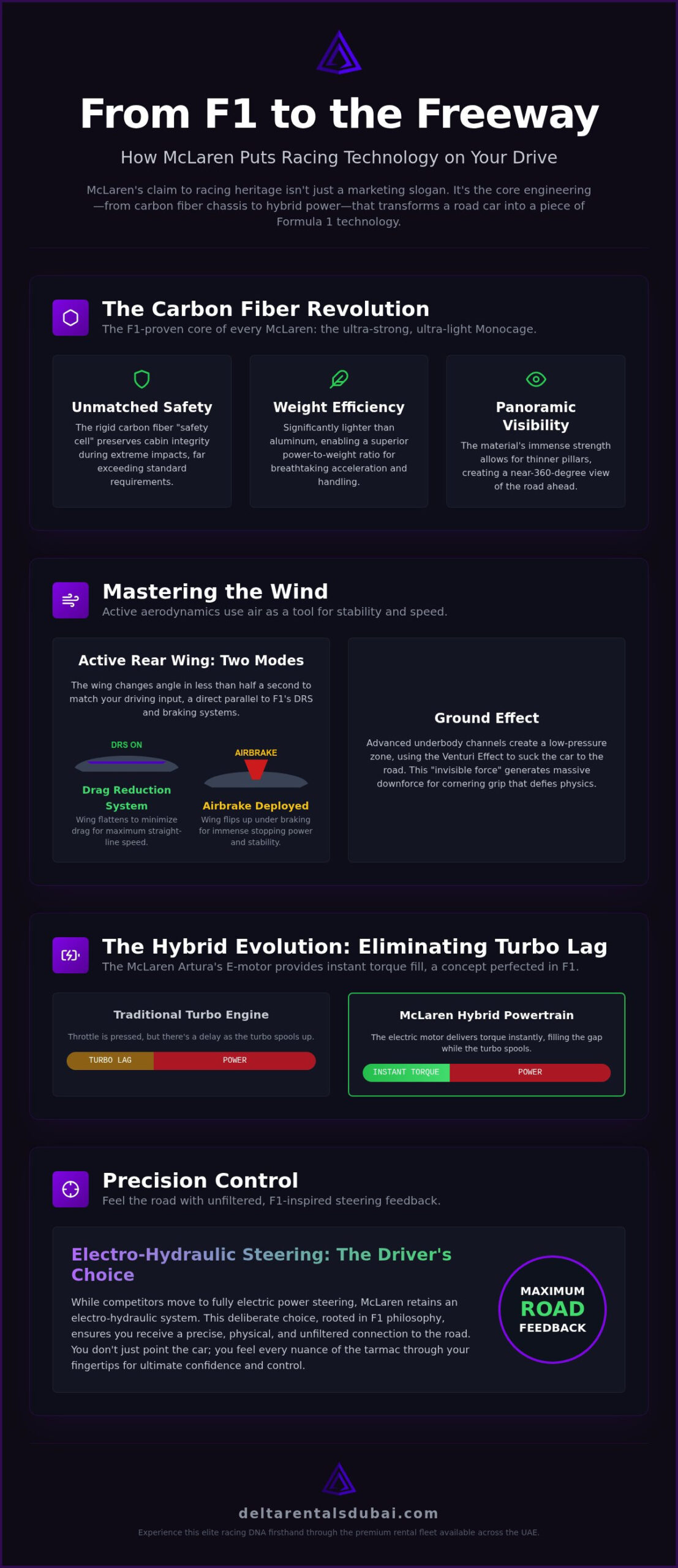
The structural evolution from racing monocoques to road-legal “Monocages” represents a massive leap in engineering. In models like the 720S, the Monocage II creates a continuous carbon fiber ‘spine’ that includes the roof structure. This design offers several key advantages:
- Unmatched Safety: F1-grade carbon fiber is designed to preserve the cabin’s integrity during extreme forces, offering a level of occupant protection that exceeds standard industry requirements.
- Weight Efficiency: A McLaren carbon fiber chassis is significantly lighter than a traditional aluminum frame. This weight advantage allows for larger, more powerful engines without compromising the car’s power-to-weight ratio.
- Visibility: Because the material is so strong, the pillars can be made thinner, providing the driver with a panoramic view of the road.
Material Science: Beyond Just Carbon
While carbon fiber is the star, the supporting cast of materials is equally impressive. McLaren utilizes superformed aluminum and high-grade alloys for the front and rear subframes. These components are designed to house the engine and suspension while acting as crumple zones. The Monocage acts as the ultimate bridge between racing safety and road car agility. Integrating McLaren’s formula 1 technology in road cars ensures that the structural rigidity directly impacts steering feedback. It creates a communicative driving experience that makes a McLaren rental feel like a precision instrument rather than a standard luxury vehicle.
Mastering the Wind: Active Aerodynamics and Ground Effect
Air is often seen as an obstacle to speed, but for a McLaren, it is a powerful tool for stability. This is the invisible force that “sticks” the car to the road. It isn’t just about a large wing on the back. It’s about how every square inch of the bodywork interacts with the atmosphere. This mastery of airflow is a direct result of McLaren’s formula 1 technology in road cars. It transforms the vehicle from a simple machine into a high-performance sculpture that thrives at high velocities.
Heat management is another area where racing heritage shines. F1 cars require immense cooling for their compact engines, a challenge shared by modern supercars. The Artura, for instance, features intricate cooling ducts that double as aerodynamic aids. These channels guide air into the hybrid-electric V6 powertrain to maintain optimal temperatures during spirited drives. These “eye sockets” and door channels ensure that performance remains consistent, even under the intense sun of the UAE.
The Airbrake and DRS Functionality
The active rear wing on models like the 720S and Artura is a piece of kinetic art. It doesn’t just sit there. It thinks. When you accelerate on a straight, the wing flattens to reduce drag, mirroring the Drag Reduction System (DRS) used by Grand Prix drivers. This increases straight-line speed by letting the car slip through the air with minimal resistance. When you hit the brakes, the wing flips up to a 90-degree angle in less than half a second. It acts as a parachute, providing massive rear stability and helping you stop with total confidence. The car’s computer processes sensor data faster than any human can, adjusting the wing’s angle to match your steering and braking inputs perfectly.
Ground Effect and Underbody Flow
While the top of the car manages the wind, the floor handles the vacuum. McLaren uses “Ground Effect” technology to create a low-pressure area beneath the chassis. This Venturi Effect literally sucks the car toward the tarmac without the need for heavy, drag-inducing wings. The 720S generates its massive downforce through underbody channels that guide air with surgical precision toward the rear diffuser. This diffuser manages turbulent air as it exits the back, ensuring a smooth wake and incredible high-speed travel. It’s a seamless transition from racing theory to road-legal reality. If you want to feel this invisible grip for yourself, you can speak with our team about a McLaren rental today.
The Hybrid Evolution: Artura and the E-Motor Revolution
McLaren didn’t adopt hybrid power to be “green” in the traditional sense; they did it because their Formula 1 team proved that electricity makes cars faster. In Grand Prix racing, the Energy Recovery System (ERS) is the difference between a podium finish and the back of the pack. The McLaren Artura is the direct beneficiary of this pursuit of speed. It represents a fundamental shift in how McLaren’s formula 1 technology in road cars is utilized, moving from structural elements to active, electrified power units.
One of the most impressive features is “torque infill.” Traditional turbocharged engines often suffer from a brief delay called turbo lag. It’s that moment you floor the pedal and wait for the exhaust gases to spin the turbines. In an Artura, the electric motor provides instant shove the millisecond you touch the throttle. It fills the gap while the turbos spool up, providing a seamless, linear surge of power that feels like a massive, naturally aspirated engine. This is exactly how a modern F1 car manages its power delivery.
The Axial Flux Motor Advantage
The heart of this system is the axial flux motor. Most electric vehicles use radial flux motors, which are often heavy and bulky. McLaren chose an axial flux design because it’s exceptionally light and compact. It weighs just 15.4kg but delivers 95PS. This is the same high power-to-weight logic found in F1’s KERS (Kinetic Energy Recovery System). This motor isn’t just about speed; it also offers a practical side for UAE drivers. You can switch into E-mode for 11 miles of silent, electric-only driving. It’s perfect for navigating quiet residential neighborhoods or urban centers before heading to the open highway to unleash the full 691 horsepower.
Efficiency Meets Extreme Power
There’s a common misconception that fewer cylinders mean less performance. The Artura’s hybrid V6 setup proves otherwise, outperforming many traditional V8s while remaining more efficient. This downsizing is a direct reflection of modern F1 regulations where efficiency is king. The system is designed to be “premium-yet-practical,” managing every watt of energy to ensure peak performance is always available.
- Energy Recovery: Regenerative braking charges the battery, ensuring you always have a “boost” ready for the next straight.
- Instant Response: The e-motor ensures there’s no hesitation in power delivery, regardless of engine RPM.
- Thermal Management: Specialized cooling systems keep the high-performance battery stable, even in the peak heat of the UAE summer.
This electrified setup ensures that McLaren’s formula 1 technology in road cars provides both world-class performance and daily usability. It makes the transition into a high-status driving experience feel effortless and technologically superior.
Precision Control: Proactive Chassis and F1 Steering Systems
Precision is not just about speed; it’s about communication. While many manufacturers move toward fully digital systems that feel like a video game, McLaren doubles down on physical feedback. This commitment ensures that every driver feels exactly what the tires are doing. It’s a philosophy born on the track and perfected for the street. By integrating McLaren’s formula 1 technology in road cars, the brand creates a high-status driving experience that prioritizes the human at the wheel. Control is absolute, and the connection is visceral.
The Hydraulic Suspension Secret
Most supercars rely on heavy metal anti-roll bars to stay level in corners. McLaren does things differently. Proactive Chassis Control III, found in the 2026 750S, replaces these traditional bars with an interconnected network of hydraulic dampers. This system links all four wheels through a complex fluid logic. When you enter a sharp turn, the car stays perfectly flat by increasing pressure on the outside wheels. On the highway, the system relaxes, allowing each wheel to move independently for a ride that is surprisingly supple. You can switch from “Comfort” to “Track” mode in milliseconds. This adaptability mimics the complex suspension geometry used by F1 teams to balance high-speed stability with mechanical grip. It’s a premium-yet-practical solution that removes the traditional compromise between performance and comfort.
Braking and Steering Feedback
Stopping power is just as critical as acceleration. McLaren uses carbon ceramic brakes as standard across its high-performance fleet to prevent brake fade during spirited national drives. These F1-grade materials can handle immense heat, ensuring consistent pedal feel even after repeated heavy use. This reliability is paired with electro-hydraulic steering. While competitors have switched to fully electric steering for ease, McLaren refuses. They use a hydraulic pump to maintain a pure, weighted feel that communicates every nuance of the tarmac. The steering wheel is a direct link to the car’s front tires, providing the physical feedback that enthusiasts crave. Even the Human-Machine Interface (HMI) is simplified; you won’t find distracting buttons on the steering wheel, just a clean design inspired by racing cockpits. If you’re ready to experience this level of mechanical purity, contact us to book your McLaren experience today. You can explore the full Delta Rentals fleet to find the perfect match for your next UAE journey.
Driving the Legend: Experience F1 Pedigree with Delta Rentals
Engineering theory finally meets the tarmac. You’ve seen how carbon fiber spines and hybrid motors redefine performance. Now, it’s time to take the wheel. Delta Rentals Dubai bridges the gap between technical specs and the open road. We offer direct access to the most advanced McLaren’s formula 1 technology in road cars available today. Whether you’re traversing the long highways of the UAE or seeking a weekend of precision driving, our fleet is ready to deliver a high-status experience.
Choosing Your Racing Machine
The Artura is the premier choice for tech-forward drivers. It’s the perfect introduction to F1-derived hybrid power, offering silent urban cruising paired with that instant, electrified torque. If you demand raw speed and aerodynamic mastery, the McLaren 720S remains the benchmark. It utilizes the active airbrakes and ground-effect floors discussed earlier to keep you pinned to the road with total confidence. Delta Rentals Dubai ensures every vehicle in our fleet undergoes rigorous maintenance to meet factory-performance standards. For owners of such complex high-end vehicles, specialized technical support from experts like Gargash Auto is essential to preserving this level of engineering. You aren’t just renting a car; you’re stepping into a precision-tuned racing machine. Explore the McLaren Artura rental options to see which model fits your driving style.
While the Porsche 911 GT3 RS is a legendary mechanical masterpiece of raw feedback, the McLaren lineup offers a different kind of sophistication. The Porsche is a track-bred benchmark for analog purity. In contrast, a McLaren feels like a glimpse into the next decade. It uses software logic and hydraulic systems to create a more adaptable, futuristic drive that feels at home on both the track and the street.
We understand that time and trust are your most valuable commodities. That’s why we’ve removed the traditional friction of the rental industry. Delta Rentals Dubai is the most transparent car rental company in the UAE, offering a no-deposit policy for high-performance supercars. This allows you to transition into a high-status experience without unnecessary barriers or hidden costs. We provide national delivery across the UAE, bringing your F1-inspired machine directly to your door. Our 300+ 5-star Google reviews reflect our commitment to being an honest, reliable partner for your luxury lifestyle. Discover the full Delta Rentals Dubai fleet and choose the pinnacle of engineering for your next journey.
Claim Your Seat in the Cockpit of Innovation
McLaren has successfully bridged the gap between the Grand Prix podium and your garage. We’ve explored how structural integrity, ground-effect aerodynamics, and high-performance hybrid motors redefine what is possible on the street. The integration of McLaren’s formula 1 technology in road cars ensures that every journey is an exercise in engineering perfection, offering stability and response times that traditional supercars simply can’t match. You aren’t just driving a luxury vehicle; you’re operating a piece of kinetic art that thinks as fast as you do.
Delta Rentals Dubai makes this elite experience accessible across the UAE. We prioritize your time and status with a transparent process backed by over 300 5-star Google reviews. With our no-deposit policy and national delivery service, the transition from spectator to driver is effortless. You don’t have to wait for a race weekend to feel the rush of world-class engineering. Your next high-status adventure is waiting for you right now.
Experience F1 Technology Firsthand – Rent a McLaren with Delta Rentals Dubai
Frequently Asked Questions
What F1 technology is used in the McLaren Artura?
The Artura integrates advanced axial flux motors and energy-dense battery packs derived from Grand Prix racing. These systems provide torque infill to eliminate turbo lag, offering immediate power delivery the moment you touch the throttle. It also features a carbon fiber chassis, a hallmark of McLaren’s formula 1 technology in road cars, ensuring maximum rigidity and safety. This combination of structural strength and electrified power makes it a pioneer in the hybrid supercar segment.
Does the McLaren 720S have a real Formula 1 engine?
No, the 720S uses a 4.0-liter twin-turbo V8 designed for road reliability and performance. While not an F1 engine, it employs racing logic like dry-sump lubrication and lightweight internal components to lower the center of gravity. This design philosophy is central to how McLaren’s formula 1 technology in road cars is applied, ensuring the vehicle remains balanced and responsive during aggressive national drives across the UAE without the extreme maintenance of a race unit.
Is the carbon fiber chassis in a road McLaren the same as an F1 car?
The road-legal Monocage is a direct evolution of the F1 monocoque, using similar high-grade carbon fiber for structural integrity. While F1 tubs are built for single-seat racing, the Monocage is optimized for two occupants and road visibility without sacrificing stiffness. This ensures the car remains a rigid platform for the suspension to operate with surgical precision, providing the driver with a safe and communicative environment that protects passengers even in high-impact scenarios.
How does McLaren’s active aerodynamics work compared to F1?
McLaren road cars feature active systems that automatically adjust to driving conditions. The rear wing can flatten to reduce drag, functioning much like an F1 Drag Reduction System (DRS) for high-speed straights. Under heavy braking, it pivots to act as an airbrake, significantly increasing downforce and stability. These aerodynamic aids work in harmony with the car’s underbody channels to manage airflow more effectively than many dedicated track cars, keeping the vehicle “stuck” to the tarmac.
What is the benefit of the E-motor in a McLaren road car?
The axial flux E-motor provides instant torque, effectively bridging the gap while turbochargers spool up to their optimal speed. This ensures a linear and powerful acceleration curve similar to a modern racing unit. Beyond performance, it offers a silent, electric-only mode for short distances. This makes it a practical choice for navigating quiet residential areas before engaging the full combustion power on the open highway, providing a premium-yet-practical balance for elite drivers.
Can I rent a McLaren with F1 technology in the UAE?
Yes, Delta Rentals Dubai offers a premium fleet including the hybrid Artura and the 720S for national hire. You can experience the pinnacle of McLaren’s formula 1 technology in road cars with a transparent, no-deposit rental process. We provide national delivery across the UAE and are backed by over 300 5-star Google reviews. This ensures a high-status experience that is both reliable and exceptionally straightforward for every client seeking an insider access to luxury performance.
How does McLaren’s suspension differ from other supercars?
Most supercars use traditional anti-roll bars, but McLaren utilizes Proactive Chassis Control. This hydraulic system links all four dampers, allowing the car to resist body roll in corners while remaining supple on the highway. By replacing physical bars with fluid logic, the car adapts to road surfaces in milliseconds. It provides a level of comfort and mechanical grip that is usually impossible to achieve in a high-performance machine, making it a superior choice for varied national road conditions.
Are McLaren road cars reliable for long-distance driving in the UAE?
Modern McLarens are engineered to withstand extreme climates and long-distance travel. Advanced thermal management systems keep the high-performance engines and hybrid batteries stable, even in the peak heat of the UAE summer. With multiple comfort settings, the steering and suspension can be adjusted for a relaxed highway cruise. Every vehicle is maintained to strict factory standards by Delta Rentals Dubai, ensuring it remains a dependable partner for any national journey you undertake.