
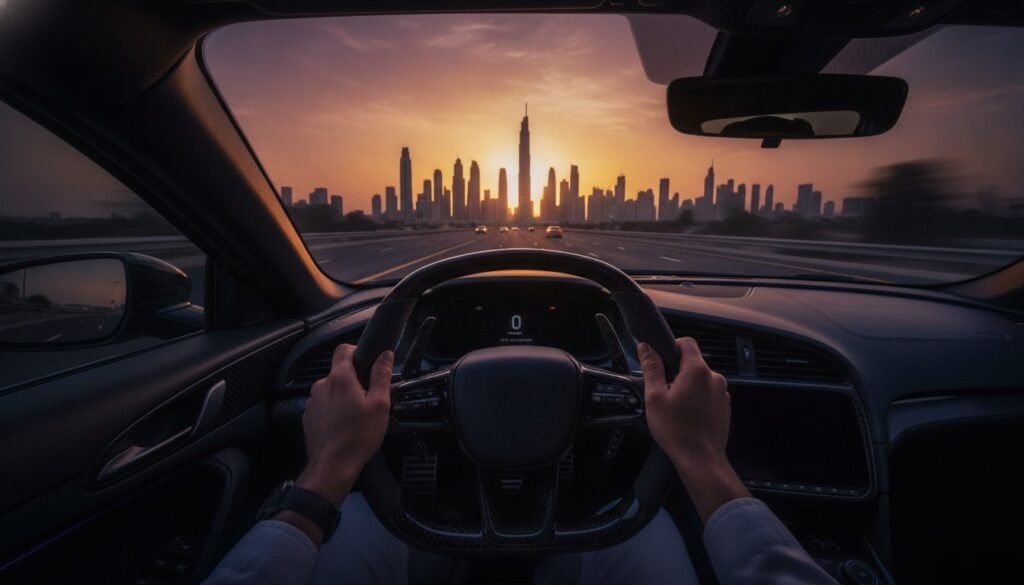
What if those sleek levers behind your steering wheel are the only thing standing between you and the raw, visceral soul of a Porsche 911 GT3 RS? Many drivers leave their supercar in “Drive” because they worry about the mechanical complexity of manual shifting. It’s natural to feel a flash of anxiety about damaging a high-performance transmission or looking inexperienced behind the wheel of a Ferrari. You want the speed and the iconic engine note, but you don’t want the stress of a costly mistake.
We understand that hesitation, and we’re here to replace it with expertise. This guide provides paddle shifters explained for beginners to help you master the tactical interface of your vehicle with total confidence. You’ll learn how to bridge the gap between driver intent and supercar physics without the friction of traditional gearboxes. We’ll cover the mechanics of the upshift, the art of the perfect downshift, and the precise moments to take control for maximum performance. By the end of this guide, you’ll be ready to command any elite fleet across the UAE with the precision of a seasoned professional.
Key Takeaways
- Demystify the racing heritage behind the steering wheel and learn why these levers are the key to unlocking true supercar performance.
- Get paddle shifters explained for beginners so you can navigate dual-clutch systems with the same precision as a professional driver.
- Master the timing of upshifts and downshifts to achieve the perfect engine roar while protecting the vehicle’s high-end transmission.
- Transition seamlessly from “Drive” to “Manual” mode with a step-by-step process designed to remove technical anxiety and gear-change confusion.
- Identify why world-class vehicles like the Porsche 911 GT3 RS provide the ultimate platform for sharpening your shifting skills with zero deposit.
What Are Paddle Shifters and Why Do Performance Cars Use Them?
At their core, paddle shifters are ergonomic levers mounted behind the steering wheel that allow you to manually select gears within an automatic gearbox. It’s the perfect middle ground for those seeking paddle shifters explained for beginners, providing the engagement of a manual without the heavy clutch pedal. This technology didn’t start in luxury SUVs. It evolved on the Formula 1 circuit, where every millisecond counts. By utilizing a semi-automatic transmission, racers could shift without taking their hands off the wheel.
Performance cars use this system because it maximizes control. In a high-speed environment, taking a hand off the wheel to reach for a traditional gear stick creates a moment of vulnerability. Paddles eliminate that risk. They also offer superior ergonomics. While economy cars might use plastic tabs, elite supercars like the Porsche 911 GT3 RS feature paddles made of magnesium or carbon fiber. These materials provide a crisp, tactile “click” that confirms gear engagement instantly. This sensory feedback is essential when you’re pushing a vehicle to its limits across the UAE.
The Left and Right Rule
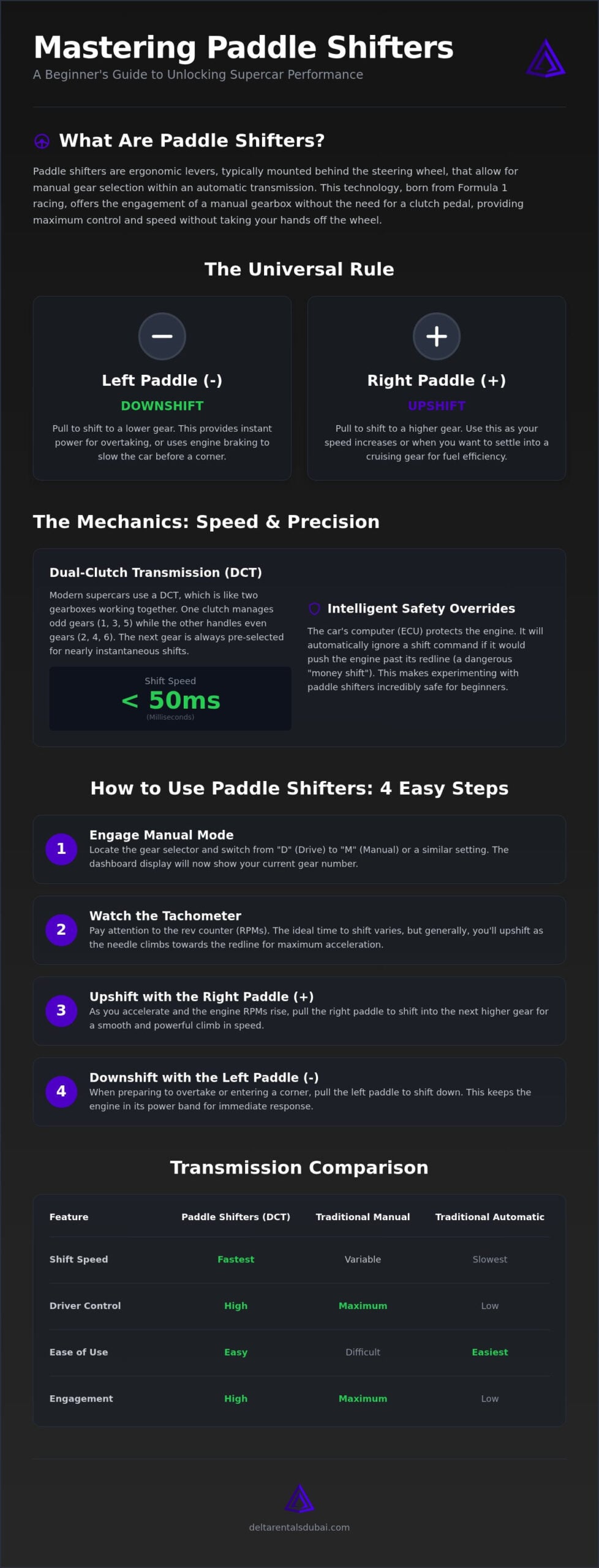
Mastering the paddles starts with a simple binary logic. On almost every modern supercar, the levers follow a universal standard:
- Right Paddle (+): Pull this toward you to upshift. Use it as your speed increases or when you want to settle into a higher gear for smooth cruising.
- Left Paddle (-): Pull this toward you to downshift. This provides immediate power for overtaking or uses engine braking to slow the car down before a corner.
Look for the small “+” and “-” symbols etched into the material. They are your visual cues to ensure you never miss a beat. If you’re looking for paddle shifters explained for beginners, remembering “right for up, left for down” is the most important rule to memorize before you start the engine.
Stationary vs. Column-Mounted Paddles
Designers generally follow two philosophies when placing these levers. Steering-wheel-mounted paddles move as you turn. This setup is common in Porsche and McLaren models, ensuring the gear you need is always right under your fingertips, even mid-corner. It favors a “hands at 9 and 3” driving style, keeping your focus on the road ahead.
Column-mounted paddles remain fixed to the steering column. You’ll find this in Italian legends like the Lamborghini Evo Spyder. These paddles are typically much larger, allowing you to reach them even if the wheel is turned significantly. While the debate between track precision and street comfort continues, both systems offer a seamless transition into a high-status driving experience once you understand their placement.
The Mechanics: How Paddle Shifters Work in Modern Supercars
Pulling a paddle doesn’t physically shove a gear into place. Instead, you’re sending a high-speed digital command to the Engine Control Unit (ECU). This computer then orchestrates the gear change with surgical precision, often completing the swap in under 50 milliseconds. This digital interface is a core reason why paddle shifters explained for beginners focuses on intent rather than physical effort. You provide the command; the car handles the heavy lifting.
The secret to this speed lies in the Dual-Clutch Transmission (DCT). Imagine two separate gearboxes working in tandem. One clutch controls the odd gears, while the other manages the even ones. While you’re accelerating in third gear, the transmission has already pre-selected fourth. When you pull the right paddle, the car simply swaps clutches. This pre-selection logic ensures that power delivery is seamless, preventing the “lurch” often felt in older automatics or traditional manuals.
Modern systems also include intelligent safety overrides. If you accidentally try to downshift while the engine is at its redline, the ECU will ignore the request. This prevents a “money shift,” a catastrophic mechanical failure where the engine is forced to spin faster than its design allows. These fail-safes make it incredibly safe for you to explore how to use paddle shifters without worrying about damaging a Ferrari or Lamborghini. If you’re ready to feel this precision first-hand, speak with our team about a tailored supercar drive today.
Porsche PDK: The Gold Standard
Porsche’s Doppelkupplung (PDK) is widely regarded as the most refined system for new drivers. In models like the Porsche 911 GT3 RS, the PDK offers lightning-fast response times that feel telepathic. It’s exceptionally forgiving because it monitors your driving style in real-time. If you’re driving aggressively, it holds gears longer. If you’re cruising, it shifts smoothly for comfort. This adaptability makes it the perfect starting point for anyone learning paddle shifters explained for beginners.
McLaren’s Seamless Shift Gearbox (SSG)
McLaren takes a different approach with its Seamless Shift Gearbox (SSG) found in the McLaren Artura. It uses “Inertia Push” technology, which harnesses the engine’s energy to provide a small torque boost during shifts. The paddles themselves are often a single rocker-shift piece. Pulling one side moves the entire mechanism, providing a distinct, mechanical “click” that communicates exactly when the gear has engaged. It’s a visceral, tactile experience that bridges the gap between driver and machine.
Paddle Shifters vs. Traditional Manual and Automatic Gearboxes
Performance is the ultimate metric for any modern supercar. In 2026, the traditional stick shift has almost entirely vanished from the production lines of Ferrari and Lamborghini. The reason is simple: speed. A professional driver might shift a manual in 500 milliseconds, but a paddle-shift system does it in less than 50. This gap is the difference between winning a race and trailing behind. For those seeking paddle shifters explained for beginners, it’s essential to understand that you aren’t sacrificing engagement for ease; you’re adopting a superior interface.
Paddles offer 90% of the manual driving experience with 0% of the risk. You don’t have to worry about stalling in the middle of a busy intersection or burning out an expensive clutch. This makes them the ideal choice for a high-status rental experience. You get the roar of the engine as you downshift, yet you can flick the car back into “Full Auto” the moment you hit heavy traffic. It’s the ultimate “best of both worlds” scenario for navigating the national roads of the UAE with total confidence.
Manual Control Without the Clutch
Understanding how dual-clutch transmissions work also reveals hidden benefits for daily driving. You can use paddles to “short-shift,” moving to a higher gear early to save fuel on long coastal drives. Conversely, you can use the left paddle for engine braking. This uses the engine’s resistance to slow the car down, which significantly reduces wear on your high-performance ceramic brakes. It’s a professional technique that keeps you in the optimal “power band” while preserving the vehicle’s hardware for the long haul.
How to Use Paddle Shifters: A Beginner’s Step-by-Step Guide
Taking control of a high-performance gearbox is a straightforward process once you understand the sequence. This paddle shifters explained for beginners guide breaks down the transition from passenger to pilot. Start by locating the “M” button on your center console or shifting the gear selector into the manual gate. In a Porsche 911 GT3 RS, this is often a simple toggle. Once engaged, the car will no longer shift for you unless you hit a safety limit. You are now in command of the engine’s power delivery.
Watch the tachometer closely. This dial measures your Revolutions Per Minute (RPM). As you accelerate, the needle will climb toward the red zone. For a smooth, high-status drive, pull the right paddle (+) toward you when the needle sits between 3,000 and 5,000 RPM. If you’re on a track and seeking maximum speed, you’ll wait until it gets closer to the redline. When it’s time to slow down, apply the brakes and pull the left paddle (-) to downshift. This keeps the engine in the optimal gear for when you’re ready to accelerate again. To return to automatic mode, simply press the “Auto” button or hold the right paddle for three seconds.
When to Shift: The Auditory Guide
Expert drivers eventually stop looking at the dashboard. They shift by ear. As the engine pitch rises and becomes a sharp, mechanical scream, it’s time to upshift. When you downshift, modern supercars perform “rev-matching.” This creates a satisfying “blip” of the throttle that synchronizes engine speed with the wheels. It sounds incredible and ensures the car remains stable during deceleration. Don’t fear the redline; most 2026 models have soft-limiters that will automatically upshift if you forget, protecting the engine from any potential damage.
Common Beginner Mistakes to Avoid
Avoid “double-clicking” the paddles. One firm pull equals one gear change. Pulling twice in rapid succession can cause the car to lurch or over-rev. Another common worry is stopping at red lights. If you’re in manual mode and come to a complete stop, don’t panic. Almost every modern supercar will automatically downshift to 1st gear for you to prevent a stall. Stay calm during rapid acceleration. The car is designed to handle the power; your job is to provide the input. Ready to put these steps into practice? Book your 5-star supercar experience with Delta Rentals Dubai today.
Experience the Thrill: Mastering Paddles in the Delta Rentals Fleet
Mastering the art of manual gear selection requires more than just theory; it demands seat time in a vehicle designed for tactical precision. Renting a high-performance vehicle provides the perfect opportunity to apply everything from this guide on paddle shifters explained for beginners in a real-world setting. At Delta Rentals Dubai, we believe that luxury should be accessible and straightforward. That’s why we offer a seamless, no-deposit rental process across the UAE, allowing you to focus entirely on the connection between your hands and the transmission as you navigate national highways with total confidence.
Before you depart, our expert team provides a personalized handover that acts as a final masterclass. We don’t just hand over the keys; we walk you through the specific nuances of your chosen vehicle. We ensure you understand exactly how to toggle between automatic and manual modes and where the “sweet spot” lies on the tachometer of your specific model. This concierge-level service is a major reason why Delta Rentals Dubai has earned over 300 5-star Google reviews. We remove the anxiety of driving an elite machine, turning a potential stressor into an empowering and high-status experience.
The Ultimate Classroom: Porsche 911 GT3 RS
There is no better place to practice your shifting technique than behind the wheel of a Porsche 911 GT3 RS Rental Dubai: Experience Track-Bred Excellence in 2026. The PDK system is incredibly intuitive, responding to your inputs with clinical accuracy that feels almost telepathic. Because the engine revs so high, every upshift feels like a significant event, providing the clear auditory feedback you need to master the timing of each gear change. It’s a visceral lesson in automotive physics that stays with you long after the drive ends, making it the gold standard for those learning paddle shifters explained for beginners.
Seamless Luxury: The McLaren Artura and Beyond
If you prefer a glimpse into the future of performance, the McLaren Artura offers a unique hybrid shifting experience. The interaction between the electric motor and the internal combustion engine creates a torque curve that makes paddle shifting feel smoother and more immediate than ever before. Every vehicle in our fleet is maintained to 5-star standards, ensuring that the tactile “click” of the paddles is as crisp as the day the car left the factory. Whether you choose a McLaren, a Ferrari, or a Lamborghini, you can rent your supercar today from Delta Rentals Dubai and experience the peak of automotive engagement without the traditional industry friction.
Take Command of the Road in 2026
You’ve explored the mechanics of the dual-clutch transmission and mastered the step-by-step process of manual gear selection. With paddle shifters explained for beginners, the anxiety of damaging a high-performance engine is replaced by the thrill of total control. You now understand that these levers aren’t just for show; they’re your direct link to the car’s soul. Whether you’re listening for the engine’s peak or watching the tachometer, you’re ready to navigate any road with professional precision.
There’s no better way to solidify these skills than behind the wheel of an elite supercar. Delta Rentals Dubai offers a premier national UAE fleet with no deposit required, making your transition into high-status driving effortless. Backed by 300+ 5-star Google reviews, our team ensures you feel like an insider from the moment you start the engine. Don’t just read about performance; feel it for yourself. Book Your Porsche 911 GT3 RS Experience with Delta Rentals Dubai and start your journey today. The open road is waiting for your next shift.
Frequently Asked Questions
Can I break the engine if I use paddle shifters incorrectly?
No, you cannot break the engine because modern supercars use electronic fail-safes to prevent mechanical damage. If you try to downshift at too high a speed, the computer simply ignores the command. This is a common concern when looking for paddle shifters explained for beginners. The car protects itself from “money shifting,” ensuring you can enjoy the drive without the fear of a catastrophic transmission failure.
Do I need to take my foot off the gas when shifting with paddles?
You don’t need to lift your foot off the accelerator when shifting. In fact, keeping a steady throttle allows the dual-clutch transmission to execute the most efficient gear change. The car’s computer handles the ignition cut or throttle blip required for the shift. This creates a seamless flow of power that is much smoother than the jerky motion often felt in traditional manual cars where you must lift the gas.
What happens if I forget to downshift when coming to a stop?
If you forget to downshift as you slow down, the vehicle will automatically shift into a lower gear for you. Most performance cars are programmed to return to first gear once you reach a complete stop. This prevents the engine from stalling, which is a major benefit for those learning paddle shifters explained for beginners. You can focus on braking safely without worrying about the mechanical logistics of stopping.
Are paddle shifters faster than a traditional manual gearbox?
Paddle shifters are significantly faster than any human can be with a traditional stick shift. A professional driver might take 500 milliseconds to shift a manual; however, a supercar like the Porsche 911 GT3 RS can complete a shift in under 50 milliseconds. This incredible speed is why almost every modern performance car has moved away from the manual gearbox to favor the precision of digital paddles.
Can I use paddle shifters in ‘Drive’ mode or do I need ‘Manual’ mode?
You can typically use the paddles in both modes, but their behavior changes. In “Drive,” pulling a paddle provides a temporary manual override before the car reverts to automatic behavior after a few seconds of steady cruising. In “Manual” mode, the car stays in your selected gear until you pull the paddle again or hit a safety limit. This gives you full control over the engine’s power band.
Why do some cars have paddles that don’t move with the steering wheel?
Fixed paddles are mounted to the steering column rather than the wheel itself. This design, often found in Italian supercars, ensures the levers stay in a predictable location even when the wheel is turned upside down. It allows you to find the gear you need during complex cornering maneuvers without hunting for the paddle’s position. Both styles offer distinct advantages depending on your personal driving preference.
Is it better to use paddle shifters or let the automatic do the work?
It’s better to use the paddles when you want maximum engagement and control over the engine note. Letting the automatic mode handle the work is ideal for heavy traffic or relaxed coastal cruises. Shifting manually allows you to hold a gear for a more aggressive sound or better acceleration. It’s a choice between the ease of a luxury cruiser and the visceral thrill of a race car.
What is the best RPM range to shift gears in a supercar?
The optimal shift point depends on whether you’re focused on performance or efficiency. For spirited driving in the UAE, shifting between 4,000 and 6,000 RPM provides a great balance of power and engine sound. In a high-revving car like the Porsche 911 GT3 RS, you can push much higher toward the redline on a track. For daily driving, shifting earlier around 3,000 RPM helps maintain a smooth and quiet cabin environment.