
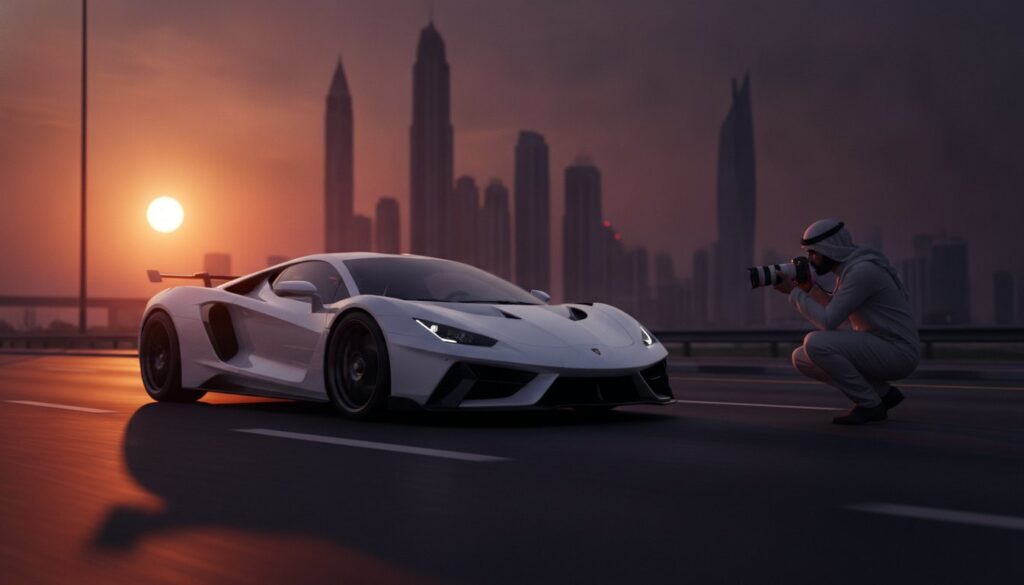
You’re standing in front of a pristine Ferrari SF90 under the intense afternoon sun, but your viewfinder shows a cluttered mess of glares and flat lines instead of a masterpiece. It’s a common frustration for many who realize that elite hardware doesn’t automatically translate to magazine-quality results. We understand that capturing the aerodynamic soul of a high-performance machine is significantly more complex than a standard shoot. Learning how to photograph a supercar requires a precise blend of light control and tactical perspective to do the engineering justice.
This 2026 professional guide empowers you to master the technical settings and creative secrets used by the industry’s top photographers. You’ll learn exactly how to eliminate distracting reflections using a CPL filter and how to frame the aggressive stance of icons like the Porsche 911 GT3 RS. We’ll explore the essential gear, the best lighting windows, and the post-processing workflows that transform a static image into a powerful narrative of speed. It’s time to stop taking snapshots and start creating art.
Key Takeaways
- Select mirrorless sensors with high dynamic range and specific focal lengths to capture the intricate details of elite automotive engineering.
- Master the “Hero Shot” and low-angle perspectives to understand exactly how to photograph a supercar with an aggressive and powerful stance.
- Use the 60-minute Golden Hour window and a circular polarizer to eliminate distracting paint glares and manage high-contrast lighting effectively.
- Execute professional panning shots and high-speed rollers to inject dynamic energy and realistic motion blur into your automotive portfolio.
- Build a high-status professional body of work by using elite rentals as your subjects, allowing you to practice advanced color grading on world-class vehicles.
Essential Gear for High-Performance Automotive Photography
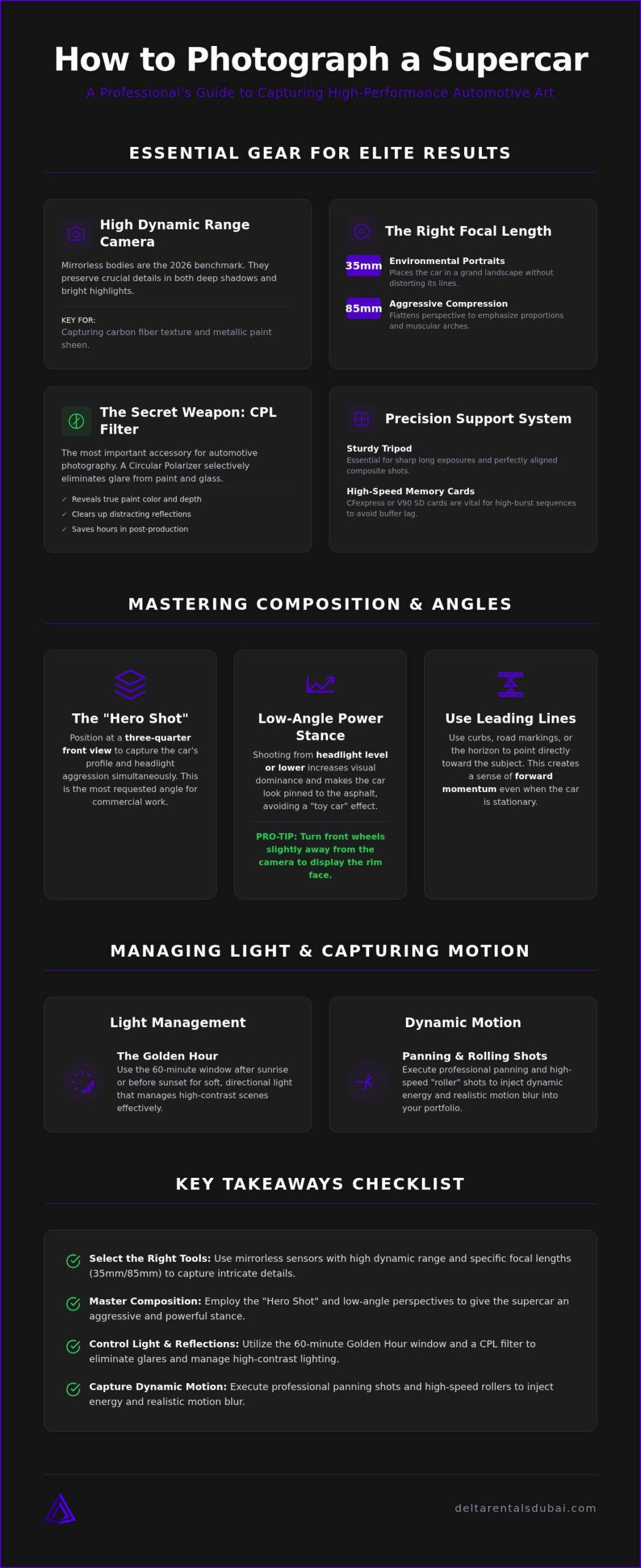
Capturing the soul of a high-performance vehicle requires more than just a standard kit. To understand how to photograph a supercar at a professional level, you need gear that handles extreme contrast and intricate textures. Mirrorless bodies like the Sony A7R IVa or the medium-format Fujifilm GFX 100S II are the benchmarks in 2026. These systems offer the high dynamic range necessary to preserve detail in both the deep shadows of a carbon fiber diffuser and the bright highlights of metallic paint. Before specializing in this niche, mastering the foundational principles of photography is critical for understanding how light interacts with complex, curved surfaces.
While the camera body provides the foundation, your support system ensures precision. A sturdy, professional-grade tripod is essential for sharp long exposures and perfectly aligned composite shots. Pair this with high-speed memory cards, such as CFexpress Type B or V90 SD cards. These speeds are vital when shooting high-burst sequences of a Porsche 911 GT3 RS in motion, ensuring you never miss a frame due to buffer lag.
The Circular Polariser: Your Secret Weapon
A CPL filter is the most important accessory in your bag. It allows you to selectively eliminate glare from windscreens and metallic surfaces, revealing the true color and depth of the paint. By rotating the filter, you can specifically highlight the intricate weave of carbon fiber components or clear up reflections on the side glass. Using a high-quality CPL saves hours in post-production by resolving complex reflections that are nearly impossible to fix digitally.
Lens Selection: 35mm vs. 85mm
Choosing the right focal length defines the car’s personality. A 35mm prime lens is perfect for environmental portraits, placing the vehicle within a grand national landscape without distorting its natural lines. It provides enough context to tell a story about the journey. Conversely, an 85mm lens provides beautiful compression, flattening the perspective to emphasize aggressive proportions and muscular rear arches. When you need to showcase the craftsmanship of the cabin, a dedicated macro lens is required to capture the exquisite stitching or the precision of the manufacturer’s badges. Mastering these focal lengths is a core part of learning how to photograph a supercar with a professional, magazine-ready aesthetic.
Mastering Composition: Angles That Define Speed
Composition is where you translate raw horsepower into visual prestige. When you learn how to photograph a supercar, you must respect the unique design language of the vehicle. Unlike a standard commuter car, every curve on a high-performance machine serves a purpose. The “Hero Shot” is your starting point. Position yourself at a three-quarter front view to capture the headlight’s aggression and the car’s profile simultaneously. This angle provides a comprehensive view of the vehicle’s depth and stance, making it the most requested shot for commercial work in 2026.
Use the environment to your advantage by seeking out leading lines. Curbs, road markings, or even the horizon can point directly toward the subject, creating a sense of forward momentum even when the car is stationary. For vehicles with extreme aero, such as the Porsche 911 GT3 RS, you must frame the active aerodynamics correctly. The massive rear wing and hood nostrils are defining features; ensure they aren’t lost against a busy background. For more technical insights on framing, Adobe’s car photography guide offers excellent perspective on maintaining visual balance during complex shoots.
The Low-Angle Power Stance
Getting low is non-negotiable. Shooting from standing height creates a “toy car” effect that diminishes the vehicle’s presence. Instead, position your lens at headlight level or lower. This increases visual dominance and makes the car look pinned to the asphalt. A professional trick is to turn the front wheels slightly away from the camera. This displays the intricate rim face rather than the black rubber of the tread, adding a layer of sophistication to the shot. If you’re ready to build your portfolio with world-class subjects, you can rent a supercar for a professional shoot to master these techniques in person.
Detail Shots: Carbon and Cockpits
Don’t overlook the micro-details that signify elite status. Supercars are defined by their materials. Use a tight crop to highlight the intricate weave of carbon fiber components or the precision of manufacturer emblems. When moving to the interior, lighting is your biggest challenge. Capture the luxury of the cockpit by focusing on the contrast between Alcantara, leather, and metal. Highlighting the branding on the steering wheel or the start button requires a soft touch and a keen eye for geometry. These detail shots are what separate a hobbyist’s gallery from a professional, magazine-quality portfolio.
Managing Light and Reflections in Elite Environments
The Golden Hour remains the undisputed peak for elite automotive imagery. Those 60 minutes before sunset provide a soft, directional glow that highlights body lines without the harshness of high noon. However, in national landscapes where the sun is often unforgiving, you must adapt your strategy. Mastering how to photograph a supercar in high-contrast environments requires tactical positioning. If you’re shooting at midday, seek out modern architectural shade or use a large white reflector. This tool is essential for bouncing light into the deep shadows of dark wheels. Without it, the tire and rim detail often disappears into a black void, ruining the balance of the shot.
For more dramatic results, light painting techniques allow you to control every highlight manually. By using a handheld LED source in a dark environment, you can trace the vehicle’s contours during a long exposure. This creates a hyper-real, studio-quality look in almost any location. It’s a high-status technique that separates professional portfolios from amateur social media posts. It requires patience and a steady hand, but the results are worth the effort.
Controlling Metallic Paint Reflections
Metallic finishes act like curved mirrors, reflecting everything in the vicinity. Identify “hot spots”, those blown-out highlights on the car’s curves, and adjust the vehicle’s angle by just a few degrees to shift the reflection away from the lens. The goal is to achieve a gradient light effect. This is defined as a smooth, intentional transition of light and shadow across the door panels that emphasizes the car’s three-dimensional form. Using natural shade from buildings or overpasses helps create this soft, even lighting across the body without the need for massive softboxes.
Night Photography and Long Exposures
Nighttime offers a different brand of prestige. Modern architectural lighting provides a sleek, futuristic backdrop, but it requires a tripod and precise long exposures. Use a handheld LED wand during a 10-second exposure to highlight the car’s silhouette, specifically tracing the roofline and rear arches. You must carefully balance the ambient street light with the car’s own LED signatures. Capturing the distinctive glow of a Lamborghini Revuelto tail light against a dark, urban background creates a cinematic feel. It’s about managing these light sources to ensure the car remains the undisputed protagonist of the frame.
Dynamic Motion: Capturing Supercars in Their Natural Element
Supercars are machines of momentum. While a static shot captures the intricate details of the carbon fiber we discussed earlier, dynamic motion tells the story of the vehicle’s engineering intent. To master how to photograph a supercar, you must move beyond the tripod and embrace the technical challenge of tracking speed. Capturing a McLaren Artura at full tilt requires a synergy between your camera settings and the driver’s precision. It is the difference between a boring snapshot and a cinematic masterpiece that feels alive.
Perfecting the Panning Technique
Panning is the most accessible way to inject energy into your portfolio. Select a shutter speed between 1/40 and 1/80 of a second to ensure beautiful wheel blur while maintaining a sharp chassis. Use your camera’s continuous autofocus mode, such as 3D tracking or animal/vehicle eye-AF, to lock onto the front headlight. The secret lies in the “follow through” movement. You must pivot your body smoothly at the hips, keeping the car in the same position in your viewfinder even after the shutter has closed. This creates a creamy, streaked background that emphasizes the car’s velocity.
The Roller: Car-to-Car Mastery
In 2026, “rollers” remain the gold standard for high-end automotive editorial work. This involves shooting the subject vehicle from a moving lead car, typically a stable SUV like a Range Rover. Constant communication is vital. Use two-way radios so the photographer can direct both drivers to adjust their speed and lane positioning with centimetre precision. Use a three-axis gimbal to stabilise your mirrorless setup, especially when framing the car against grand national landmarks to provide a sense of epic scale. This technique allows you to capture the aggressive stance of the vehicle in its natural habitat.
Safety is the primary priority during any high-speed tracking shot. Never attempt complex maneuvers on public national roads without a clear plan and experienced drivers. If a moving shoot isn’t possible, you can still imply speed through “static motion.” Position the car near foreground elements like tall grass or road barriers and use a slightly longer exposure as you move the camera. This creates a sense of rush even if the vehicle is parked. If you want to practice these professional techniques, book a supercar for your next professional shoot and build a world-class portfolio today.
Post-Processing Mastery and Finding Your Ultimate Subject
The final stage of learning how to photograph a supercar happens at the workstation. Raw files are simply the high-performance foundation; post-processing is where you apply the commercial polish expected by elite publications. In 2026, the industry trend has shifted toward authentic yet highly refined visuals. This requires a surgical approach to color grading, ensuring the specific, exotic hues of a McLaren Artura are represented with perfect accuracy and depth. Beyond color, you must “clean the canvas” by meticulously removing sensor dust and distracting reflections that even a CPL filter could not fully eliminate.
The Commercial Edit Workflow
A professional workflow begins with Adobe Lightroom to establish the base contrast. Use selective masking to brighten darkened grilles and wheels, ensuring the mechanical complexity of the vehicle is not lost in the shadows. For carbon fiber components, a slight increase in clarity and texture reveals the intricate weave that signifies high-end engineering. To achieve a dreamlike, high-status glow, many professionals apply a subtle “Orton Effect” in the final stages. This technique adds a soft luminance to the highlights, giving the image a prestigious, magazine-ready finish that feels both powerful and ethereal.
Building Your Professional Portfolio
The biggest barrier for most photographers is not the gear; it’s the access. Knowing how to photograph a supercar is irrelevant if you don’t have a world-class subject in front of your lens. Renting is the most efficient tactical career move you can make. A single, well-executed session with a Porsche 911 GT3 RS can launch a professional career by providing the high-tier content needed to attract commercial clients. It allows you to build a portfolio of vehicles you don’t yet own, demonstrating your ability to handle elite machinery with confidence.
By leveraging the fleet at Delta Rentals Dubai, you gain insider access to the world’s most photogenic vehicles without the friction of traditional ownership. Their “Super car shoot” service is designed specifically for creators who value time and visual impact. Establishing a relationship with Delta Rentals Dubai opens doors for long-term opportunities and consistent portfolio growth. It transforms an aspirational lifestyle into an attainable professional reality. Secure your subject, master the light, and let your portfolio reflect the prestige of the cars you capture.
Elevate Your Automotive Portfolio Today
Mastering the technical nuances of how to photograph a supercar is the key to transitioning from a hobbyist to a professional creator. You now possess the tactical knowledge to manage harsh reflections, frame aggressive hero shots, and execute cinematic motion sequences. By combining these skills with a high-end commercial editing workflow, you’ll produce images that resonate with the prestige of the vehicles themselves.
The final step is securing a subject that does your talent justice. Delta Rentals Dubai provides immediate access to exclusive models like the Porsche 911 GT3 RS, ensuring your portfolio features only the most photogenic machinery. Our fleet is expertly maintained for pristine visual results, and our no-deposit rental options remove the traditional barriers to elite automotive content. It’s time to put your expertise into practice.
Book your next supercar for a professional shoot at Delta Rentals Dubai
Frequently Asked Questions
What is the best camera for supercar photography in 2026?
The Sony A7R IVa is currently the benchmark for 2026 due to its exceptional resolution and high dynamic range. For photographers seeking maximum detail in static shots, the medium-format Fujifilm GFX 100S II is the superior choice. If your focus is high-speed action, the Sony A9 III with its global shutter is preferred. Selecting the right body is the first step in learning how to photograph a supercar with professional precision.
Do I need a tripod for automotive photography?
Yes, a professional tripod is a non-negotiable tool for static hero shots and night-time light painting. It ensures absolute sharpness during long exposures and allows you to create perfect composite images by keeping the frame identical between shots. While you can shoot handheld for dynamic rollers, a tripod provides the stability required for the high-end, polished aesthetic that defines the most successful professional automotive portfolios in 2026.
How do I get rid of reflections on a car in photos?
Use a Circular Polariser (CPL) filter to selectively eliminate glares from windscreens and metallic paint. By rotating the filter, you can control exactly which reflections are visible. Additionally, moving the vehicle by just a few degrees or utilizing natural shade can shift distracting “hot spots” away from the lens. This combined approach is vital for anyone mastering how to photograph a supercar with clean, aerodynamic lines and deep paint depth.
What shutter speed should I use for car panning shots?
Aim for a shutter speed between 1/40 and 1/80 of a second to achieve the perfect balance of background blur and vehicle sharpness. If you shoot too fast, the wheels will look static; too slow, and you risk losing the car’s crispness. Smoothly track the vehicle’s movement with your hips and use a continuous autofocus mode to lock onto the front headlight throughout the entire motion sequence for a cinematic result.
Can I take professional supercar photos with a smartphone?
Modern smartphones like the iPhone 16 Plus are capable of capturing impressive social media content, but they don’t replace mirrorless systems for high-end commercial work. Professional cameras offer superior dynamic range and the lens compression necessary for magazine-quality results. Use your smartphone for behind-the-scenes content or quick lifestyle shots, but rely on a dedicated camera body for your primary portfolio pieces and large-scale prints to maintain a premium standard.
Where can I find supercars to photograph for my portfolio?
Renting a vehicle is the most efficient way to access world-class subjects for your portfolio. Delta Rentals Dubai offers an elite fleet including the Porsche 911 GT3 RS and McLaren Artura specifically for professional shoots. We provide no-deposit rental options nationally across the UAE, making it straightforward for photographers to secure a pristine vehicle. This tactical move allows you to build a high-status body of work without the friction of private ownership.
What is a “roller” in car photography?
A “roller” is a car-to-car motion shot taken from a lead vehicle while both cars are driving at speed. This technique captures the supercar in its natural element, creating a sense of realistic momentum and grand scale. It requires precise communication between the photographer and both drivers. Using a three-axis gimbal during these sessions ensures the images remain stable despite the movement of the tracking SUV, resulting in a cinematic, professional look.
Why is a CPL filter necessary for car shoots?
A CPL filter is necessary because it is the only tool that physically removes light reflections from non-metallic surfaces like glass and paint. It allows you to see through windscreens and reveals the true depth of the vehicle’s color. Without it, your images will often look flat and cluttered with distracting glares. It saves significant time in post-production by resolving complex visual issues during the initial capture, ensuring a much cleaner final edit.