
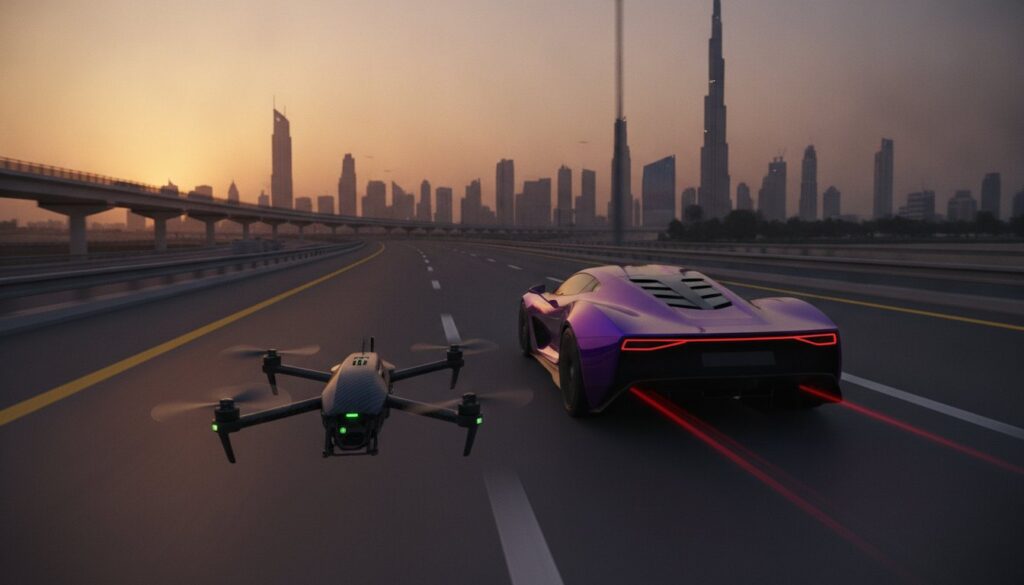
Capturing a Porsche 911 GT3 RS at full throttle isn’t just about owning a drone; it’s about managing a high-speed collision course between two pieces of elite technology. Mastering drone filming with a supercar requires more than just a pilot’s license. You want that breathless, frame-perfect shot for your next social media edit, but the fear of clipping a wing or facing an AED 2,000,000 fine is a heavy weight to carry. It’s a common tension for creators who demand prestige without the catastrophic risk.
This 2026 professional guide eliminates that friction. We provide a seamless roadmap through hardware selection, legal compliance, and cinematic choreography. You’ll gain a clear understanding of the latest GCAA registration requirements and the specific FPV techniques needed to track a McLaren Artura or Ferrari SF90 with surgical precision. By the end of this guide, your production day will feel like a coordinated victory rather than a gamble. We’ve simplified the complexity so you can focus on the art of high-performance speed.
Key Takeaways
- Understand how modern drone technology has replaced traditional helicopter shoots with more agile, cost-effective aerial perspectives.
- Identify the critical hardware differences between high-velocity FPV drones for aggressive chasing and GPS-stabilized units for smooth reveals.
- Navigate the 2026 national GCAA registration requirements and pilot certification protocols to ensure a fully compliant and legal production.
- Master professional choreography for drone filming with a supercar, including road-level high-speed chases and cinematic orbit techniques.
- Streamline your production logistics by utilizing no-deposit rental options and free national vehicle delivery for your chosen hero car.
The Evolution of Drone Filming with a Supercar
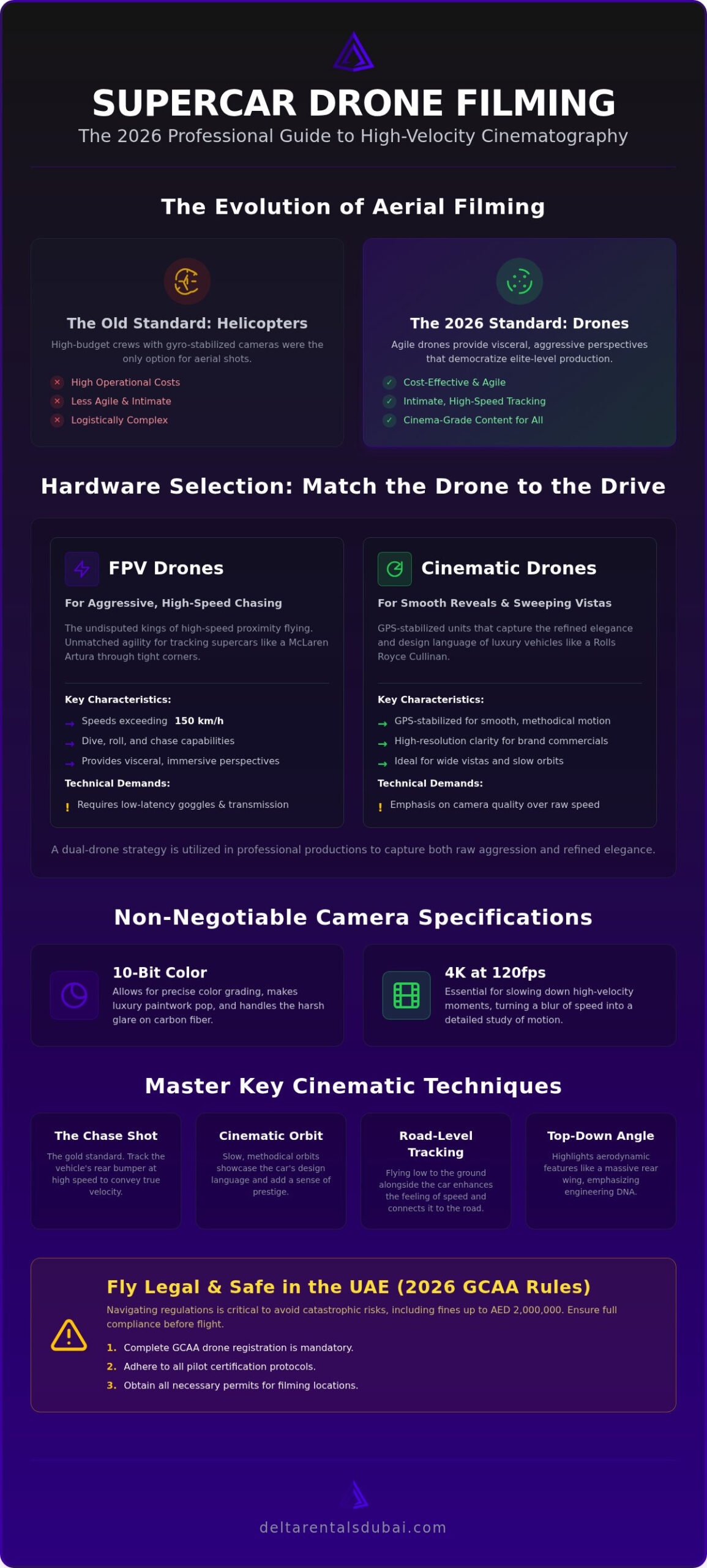
Supercar drone cinematography is the art of capturing high-velocity performance through a lens that moves as fast as the subject. In 2026, the industry has pivoted. High-budget helicopter crews with gyro-stabilized cameras are no longer the standard. Instead, agile drones provide a more intimate, aggressive perspective that traditional aircraft simply cannot match. This shift has democratized elite-level production. It allows creators to produce cinema-grade content that was once reserved for major motion pictures. Drone filming with a supercar has become the primary method for showcasing automotive excellence in a way that feels visceral and immediate.
When selecting a vehicle from Delta Rentals, the Porsche 911 GT3 RS stands out as the ultimate hero car for these productions. Its track-focused design and aggressive aerodynamics translate perfectly to aerial tracking. The car doesn’t just look fast; its complex wing work and vents provide visual texture that drones can highlight from angles impossible for ground-based crews. This evolution isn’t just about better cameras. It’s about a new philosophy of speed where the camera is an active participant in the race.
Visual Impact and Storytelling
Aerial perspectives provide a sense of scale that ground-level cameras miss. You aren’t just filming a car; you’re placing a masterpiece within a national landscape. Drones excel at highlighting specific aerodynamic features that define a supercar’s identity. For instance, the massive rear wing of the Porsche 911 GT3 RS becomes a focal point from a top-down angle, emphasizing its engineering DNA. This “bird’s eye view” triggers a sense of dominance and exclusivity in the viewer. It’s a high-status perspective that mirrors the luxury of the vehicle itself, instantly elevating the perceived prestige of your content.
Commercial vs. Editorial Use
Identifying your final output is the first step toward a successful production. Whether you’re crafting a 15-second social media edit or a full-scale brand commercial, the approach to drone filming with a supercar must be intentional. Dynamic movement is the only way to hold the attention of a high-status audience in 2026.
- Social Media Reels: Focus on high-energy, fast cuts and vertical framing to capture immediate attention and drive engagement.
- Brand Commercials: Prioritize wide, sweeping vistas and high-resolution clarity to build a narrative of prestige and heritage.
- Editorial Features: Use slow, methodical orbits to showcase the design language of a Rolls Royce Cullinan or McLaren Artura.
The chase shot is the gold standard for automotive drones, requiring the pilot to track the vehicle’s rear bumper at high speeds to convey true velocity. Static shots are a relic of the past. Modern audiences expect to feel the air move as the car passes the lens. By mastering these techniques, you transform a simple car video into a high-octane cinematic experience that commands respect.
Hardware Selection: FPV vs. Cinematic Drones
Choosing the right hardware for drone filming with a supercar is a decision rooted in physics. You must match the camera’s mobility to the car’s performance. A vehicle like the Ferrari SF90 can reach 100 km/h in a staggering 2.5 seconds; most consumer drones simply cannot keep up. Professional productions in 2026 utilize a dual-drone strategy to capture both the raw aggression of the chase and the refined elegance of the vehicle’s design. This ensures no frame is wasted and every bit of the car’s performance is documented.
Your camera specifications are just as vital as the drone’s motors. 10-bit color is a non-negotiable requirement for high-end automotive content. It allows for the precise color grading needed to make luxury paintwork pop and ensures the dynamic range can handle the glare of the sun on polished carbon fiber. Additionally, shooting at high frame rates, such as 120fps in 4K, is essential. It gives you the flexibility to slow down high-velocity moments, turning a blur of speed into a detailed study of motion.
When to Use FPV Drones
First Person View (FPV) drones are the undisputed kings of high-speed proximity flying. When you are tracking a McLaren Artura through tight corners, the agility of an FPV quadcopter is unmatched. These drones can dive, roll, and chase at speeds exceeding 150 km/h, providing a visceral, immersive perspective that engages modern audiences. However, this performance comes with high technical demands. Pilots must use low-latency goggles and high-bitrate transmission systems to ensure they don’t lose signal while flying inches from a multi-million dirham asset. If you are looking to push the limits of your production, consult with our team about selecting a vehicle with the right aerodynamic profile for high-speed chasing.
The Case for Cinematic GPS Drones
While FPV captures the adrenaline, standard GPS drones like the DJI Mavic series capture the prestige. These units are perfect for the “hero shot” of a Rolls Royce Cullinan Black Badge. They offer rock-solid stability and intelligent flight modes that simplify complex maneuvers. Features like ActiveTrack allow the drone to lock onto the car’s silhouette, maintaining a perfect center even as the vehicle moves through the landscape. This automation acts as a safety net, using 360-degree obstacle avoidance to prevent collisions during low-altitude orbits. It’s the most reliable way to secure consistent, high-status footage without the high-stress environment of manual FPV flight.
National Regulations and Safety Protocols in the UAE
Compliance is the foundation of every professional production. In 2026, the UAE maintains some of the world’s strictest drone laws under Federal Decree-Law No. 26 of 2022. Every drone must be registered with the General Civil Aviation Authority (GCAA). If you’re filming in specific zones, you’ll also need to interface with the local Civil Aviation Authority. These regulations aren’t barriers; they’re safeguards for your production. Unauthorized commercial activity can lead to fines reaching AED 2,000,000. It’s essential to secure a No-Objection Certificate (NOC) before you begin drone filming with a supercar on national highways.
Stay clear of restricted airspace to avoid legal friction. Drones are strictly forbidden within five kilometers of airport fences, heliports, or landing sites. Your maximum flight altitude is capped at 400 feet (120 meters) above ground level. Respecting these boundaries ensures your shoot remains stress-free and prestigious. By following these protocols, you project the image of a serious professional who values both art and authority.
Legal Compliance for Creators
Professional sets require professional permits. A recreational license won’t suffice for brand work or high-status social media content. You must hold a GCAA-approved training certificate and have the drone registered to an Emirates ID holder. Commercial insurance is mandatory. It protects your team and the high-value assets provided by Delta Rentals. National law requires a registered spotter for all FPV flights to maintain a constant visual line of sight at all times.
Operational Safety on Set
Safety is a non-negotiable part of the luxury experience. Establish a “sterile” environment before the first take. Maintain a minimum safety distance between the drone and the supercar to account for sudden maneuvers or wind gusts. Use two-way radios to coordinate every move between the pilot and the driver. This real-time communication is vital when tracking at high speeds. Your pre-flight checklist must include:
- Comprehensive battery health and voltage checks
- Signal interference scans for the local area
- Propeller integrity and motor mount inspections
If signal loss occurs, the pilot must initiate a pre-programmed “Return to Home” protocol immediately. This level of organization prevents friction and ensures a seamless production day. It’s about removing risk so you can focus on capturing the perfect shot of a Porsche 911 GT3 RS or Ferrari SF90.
Cinematic Techniques for High-Speed Automotive Shoots
Execution separates a professional production from a hobbyist edit. To master drone filming with a supercar, you must move beyond basic following. The ‘Low-and-Fast’ chase is your primary tool for capturing a Lamborghini Revuelto or Evo Spyder. By flying just inches above the tarmac, you amplify the car’s ground-hugging stance. It creates a visceral sense of speed that higher angles lose. Conversely, use the ‘Orbit’ reveal for a Rolls Royce Cullinan Black Badge. A slow, steady 360-degree rotation showcases the vehicle’s commanding presence and intricate detailing from every angle.
Parallax shots are essential for emphasizing velocity. By flying the drone in the opposite direction of the background or at a different speed than the car, you create a sense of depth. This technique makes a Ferrari SF90 look like it’s tearing through the environment. For a change of pace, employ the ‘Top-Down’ follow. This angle highlights the geometric symmetry and aerodynamic lines that define modern supercar design, offering a clean, editorial look that resonates with luxury audiences. It’s the most effective way to show off the carbon fiber work on a Porsche 911 GT3 RS.
Mastering the Chase Shot
Consistency is the secret to a usable edit. Maintain a fixed distance from the vehicle’s rear bumper to avoid “speed jitter,” where the car appears to bounce forward and backward in the frame. Use ND filters to manage your shutter speed. This creates natural motion blur on the road surface, which is critical for making high-speed footage feel authentic. Coordination is key. The driver must maintain a predictable line, allowing the pilot to focus on proximity rather than reacting to sudden steering inputs. Precision requires synergy between the cockpit and the controller.
Creative Reveal Transitions
Elevate your storytelling with dynamic transitions. Use an FPV drone to fly through a narrow gap, such as a bridge or a natural rock formation, to suddenly reveal the supercar on an open stretch of road. This “gate” shot adds a layer of technical sophistication to your reel. Alternatively, try the ‘Pull-Away’ shot. Start on a tight detail, such as the badge or a wheel rim, and rapidly fly backward and upward to reveal the car within the vast national landscape. Always time your shoot for the ‘Golden Hour.’ The low sun enhances the paintwork’s depth and adds a premium glow to every frame.
Ready to capture your own cinematic masterpiece? Book a track-ready hero car from Delta Rentals today and start your production with the best fleet in the country.
Planning Your Production with Delta Rentals
Capturing elite content is a logistical puzzle. Excellence in drone filming with a supercar requires more than a steady hand on the controller; it demands a partner that understands the pace of a professional set. Delta Rentals serves as a high-status facilitator, removing the traditional friction of vehicle procurement. We don’t just provide cars. We provide the hero subjects that define your visual narrative. Our 5-star Google reviewed service ensures that your production day remains seamless from the first battery swap to the final wrap.
The Best Supercars for Drone Content
Selecting the right vehicle is a creative decision that impacts your entire edit. The Porsche 911 GT3 RS is our most sought-after subject for technical tracking. Its complex aerodynamics and aggressive rear wing provide incredible visual texture for FPV chases. If your project leans toward a futuristic or high-tech aesthetic, the McLaren Artura offers a sleek, hybrid profile that catches the light beautifully at high speeds. For projects requiring a sense of absolute dominance, the Rolls Royce Cullinan Black Badge provides a commanding presence in aerial wide shots, anchoring the national landscape with its unmistakable silhouette.
Seamless Logistics for National Shoots
Time is a commodity on any production set. We’ve designed our services to respect your schedule and your bottom line. Our no-deposit supercar rental model is a game-changer for production budgets. It frees up capital that can be better spent on specialized hardware or post-production. To ensure your team stays focused on the creative, we offer free national delivery. Your chosen vehicle arrives exactly where you need it, in pristine condition, ready for the lens.
Precision is mandatory for complex choreography. Our VIP chauffeur services provide professional drivers who understand the nuances of camera-car positioning. Whether you need a steady line at 120 km/h or a micro-adjustment for a detail shot, our team works in synergy with your pilot. This level of coordination is why we are the most trusted partner for high-end automotive content in 2026. Rent the Porsche 911 GT3 RS for your next shoot and experience a production process that is as refined as the vehicles we rent.
Elevate Your Production to Elite Status
Mastering drone filming with a supercar in 2026 is about more than just technical skill; it’s the synergy of high-performance hardware, legal precision, and the right automotive partner. You’ve learned how to navigate GCAA regulations and execute the gold-standard chase shot with surgical accuracy. Now, it’s time to put those cinematic techniques into motion with a fleet that matches your creative ambition. Success on set depends on removing friction before the first prop spins.
Delta Rentals acts as your high-status partner by streamlining every logistical detail. We offer a 5-star Google reviewed rental service that prioritizes your production’s speed and reliability. With no deposit required on supercar rentals and free national delivery across the UAE, we ensure your hero car arrives in pristine condition exactly when you need it. Whether you’re tracking the Porsche 911 GT3 RS or capturing the elegance of a Rolls Royce, we handle the details so you can focus on the art.
Explore the Delta Rentals Elite Fleet for Your Next Shoot
Take the lead and capture the extraordinary today.
Frequently Asked Questions
Do I need a special permit for drone filming with a supercar in the UAE?
Yes, you must have a GCAA-registered drone and a commercial permit for any professional production. Filming on national highways requires a No-Objection Certificate (NOC) from the relevant civil aviation authorities. This ensures your project remains legally compliant and avoids the significant fines associated with unauthorized drone filming with a supercar. Always verify the latest 2026 security clearances before launching your equipment.
What is the best drone for chasing a supercar at high speeds?
FPV (First Person View) drones are the superior choice for high-speed chases due to their agility and top speeds that can exceed 140 km/h. For smooth, cinematic reveals of a Rolls Royce Cullinan, a GPS-stabilized drone like the DJI Mavic series is more effective. Matching the drone’s flight characteristics to the vehicle’s performance ensures your footage looks professional, intentional, and high-quality.
Can I rent a supercar for a photoshoot without a credit card?
You can secure a high-performance vehicle from Delta Rentals without the traditional friction of a credit card deposit. We offer specialized no-deposit supercar rental options to streamline your production budget and reduce administrative delays. This allows you to allocate more resources toward your creative team and equipment while enjoying a seamless, high-status rental experience that prioritizes your project’s efficiency.
How fast should a supercar drive during a drone chase?
Coordination between the pilot and driver is more important than raw speed. Most cinematic chase shots are captured at speeds between 60 km/h and 90 km/h. This range allows the drone to maintain a consistent proximity while using ND filters to create natural motion blur. Driving at a steady, predictable pace ensures the pilot can focus on framing the supercar perfectly without erratic movements.
Is it safe to fly a drone close to a Porsche 911 GT3 RS?
Flying close to a Porsche 911 GT3 RS is safe when conducted by a certified pilot with a registered spotter. Professional sets use pre-defined flight paths and two-way radio communication to manage proximity in real time. Maintaining a sterile environment and respecting minimum safety distances prevents any risk to the vehicle’s complex aerodynamics or the drone’s hardware during high-speed maneuvers.
What happens if weather conditions are bad on my filming day?
Safety is the priority for any elite production. If weather conditions like high winds or low visibility occur, drone operations must be suspended to protect the equipment and the supercar. Delta Rentals provides a flexible, 5-star reviewed service that helps you align your vehicle booking with the best possible filming windows. Planning for a backup day ensures a stress-free and successful shoot regardless of the forecast.
Do I need a professional drone pilot for my supercar content?
Hiring a professional pilot is essential for high-end drone filming with a supercar. Commercial permits in the UAE require certified operators who understand the legal landscape and technical demands of high-speed tracking. A professional brings the expertise needed to handle a McLaren Artura or Ferrari SF90 with the precision required for a prestige social media edit or a professional brand commercial.
Does Delta Rentals offer delivery to national filming locations?
Delta Rentals provides free delivery to filming locations across the country. Whether you are shooting on a remote mountain pass or a coastal highway, we ensure your hero car arrives in pristine condition and on schedule. This convenience allows your production team to remain on-site and focused on the creative process while we handle the complex vehicle logistics and national transportation requirements.