
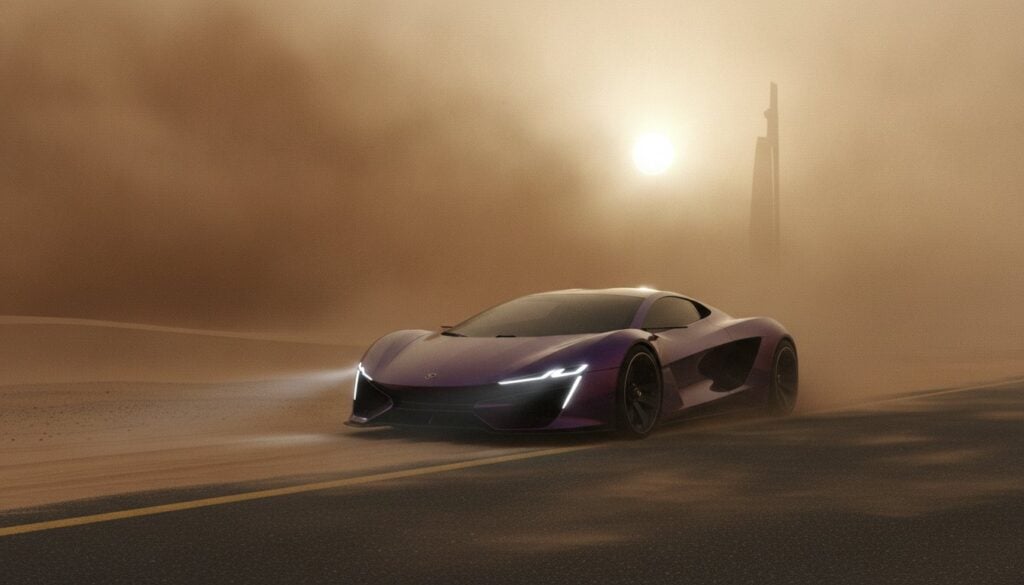
A single severe sandstorm can strip the factory paint off a Ferrari and clog a Porsche’s high-performance intake in under ten minutes. When you’re behind the wheel of a precision-engineered machine, these weather events aren’t just an inconvenience; they’re a direct threat to your investment. Understanding how to handle a supercar in sandstorms is the difference between a minor delay and a six-figure repair bill.
You likely already know the paralyzing anxiety of watching visibility vanish while sitting just inches off the asphalt in a low-clearance vehicle. It’s a high-stakes environment where confusion about whether to stop or keep moving can be dangerous. We’re here to replace that uncertainty with a clear, technical protocol designed for the elite driver. It’s about maintaining control when the elements turn hostile.
This guide masters the official “Pull Aside, Stay Alive” safety standards while detailing the mechanical steps needed to shield sensitive air-breathing components. You’ll gain the confidence to manage high-performance aerodynamics in heavy gusts and learn the exact recovery steps to ensure your vehicle returns to its pristine state. We will explore everything from specialized filtration technology to the critical post-storm inspection points that protect your engine’s longevity.
Key Takeaways
- Protect high-performance cooling systems and mid-engine air intakes from sand ingestion to prevent catastrophic mechanical wear.
- Discover the technical protocols for how to handle a supercar in sandstorms, including why extinguishing all lights while parked is a life-saving necessity.
- Shield your vehicle’s carbon fiber and paintwork from the “sandblast effect” by maintaining extreme following distances from other traffic.
- Execute a safe exit strategy using the official “Pull Aside, Stay Alive” protocol to wait out visibility drops without risking a high-speed collision.
- Ensure long-term vehicle health with a specialized post-storm recovery plan that includes professional abrasive dust removal and precision filter inspections.
The Technical Impact of Sandstorms on High-Performance Vehicles
A sandstorm transforms the atmosphere into a high-velocity abrasive chamber. While a standard SUV might weather the grit with minor inconvenience, a supercar faces a mechanical and aesthetic assault. Understanding what is a haboob helps drivers realize these aren’t just “dusty days”; they are intense meteorological events characterized by wall-like fronts of particulate matter. For those learning how to handle a supercar in sandstorms, the first lesson is technical. High-performance vehicles are precision tools designed for clean airflow, not for processing pounds of airborne silica. High-speed reaction times are cut in half as visibility drops, making every aerodynamic twitch more critical.
Understanding Abrasive Damage
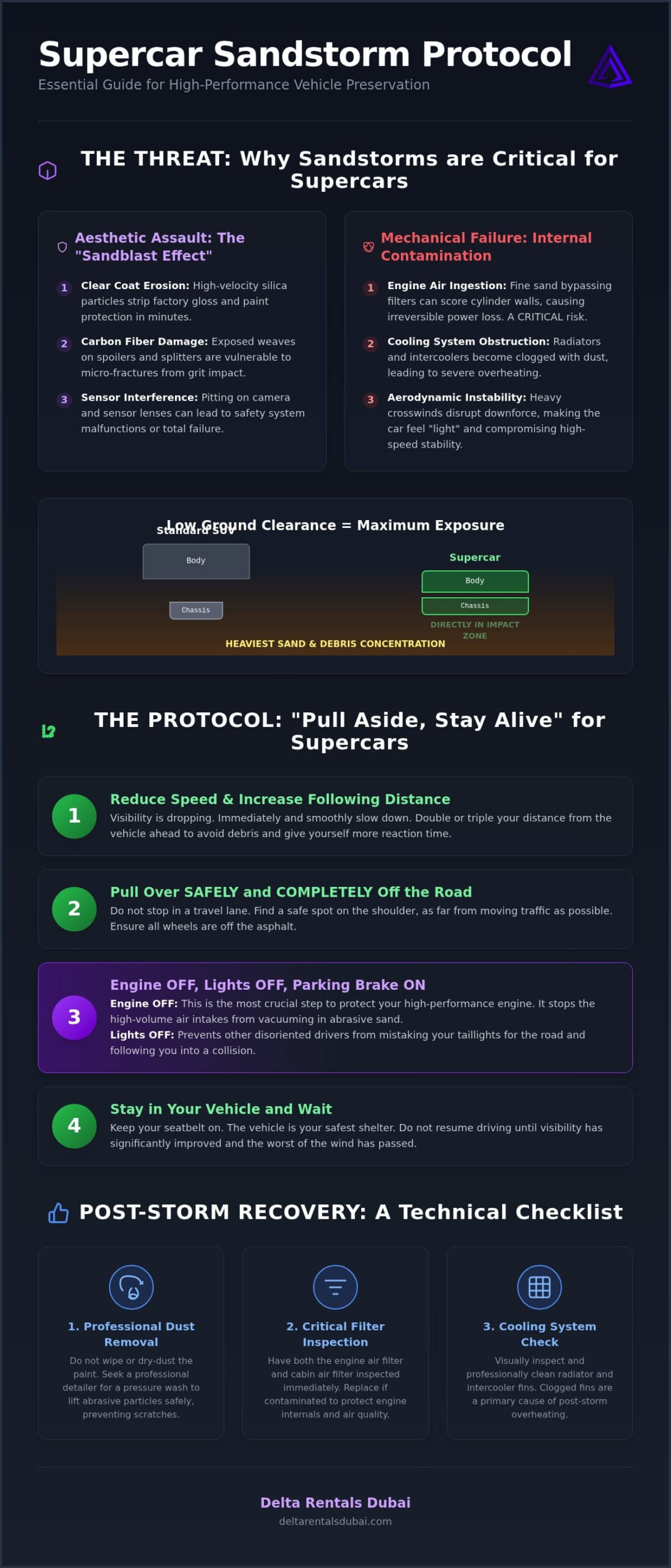
The “sandblast effect” is a literal description of what happens to a car’s exterior at speed. Wind-borne silica particles act as microscopic sandpaper, chewing through premium clear coats and clouding polycarbonate headlight lenses. The damage is often immediate and permanent without professional intervention.
- Clear Coat Erosion: High-speed impacts can strip the factory gloss from a hood in minutes.
- Carbon Fiber Vulnerability: Exposed weaves and active aero flaps are prone to micro-fractures when pelted by heavy grit.
- Sensor Interference: Modern safety systems rely on pristine sensor housings. Micro-pitting on these surfaces can trigger false readings or total system failures.
Standard vehicles sit high above the heaviest concentration of sand. Supercars, with their aggressive low ground clearance, operate directly in the thickest part of the dust cloud. This proximity increases the volume of sand striking the vehicle’s most sensitive components.
Aerodynamic Instability in High Winds
High-downforce machines like the Porsche 911 GT3 RS are engineered to interact with “clean” air. When a storm hits, that air becomes turbulent and heavy. Crosswinds don’t just push the car; they disrupt the vacuum effect created by underbody diffusers. This can lead to a “lifting” sensation where the steering feels unnervingly light. It’s a dangerous scenario when reaction times are already compressed by near-zero visibility.
Managing steering feedback requires a delicate touch. The wind disrupts the calculated airflow over wings and through vents, turning your aerodynamic advantages into liabilities. At Delta Rentals Dubai, we ensure every vehicle is maintained to withstand these environmental pressures, but the driver must still respect the physics of a lightweight chassis in a gale. High-torque powertrains become harder to modulate when the tires lose optimal contact due to wind-induced lift. Precision is your only defense.
Mechanical Preservation: Protecting Air Intakes and Cooling
Supercars are high-volume air consumers. While an everyday sedan might struggle with visibility, a precision-engineered engine faces a more insidious threat: internal contamination. Learning how to handle a supercar in sandstorms requires you to prioritize the engine’s internal health over outward aesthetics. While paint can be polished, internal engine damage is often irreversible. These vehicles act like high-powered vacuums, and when the air is thick with silica, they are at extreme risk of catastrophic wear.
The Air Intake Vulnerability
Supercars breathe significantly more air than standard vehicles to maintain their explosive performance. This increased intake volume means they process a massive amount of airborne grit during a storm. Sand ingestion is the primary mechanical threat during desert storms. If fine silica bypasses the filtration system, it leads to internal engine scoring, where abrasive material grinds against cylinder walls and piston rings, compromising compression and power output.
High-performance air filters are your first line of defense. They are specifically designed to trap fine dust that would pass through standard paper elements. Mid-engine and rear-engine layouts, such as the McLaren Artura, require extra caution. Their side-mounted intakes often sit directly in the vortex of dust kicked up by the front wheels, making them more susceptible to heavy debris than front-engine designs. Ensuring these intakes remain clear is vital for maintaining the engine’s precise tolerances.
Cooling System Obstruction
Airflow isn’t just for combustion; it’s the lifeblood of your cooling system. High-performance radiators feature intricate, tightly packed fins designed for maximum heat exchange. During a storm, these fins can become clogged with fine sand in minutes. This obstruction quickly leads to rapid overheating, even if the car is moving at a steady pace. Following National Weather Service safety tips and pulling over safely is often the only way to prevent a total mechanical meltdown when cooling efficiency drops.
Keep a close eye on your oil and coolant temperatures. If you see the needle climb, it’s a sign that your cooling efficiency is compromised. Avoid high-RPM driving when the air is thick with dust. Revving the engine increases the demand for cooling and the volume of air sucked through the intakes, exacerbating the problem. At Delta Rentals Dubai, our fleet undergoes specialized maintenance to ensure cooling systems are pristine before every journey. If you find yourself caught in extreme conditions, our concierge team is available to provide immediate guidance. Contact us via WhatsApp for expert support or to discuss your next elite rental experience.
The Supercar Protocol: Driving Tactics for Low Visibility
Operating a high-torque machine in a dust storm requires a fundamental shift in driving style. Traditional reflexes must be suppressed in favor of deliberate, smooth inputs. When learning how to handle a supercar in sandstorms, your first priority is speed management. Reduce your velocity gradually. Sudden deceleration in a vehicle with aggressive braking systems can lead to rear-end collisions from drivers behind you who lack your stopping power. Increase your following distance to at least three times the standard length. This isn’t just for safety; it’s a financial necessity to avoid the heavy stone chips kicked up by the tires of larger vehicles.
Switch your transmission to manual mode immediately. Using paddle shifters allows for better engine braking, giving you more predictable control over the chassis without relying solely on the friction of sand-covered rotors. While modern Advanced Driver Assistance Systems (ADAS) provide a safety net, be wary of sensor interference. Thick dust can confuse radar and lidar systems, potentially leading to ghost braking or lane-keep errors. Stay alert and ready to override these systems at a moment’s notice.
Visibility and Lighting Strategy
Your lighting choice determines whether you see the road or a wall of beige. Use your dedicated fog lights to cut beneath the dust layer. Avoid using high beams, as the light reflects off the silica particles, creating a blinding glare that further reduces your field of vision. In a national context, hazard lights should only be used when you are fully stopped. If you are still moving, maintain standard lighting so other drivers can interpret your turn signals. If your windshield becomes dusty, resist the urge to use your wipers immediately. Wiping dry sand across the glass can cause permanent micro-scratches; wait until you can apply a heavy stream of washer fluid or, preferably, stop safely first.
Managing Traction and Torque
High-downforce cars like the Porsche 911 GT3 RS are particularly sensitive to the erratic crosswinds found in a storm. These gusts can disrupt the airflow over active wings, causing the car to feel unsettled even at moderate speeds. Switch your drive mode from “Track” or “Sport” to “Wet” or “Comfort.” These settings soften the throttle response and increase the sensitivity of traction control, preventing the rear wheels from breaking loose on sand-slicked tarmac. Following the Pull Aside, Stay Alive protocol is the ultimate safety standard when visibility drops below 100 meters. It’s better to pause your journey than to fight a lightweight, rear-wheel-drive car against a 70 km/h gale.
Emergency Procedures: When and How to Pull Over Safely
When visibility drops to the point where the road ahead is a blur of shifting beige, the most elite skill is knowing when to stop. Mastering how to handle a supercar in sandstorms involves recognizing the exact moment to exit the highway before your safety margin disappears. If you cannot see the vehicle ahead of you, it’s time to execute a controlled exit. This isn’t a sign of defeat; it’s a calculated move to preserve both your life and your high-value asset.
Once you’ve moved off the roadway, the most critical step is to turn off all your lights, including your hazard flashers. In a dense storm, other drivers often instinctively follow the taillights ahead of them. If you are parked and leave your lights on, a trailing driver may follow your “path” right into the back of your stationary vehicle. Set your emergency brake, take your foot off the brake pedal to extinguish the brake lights, and remain in the vehicle with your seatbelt fastened until the storm passes.
Choosing a Safe Location
Low-clearance vehicles are at a distinct disadvantage during extreme weather. You must be strategic about where you stop. Avoid low-lying areas where shifting sand can form drifts; these can trap a car with minimal ground clearance in minutes. Ensure your vehicle is completely off the traveled portion of the road to avoid being hit by larger trucks that may still be attempting to navigate the storm.
- Avoid Wind-Borne Hazards: Park far away from large signs, trees, or construction hoardings that could become projectiles in high winds.
- Hard Shoulders: Look for paved or hard-packed surfaces rather than soft sand to ensure you don’t get stuck when the storm clears.
- National Highways: Use official rest areas or petrol stations if they are within immediate reach; otherwise, prioritize distance from the moving traffic lanes.
Interior Protection
Luxury interiors require immediate defense against the fine particulate matter found in UAE storms. Switch your climate control to full recirculation mode instantly to keep dust from entering the cabin through the HVAC system. Supercars with frameless doors, like the McLaren Artura, require you to verify that windows are fully indexed and seals are tight. Even a millimeter gap can ruin fine leather upholstery and delicate electronics. Avoid smoking inside the cabin during the event; the air quality is already compromised, and your filtration system is working at maximum capacity to keep the environment breathable.
UAE sandstorms often have a lull or an “eye” where conditions seem to improve. Don’t be fooled by a sudden clearing. Wait for official weather updates or a sustained return of visibility before rejoining traffic. If you are currently managing a high-performance vehicle during a weather event and need professional advice on recovery, message our concierge team on WhatsApp for immediate assistance and expert guidance.
Post-Storm Recovery and the Delta Rentals Standard
The conclusion of a weather event marks the beginning of a critical technical phase. While the immediate danger has passed, the abrasive residue left on your vehicle requires a professional touch. Learning how to handle a supercar in sandstorms involves understanding that the recovery process is as vital as the driving tactics themselves. At Delta Rentals Dubai, we maintain our fleet to the highest national standards, ensuring that every vehicle returns to its peak condition through a rigorous post-storm inspection and restoration protocol.
Understanding the legal and insurance nuances of driving in extreme weather is essential for the elite driver. We treat severe sandstorms as significant environmental events, and our transparent protocols remove the friction often associated with “Acts of God” claims in the luxury rental market. If you encounter a storm, reporting the details to your concierge immediately ensures that any minor sensor pitting or filter clogging is handled before it becomes a major mechanical failure. This proactive communication is the hallmark of a high-status partnership with Delta Rentals Dubai.
The Professional Cleaning Process
Professional cleaning is a non-negotiable requirement for high-value vehicles. Wind-borne silica is highly abrasive. Attempting to “dust off” a supercar with a standard cloth will result in permanent swirl marks and clear coat damage. A professional recovery starts with a touchless pre-wash. This process uses high-pressure water and specialized snow foams to lift the sand particles away from the surface before any physical contact is made. We also perform deep-cleans of the engine bay and cooling fins, as sand accumulation in these areas can lead to long-term overheating issues if left unaddressed.
Renting with Peace of Mind
Renting with peace of mind means knowing your vehicle is prepared for the extremes. We specialize in track-bred models like the Porsche 911 GT3 RS, which are professionally maintained and pre-protected for local conditions. Our fleet undergoes specialized maintenance for high-performance cooling systems to ensure reliability regardless of the weather. This commitment to excellence allows you to focus on the drive while we handle the technical preservation.
Our concierge-level support is available 24/7 to provide roadside assistance or immediate technical guidance. Whether you need a vehicle swap or an emergency inspection, our team acts as a bold facilitator for your lifestyle. Explore our full luxury fleet for your next national journey, knowing that you are backed by the most trusted car rental service in the region. We remove the barriers to prestige, making an aspirational lifestyle feel straightforward and secure.
Command the Road in Any Climate
Mastering how to handle a supercar in sandstorms is about more than just safety; it’s about preserving the peak performance of a high-status machine. You now have the technical protocol to shield your engine’s intakes, manage aerodynamic instability, and execute a safe emergency stop. These steps ensure that even the most intense weather events remain a manageable part of your elite driving experience. Confidence comes from preparation.
At Delta Rentals, we remove every barrier to your prestige. Our 5-Star Google Reviewed Fleet is maintained to the highest national standards, ensuring reliability regardless of the conditions. We make the transition into a high-status lifestyle effortless with no deposit options available and free delivery for luxury rentals. Our concierge team acts as your expert guide, providing insider access to the world’s most desirable vehicles and ensuring your journey is seamless from start to finish.
Ready to get behind the wheel of a track-bred masterpiece? Experience Elite Performance with Delta Rentals Dubai today. Your next high-performance journey is just a message away.
Frequently Asked Questions
Is it safe to drive a supercar during a sandstorm in the UAE?
Driving a supercar during a peak sandstorm is not recommended due to the high risk of abrasive damage and near-zero visibility. While these vehicles are engineered for extreme performance, they aren’t designed to process heavy particulate matter. If you’re caught in one, prioritize finding a safe location to wait it out. Delta Rentals Dubai provides vehicles maintained to the highest national standards, but environmental factors require a cautious approach to preserve the car.
Will a sandstorm damage the paint on my rental Porsche or Ferrari?
Yes, wind-borne silica acts as a high-velocity abrasive that can strip clear coats and cloud headlight lenses in minutes. This “sandblast effect” is particularly aggressive on low-clearance vehicles like a rental Porsche or Ferrari. To minimize damage, increase your following distance and avoid high speeds. Our fleet at Delta Rentals Dubai is pre-protected, but professional post-storm detailing is always necessary to safely remove grit without scratching the surface.
What should I do if my supercar starts overheating during a dust storm?
Pull over safely and shut down the engine immediately if you notice rising temperatures. Fine sand can quickly clog the intricate cooling fins of high-performance radiators, leading to rapid overheating. Don’t attempt to continue driving, as this can cause permanent engine warping. Once stopped, contact our concierge team for assistance. We ensure all our vehicles have pristine cooling systems before delivery, but environmental obstruction requires professional recovery at Delta Rentals Dubai.
Do I need to turn on my hazard lights while driving in low visibility?
Use your hazard lights only when your vehicle is completely stopped and off the traveled portion of the road. While driving, keep your standard low-beam headlights and fog lights on so other drivers can see your position. Using hazards while moving can confuse trailing drivers and lead to collisions. Following the official “Pull Aside, Stay Alive” protocol is the best way to handle a supercar in sandstorms when visibility drops.
Can sand get into the engine of a mid-engine car like a McLaren?
Mid-engine vehicles like the McLaren Artura are particularly vulnerable because their side-mounted intakes sit directly in the path of dust kicked up by the tires. Sand ingestion can cause internal engine scoring and damage precision components. High-flow filters offer some protection, but the volume of dust in a severe storm can overwhelm any system. Avoid high-RPM driving to reduce the volume of air sucked into the engine until conditions clear.
What is the best drive mode for handling a supercar in high winds?
Switch your vehicle to “Comfort” or “Wet” mode to manage the instability caused by high winds. These settings soften throttle response and increase the sensitivity of traction control systems, which is vital when crosswinds disrupt your aerodynamics. Avoid “Track” or “Sport” modes, as the aggressive power delivery can unsettle the car on sand-slicked surfaces. This adjustment helps maintain chassis balance when gusts threaten to lift or push your lightweight vehicle.
Should I stop or keep driving if visibility drops to zero?
You must stop immediately if visibility drops to zero. Driving blindly in a high-performance vehicle is a catastrophic risk to yourself and the machine. Find a safe exit or pull completely off the roadway onto a hard shoulder. Once parked, extinguish all lights and set the emergency brake. Remaining in the cabin with your seatbelt fastened is the safest protocol until the dust settles and a clear path becomes visible again.
Does rental insurance cover sandstorm damage to luxury vehicles?
Coverage for environmental events depends on your specific rental agreement and insurance tier. Most premium policies treat these as “Acts of God,” but immediate reporting to your rental concierge is mandatory. At Delta Rentals Dubai, we provide transparent guidance on your responsibilities and support you through the process. Always check your terms regarding road use, as our luxury fleet is strictly for national road use and not off-road desert tours.