
Failure to present the correct original identification on a UAE yacht charter can result in an immediate fine of up to AED 1,500 per person. It’s a steep price for a simple oversight, yet many guests remain unaware of how strictly maritime authorities enforce these rules in 2026. You deserve an elite experience on the water that’s defined by prestige rather than paperwork. It’s natural to feel concerned about booking with unlicensed operators or mismanaging guest documentation when the legal landscape is constantly shifting.
Mastering the current yacht rental regulations in UAE is the only way to ensure your luxury charter remains seamless and legally compliant. This comprehensive guide provides the clarity you need to navigate these elite waters with total confidence. We’ll break down the latest maritime laws, including the new unified inter-emirate permit system and updated sailing time restrictions. You’ll also learn the exact protocols for verifying a legitimate provider, ensuring your high-status experience is backed by the highest safety standards. From digital passenger manifests to STCW certification updates, here’s everything you must know for a flawless voyage.
Key Takeaways
- Gain immediate clarity on the UAE’s maritime governance to ensure your luxury charter adheres to the highest global safety standards.
- Master the essential yacht rental regulations in UAE regarding digital passenger manifests and original identification to avoid significant on-board fines.
- Ensure your crew holds the latest 2026 STCW certifications for a voyage defined by professional excellence and total passenger security.
- Understand the specific 2026 restrictions on sailing times and noise levels to maintain a frictionless, high-status experience on the water.
- Learn how to identify a compliant partner that integrates elite maritime logistics with the precision and reliability of a supercar lifestyle.
The Framework of UAE Maritime Governance
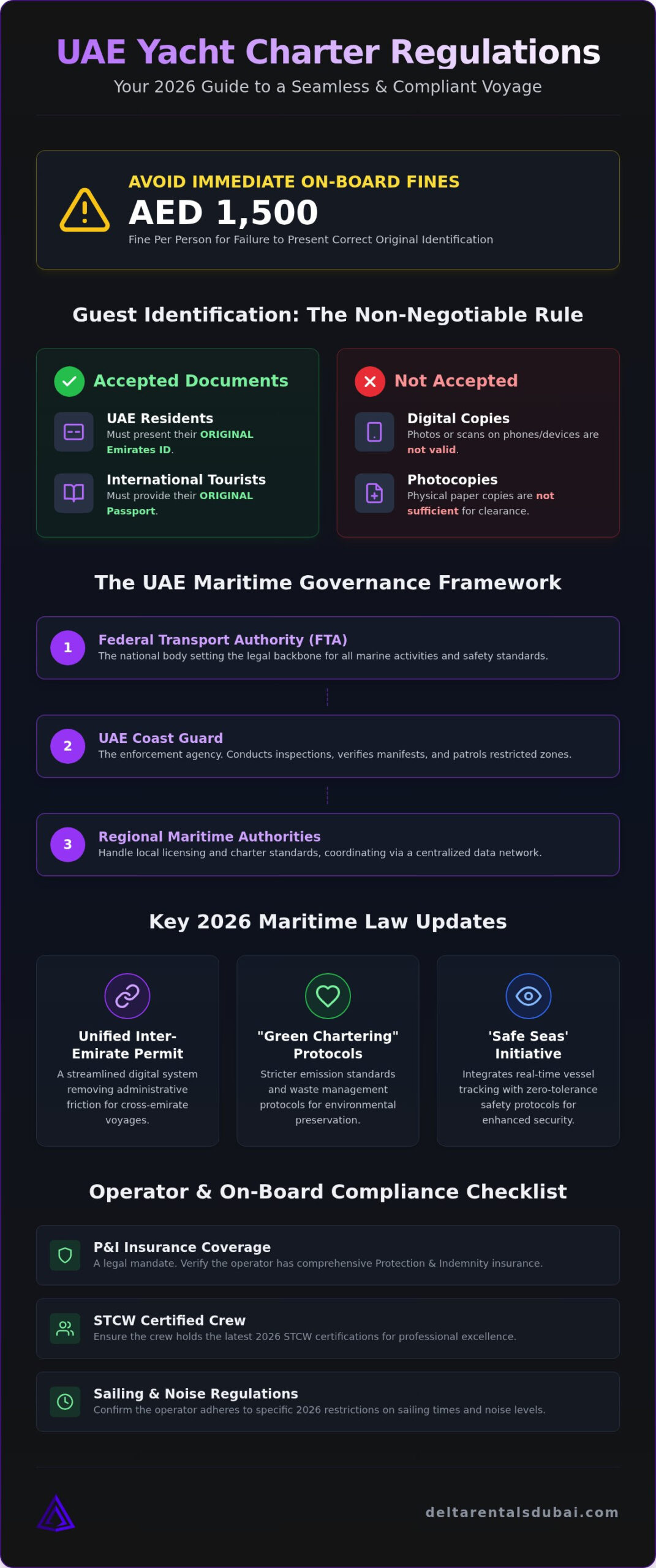
The UAE’s maritime landscape operates with the same precision as its world-class supercar industry. It’s a highly regulated ecosystem where safety isn’t just a suggestion; it’s a mandatory standard. At the top of this hierarchy sits the Federal Transport Authority (FTA), the national body responsible for setting the legal backbone of all marine activities. These strict yacht rental regulations in UAE exist to protect the nation’s reputation as a premier global destination for luxury. By maintaining rigorous oversight, the government ensures that every vessel meets specific structural and operational benchmarks before it ever touches the water.
Enforcement on the open sea falls under the jurisdiction of the UAE Coast Guard. This agency acts as the ultimate guardian of national waters, conducting frequent inspections to verify manifests, crew licenses, and safety equipment. Their presence is a reassurance for those seeking a secure experience. They monitor traffic patterns and enforce restricted zones with absolute authority, ensuring that the elite waters remain safe for high-end leisure. This level of governance is why the UAE is often cited as having some of the most robust maritime safety laws in the world.
Primary Regulatory Bodies
While the FTA provides the national framework, regional bodies like the Maritime City Authority handle the granular details of local licensing and charter standards. These organizations don’t work in isolation. They coordinate through a centralized data network to ensure that a yacht licensed in one emirate meets the criteria required across the entire country. This synergy is vital for maintaining a frictionless experience for guests. It allows for a unified standard of hospitality and safety that reflects the Delta Rentals Dubai commitment to prestige and reliability. When you step on board, you’re entering a space that has been vetted by multiple layers of authoritative expertise.
The Evolution of Yachting Laws in 2026
The year 2026 marks a significant shift toward digitalization and sustainability in the maritime sector. The introduction of the Unified Inter-Emirate Permit System has streamlined charter approvals, removing the administrative friction that previously slowed down cross-emirate voyages. Modern regulations now place a heavy emphasis on “Green Chartering,” requiring vessels to adhere to stricter emission standards and waste management protocols. This evolution ensures that the luxury lifestyle remains compatible with environmental preservation. The 2026 ‘Safe Seas’ initiative represents a national commitment to integrating real-time vessel tracking with zero-tolerance safety protocols to ensure every luxury voyage remains secure and sustainable. These updates reflect a forward-thinking approach where technology and law work together to enhance the passenger experience.
Essential Documentation and Legal Requirements
Securing your place on an elite charter requires more than just a reservation. It demands a precise adherence to documentation standards that protect both the vessel and its passengers. Understanding the yacht rental regulations in UAE ensures that your transition from the dock to the open water is frictionless and entirely legal. In 2026, the maritime authorities have moved toward a fully digital ecosystem, making compliance faster but also more transparent. You don’t want your high-status experience interrupted by a routine Coast Guard check that reveals missing paperwork.
Every legitimate charter must be backed by comprehensive Protection and Indemnity (P&I) insurance. This isn’t just a recommendation; it’s a legal mandate that provides guests with full protection in the event of an incident. Before you step on board, you have the right to request proof of this coverage. A professional operator will have these certificates readily available, reflecting a commitment to reliability that mirrors the standards of a luxury supercar fleet. If you need immediate assistance with documentation requirements for your next elite experience, connect with our concierge team for expert guidance.
Guest Identification Protocols
Identification is the most critical element of the pre-boarding process. UAE residents are legally required to present their original Emirates ID, while international tourists must provide their original passports. Digital copies or photocopies are generally not accepted for maritime clearance. Failure to provide the required original identification can result in a fine of up to AED 1,500 per person, a significant penalty that can easily be avoided with proper preparation.
The digital passenger manifest is now the standard for all leisure voyages. Every guest must be registered in the system before the yacht leaves the berth. This data is transmitted directly to the Coast Guard to ensure national security and passenger safety. In 2026, these systems employ advanced encryption to ensure your personal information remains private and secure. It’s a streamlined process designed to move you through the dock quickly while maintaining absolute legal compliance.
Vessel Compliance Documents
You should never board a vessel that cannot prove its commercial status. A legitimate yacht must display a valid commercial charter permit issued by the relevant maritime authority. This permit confirms the vessel has passed rigorous safety inspections and is legally allowed to host paying guests. Look for the UAE flag and registration details, which should be clearly visible on the hull and within the cabin documentation. These markers of legitimacy separate elite providers from high-risk, unlicensed operators. Verifying these credentials is a hallmark of a sophisticated renter who values both safety and prestige.
- Commercial Permit: Must be current and specific to charter activities.
- P&I Insurance: Essential for guest liability and medical coverage.
- Registration: The vessel must be registered under the UAE flag for national compliance.
Crew Qualifications and On-Board Safety Standards
The caliber of your crew defines the safety and success of your voyage. In the UAE, luxury isn’t a substitute for professional competence. Elite charters operate under rigorous yacht rental regulations in UAE that mandate specific certifications for every staff member on board. These standards ensure that your experience is managed by experts trained to handle everything from complex navigation to emergency medical response. When you book a high-status vessel, you’re investing in a team that has been vetted by international maritime authorities.
The Captain holds absolute legal authority over the vessel, its crew, and its passengers. This responsibility extends beyond navigation; the Captain is legally accountable for the conduct and safety of everyone on board. They have the power to terminate a charter immediately if safety protocols are breached or if guest behavior compromises the vessel’s security. This authoritative oversight is a hallmark of the Delta Rentals Dubai philosophy, where professional reliability removes the friction of traditional chartering.
Capacity limits are another area where the law is uncompromising. Maritime authorities set a maximum passenger count for every vessel based on its structural design and available life-saving equipment. Attempting to add even one extra guest beyond the registered manifest is a major legal risk. It invalidates the vessel’s insurance and can lead to immediate impoundment by the Coast Guard. True prestige lies in respecting these boundaries to ensure a secure environment for all guests.
Professional Crew Standards
Every crew member must hold valid STCW (Standards of Training, Certification, and Watchkeeping) credentials. As of January 1, 2026, these requirements have expanded to include mandatory modules on the prevention of violence and harassment, ensuring a sophisticated and respectful environment for all. Additionally, all STCW certificates are now issued in a secure electronic format for instant verification by maritime authorities. Minimum manning levels are strictly enforced based on the yacht’s size, ensuring there’s always enough personnel to manage guest needs and emergency protocols simultaneously. Crew members are also required to maintain high levels of English proficiency to provide clear instructions to a global clientele.
Safety Equipment and Protocols
Modern luxury vessels in 2026 are equipped with advanced life-saving appliances (LSA) that blend seamlessly into the yacht’s aesthetic without compromising function. This includes high-performance inflatable life jackets that are more compact and comfortable than traditional foam versions. Automated fire suppression systems and real-time hull monitoring tech are now standard on all commercial charters. The mandatory ‘Zero-Risk’ safety briefing protocol requires all passengers to be physically shown the location of life-saving equipment and emergency exits before the vessel departs the berth. These protocols ensure that every guest is empowered and informed, reflecting a premium-yet-practical approach to maritime security.
Operational Conduct and Restricted Zones
Sophisticated voyaging requires a deep respect for the maritime boundaries that preserve the UAE’s coastal integrity. While the open water offers a sense of absolute freedom, the reality is a carefully managed grid of high-traffic channels and sensitive security perimeters. Adhering to the latest yacht rental regulations in UAE isn’t just about avoiding fines; it’s about maintaining the high-status environment that makes these waters world-class. In 2026, operational compliance is monitored with digital precision, ensuring that every vessel contributes to a safe and orderly maritime ecosystem.
Navigating these waters involves more than just steering the vessel. It requires an intimate knowledge of the national security perimeters and exclusion zones that are strictly off-limits to leisure craft. These areas are often marked by buoy systems but are primarily enforced through real-time tracking. If you’re looking to pair your maritime adventure with a high-performance ground experience, our luxury fleet offers the perfect transition from sea to land. For those ready to secure a compliant and elite charter experience, contact our authoritative concierge team for immediate booking assistance.
Restricted Waters and Speed Limits
The UAE utilizes the Automatic Identification System (AIS) to track every commercial vessel’s position, speed, and heading. This digital eye in the sky ensures that yachts respect no-wake zones and maintain safe speeds in high-traffic channels. National security exclusion zones are non-negotiable; entering these areas without authorization can lead to immediate Coast Guard intervention and heavy legal repercussions. Captains are trained to navigate these perimeters with absolute precision, ensuring your itinerary remains both exciting and entirely within the law. Staying within the designated leisure corridors is the only way to guarantee a frictionless voyage.
Conduct and Environmental Stewardship
The 2026 ‘Clean Waters’ act has introduced a zero-tolerance policy for maritime littering. Discharging waste or throwing even minor items overboard carries heavy financial penalties and potential license suspension for the operator. Environmental protection extends to the seabed, where damage to coral reefs or unauthorized anchoring in protected zones is strictly prohibited. Conduct on board is also subject to updated noise ordinances. While music is a staple of the luxury experience, volume levels must be moderated when near the coastline or other vessels to respect the shared maritime environment.
- Alcohol Laws: Consumption is strictly limited to the vessel’s interior or designated ‘wet’ zones, and public intoxication remains a serious legal offense.
- Swimming and Fishing: These activities are only permitted in designated areas. Unauthorized fishing can result in the immediate confiscation of equipment and vessel impoundment.
- Littering: The 2026 regulations mandate strict waste logs for every charter to ensure all refuse is disposed of at authorized dockside facilities.
Choosing a Compliant Partner: The Delta Standard
Luxury is often defined by what you don’t see. Behind every successful voyage lies a complex architecture of safety, legality, and logistical precision. In a market where many operators cut corners, true prestige is found in absolute transparency. Adhering to the latest yacht rental regulations in UAE is not a burden for an elite provider; it’s a commitment to protecting the client’s status and safety. Choosing a partner that views compliance as a non-negotiable standard ensures that your experience remains focused on the horizon, not on legal risks.
At Delta Rentals, we bridge the gap between high-performance automotive excellence and elite maritime travel. Our “Premium-yet-Practical” approach removes the traditional industry friction that often complicates luxury bookings. We apply the same level of scrutiny to our maritime fleet as we do to our supercars, ensuring every vessel is a fortress of safety and style. This synergy allows for a seamless transition from the cockpit of a Porsche 911 GT3 RS to the deck of a world-class yacht, all under the umbrella of a single, trusted partner.
The Delta Rentals Distinction
We believe that directness is the ultimate courtesy. Our charter agreements are streamlined and devoid of hidden clauses, providing you with a clear understanding of your rights and responsibilities. By acting as an authoritative concierge, Delta Rentals Dubai provides insider access to the UAE’s most exclusive maritime experiences while maintaining a zero-tolerance policy for regulatory lapses. We handle the complexities of digital manifests and crew vetting so you can enjoy the effortless prestige you’ve earned. Our mission is to make an aspirational lifestyle feel both attainable and completely secure.
Your Charter Compliance Checklist
Before you commit to a luxury charter, use this 5-point framework to evaluate your provider. A legitimate operator will welcome these questions as a sign of a discerning client. If a provider hesitates to provide this information, it’s a clear signal to look elsewhere.
- Step 1: Verify the Commercial License. Ensure the vessel is registered for commercial chartering, not just private leisure.
- Step 2: Check Crew STCW Status. Confirm that the Captain and crew hold updated 2026 electronic certifications.
- Step 3: Confirm Insurance Coverage. Request proof of Protection and Indemnity (P&I) insurance that explicitly covers guests.
- Step 4: Validate Safety Gear. Ask for the last inspection date of life-saving appliances and fire suppression systems.
- Step 5: Digital Manifest Confirmation. Ensure your provider uses the official FTA digital filing system for passenger registration.
Managing the logistics of an elite lifestyle requires a holistic approach. For those who demand the same level of compliance and prestige for their ground travel, explore The 2026 Guide to Luxury Chauffeur Service Dubai to secure your national travel plans. By vetting every stage of your journey, you ensure a high-status experience that is as safe as it is spectacular.
Secure Your Elite Voyage Today
Mastering the yacht rental regulations in UAE is the final step in transitioning from a casual renter to a sophisticated maritime guest. You now have the authoritative framework to verify commercial licenses, confirm crew certifications, and navigate restricted zones with total confidence. A seamless charter experience isn’t just about the vessel’s aesthetic; it’s about the invisible standards of safety and legal compliance that protect your status on the water. By following this 2026 guide, you ensure that every moment on board is defined by effortless prestige and absolute reliability.
Delta Rentals Dubai, operating under Triple D Rentals LLC, remains your premier partner for elite lifestyle experiences. Our exclusive fleet of 2026 supercar and yacht models is backed by a 5-star Google reviewed service that prioritizes your time and security. Don’t leave your luxury experience to chance. Experience Elite UAE Charters with Delta Rentals and let our concierge team handle the logistics while you focus on the horizon. The elite waters of the UAE are waiting for you.
Frequently Asked Questions
Do I need a passport to rent a yacht in the UAE?
Yes, international tourists must present an original passport to comply with current yacht rental regulations in UAE. Residents can use their original Emirates ID. Digital copies or photos aren’t legally valid for maritime clearance. Failing to provide original identification can lead to an immediate fine of up to AED 1,500 per person. Always ensure your guests bring their physical documents to the dock to avoid any boarding delays or legal penalties.
Are there age restrictions for children on chartered yachts?
There are no specific legal age bans for children on luxury charters, but safety requirements are absolute. Every child must have a properly fitted life jacket that meets 2026 safety standards. Most professional operators recommend that children under the age of 12 wear life jackets at all times while the vessel is in motion. It’s essential to confirm the availability of child-sized safety equipment with your concierge before the departure date.
Can we play loud music during a yacht rental in UAE waters?
You can play music, but it must be moderated according to 2026 noise ordinances. Authorities enforce strict volume limits when yachts are near the shoreline or other vessels to prevent noise pollution. Playing excessively loud music, especially after sunset, can result in fines for the operator and an immediate end to your charter. Professional crews monitor volume levels to ensure your celebration stays within the legal boundaries of national maritime law.
What happens if the Coast Guard stops our chartered yacht?
If the Coast Guard stops your vessel, the Captain will handle all communications and present the digital passenger manifest. They’ll verify that every guest on board matches the registered identification provided before departure. These are routine safety checks to ensure compliance with national security protocols. As long as your documentation is in order and you’re following the yacht rental regulations in UAE, the process is quick and professional.
Is insurance included in the yacht rental price in the UAE?
Yes, comprehensive Protection and Indemnity (P&I) insurance is a legal requirement for all commercial charters in the UAE. This coverage protects guests against accidents and is included in the base rental price. You should always verify that the vessel carries a valid insurance certificate before boarding. Reputable providers like Delta Rentals maintain full corporate transparency under Triple D Rentals LLC to ensure all passengers are completely protected throughout their journey.
Are there specific dress code regulations for yacht charters?
While there’s no federal law governing dress codes, most luxury charters enforce a “no shoes on board” policy to protect the yacht’s decking. Guests typically wear smart-casual attire or swimwear with appropriate cover-ups. It’s respectful to dress modestly when entering and leaving the marina facilities. Always check with your concierge for specific vessel requirements, as some high-status yachts may have specific aesthetic standards for evening events or formal gatherings.
What are the rules regarding alcohol on a rented yacht?
Alcohol consumption is permitted on chartered yachts but is strictly regulated to designated “wet” zones or the vessel’s interior. Public intoxication remains a serious offense under national law, and guests must behave responsibly at all times. It’s illegal to carry alcohol off the boat or consume it in public marina areas. Professional crews are trained to monitor consumption to ensure the safety of all passengers and maintain the vessel’s legal standing.
How do I know if a yacht rental company is legally licensed?
You can verify a company’s legitimacy by requesting to see their commercial charter permit and proof of UAE flag registration. Legitimate providers will also have a clear corporate structure, such as Triple D Rentals LLC, and a history of positive client feedback. Check for a 5-star Google reviewed status and look for the official maritime authority stamps on their documentation. Avoid operators who offer “private” rentals for commercial use, as these are often unlicensed.